


The listing is the start of the liquidity problem, not the end of it.
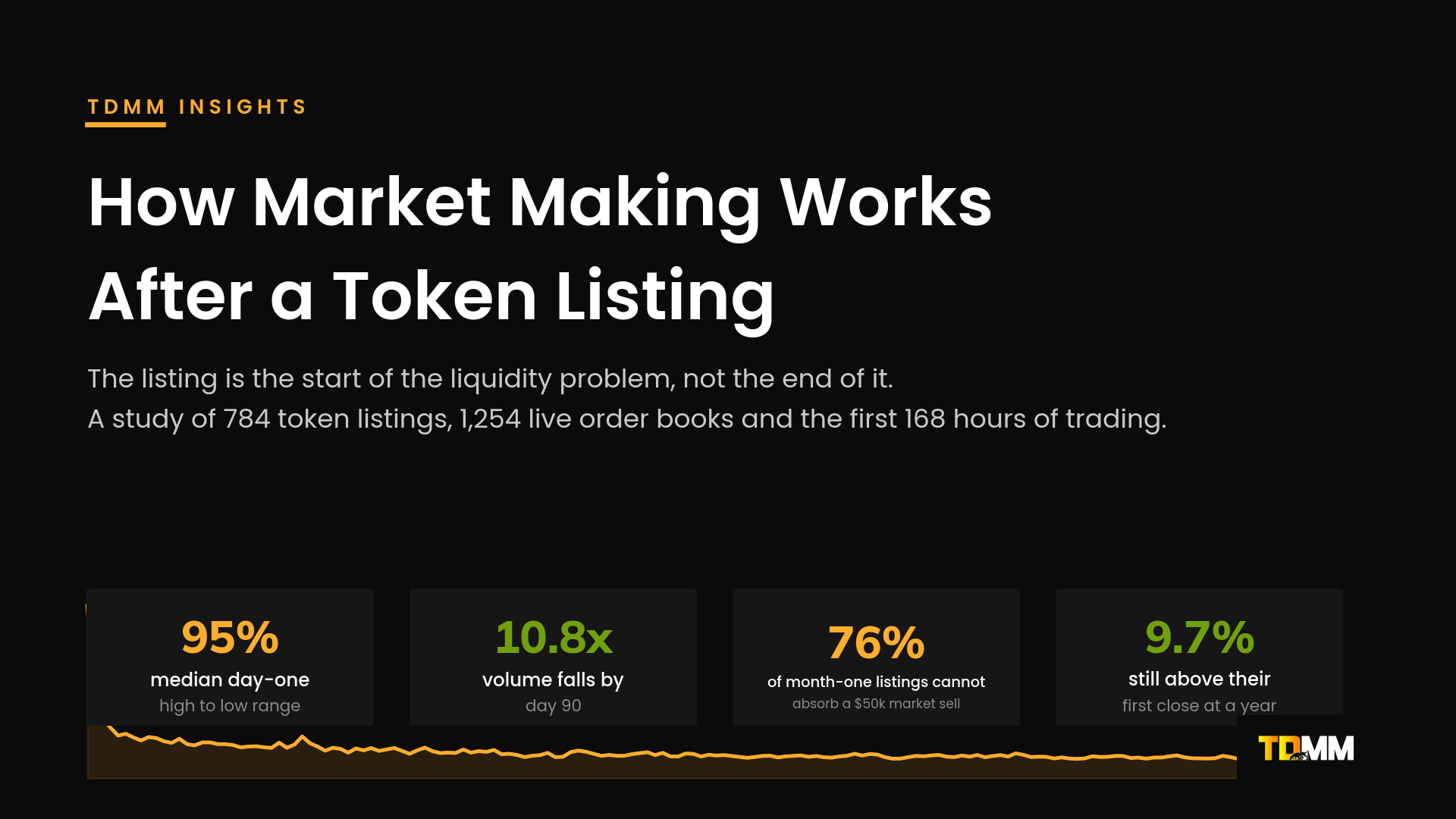
TDMM measured 784 token listings, 1,254 live order books and the first 168 hours of trading on 25 September 2026. Here is what the data says.
Five takeaways
1. The first hour is the widest hour a token will ever have. Median high to low range inside hour one: 41.2%. By hour twenty-four: 5.7%. By hour 168: 3.3%. Twelve times narrower in a week. Across 753 listings, the median first full day traded through a range equal to 94.8% of its closing price.
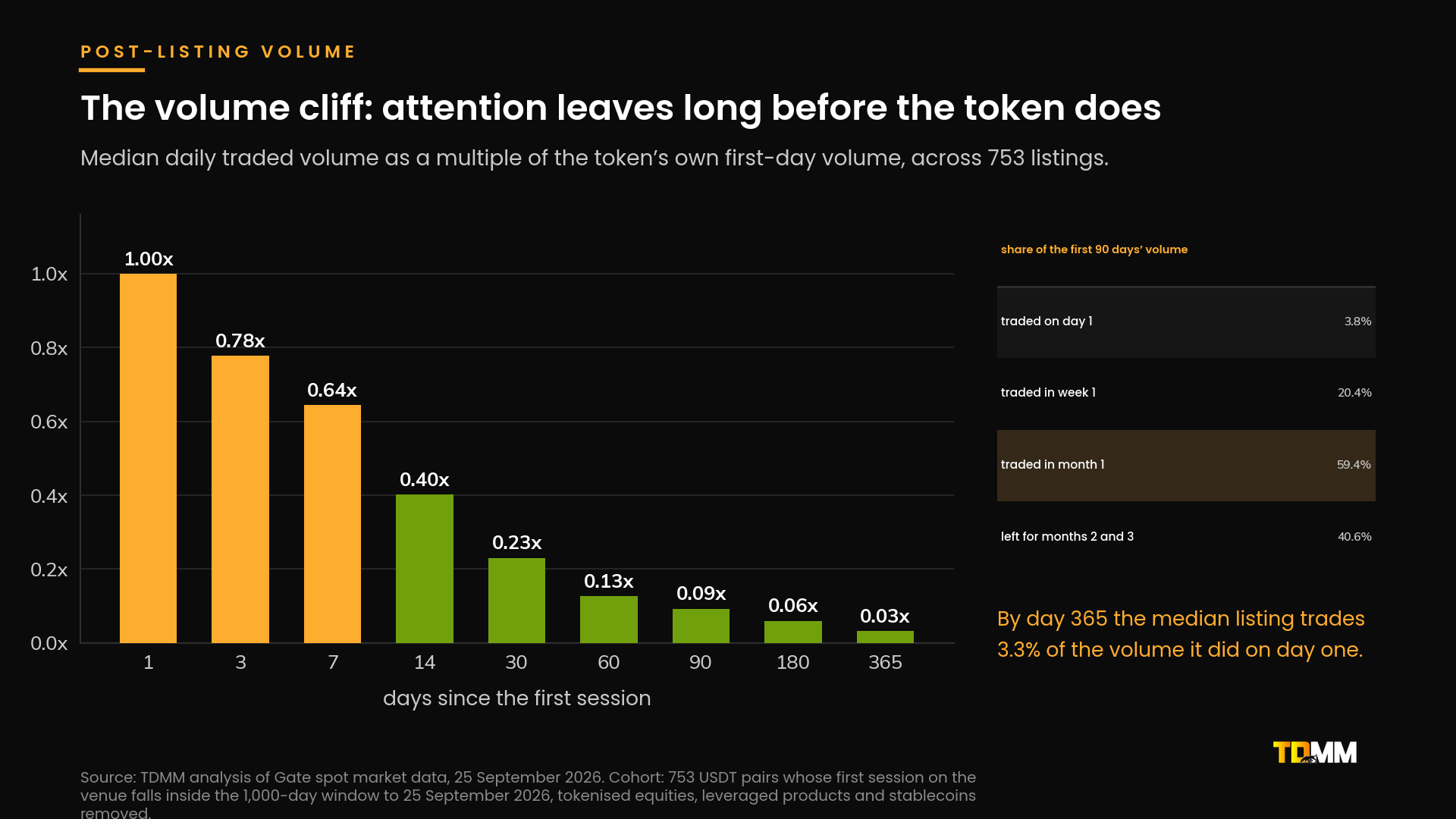
2. Volume collapses faster than price. Measured against each token’s own first-day volume, the median listing traded 0.23 times day one at day thirty, 0.09 times at day ninety and 0.03 times at day 365. Month one accounted for 59.4% of everything traded in the first ninety days.
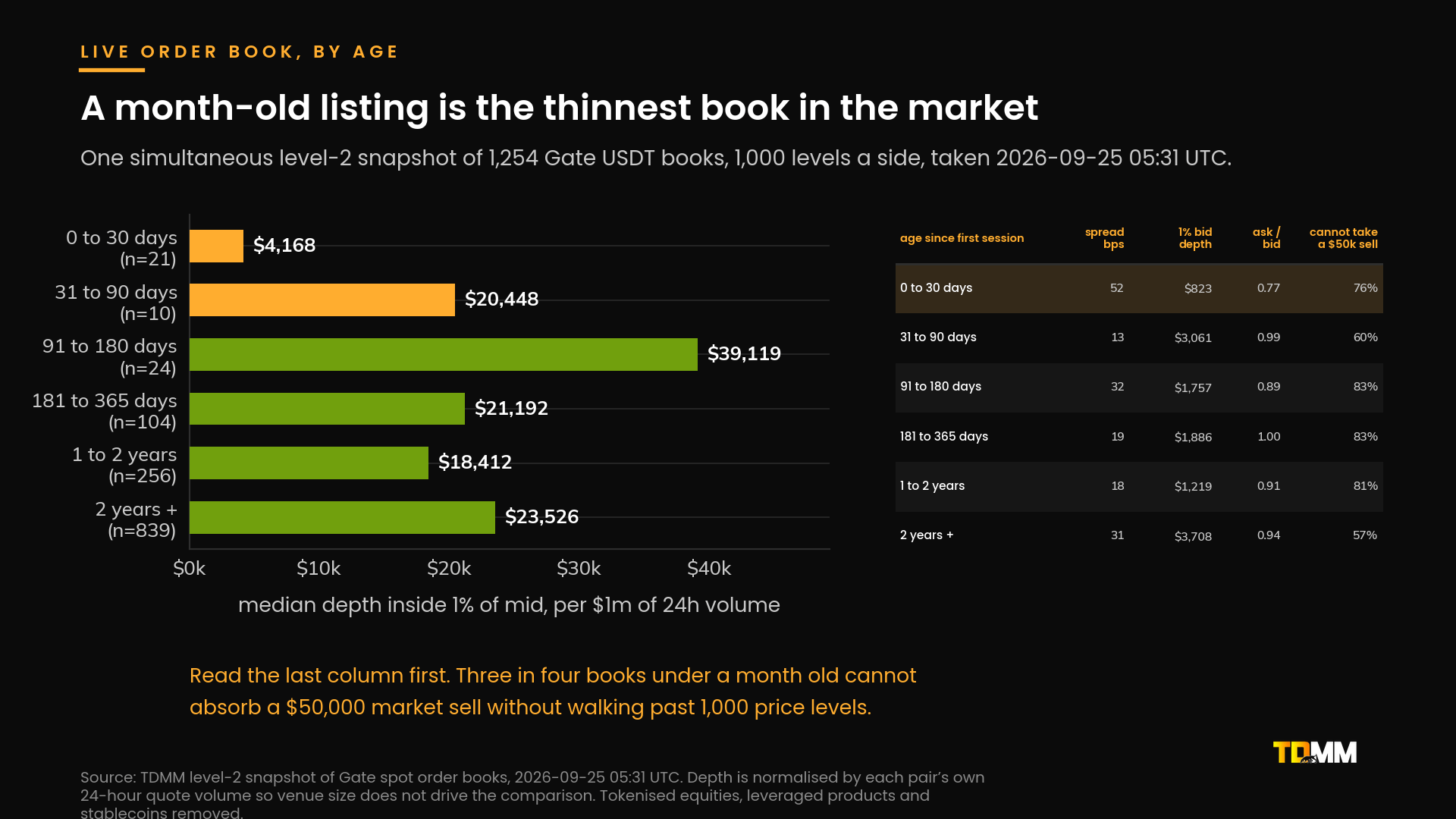
3. A month-old book is the thinnest book in the market. In a live snapshot of 1,254 order books, listings under thirty days old quoted a median 52.3 basis point spread with $823 of depth inside 1% of mid, and 76.2% of them could not absorb a $50,000 market sell inside 1,000 price levels. Matched on turnover against tokens trading over two years at a comparable $179,018 a day, the young token carried 3.26 times less depth and quoted 1.78 times wider.
4. The “free” market maker deal is the expensive one. TDMM measured the annualised volatility of a new listing over days eight to ninety-eight at a median 166% across 750 listings. At that volatility, a 1.5%-of-supply token loan with three call tranches struck at 1.25, 1.50 and 2.00 times the reference price is worth $764,723 on a $1.5 million notional. That is 51.0% of the loan. No cash leaves the treasury, so nobody budgets for it.
5. Liquidity is not price support, and we checked. Young tokens quoting the tightest spreads were 19.9 percentage points more likely to be above their first close at ninety days, with a bootstrap interval that excludes zero. Sorting the same tokens by order book depth gave a result indistinguishable from chance. Both are associations with survivorship running both ways. Nobody should read either as a promise.
The order book, by age since listing
The chart below carries the full table. The short version:
Books under thirty days old, 21 pairs: a median 52.3 basis point spread, $823 of bid depth inside 1% of mid, and 76.2% unable to absorb a $50,000 market sell.
Thirty-one to ninety days, 10 pairs: 12.9 basis points, $3,061 of depth, 60.0% unable to absorb it.
One hundred and eighty-one to 365 days, 104 pairs: 19.0 basis points, $1,886 of depth, 82.7% unable to absorb it.
Two years and over, 839 pairs: 31.3 basis points, $3,708 of depth, 57.3% unable to absorb it.
Walking the visible bid side with a $50,000 market sell cost a median 629 basis points on a book under thirty days old, against 78 basis points on one trading over two years, and that number is computed only on the books that could take the order at all.
Memecoins
A memecoin usually reaches a centralized exchange already price-discovered on a launchpad and a pool, so its first session is calmer: a median day-one range of 68.5% against 102.6% for other listings. At day ninety the median memecoin still traded 0.50 times its first-day volume against 0.08 times for everything else.
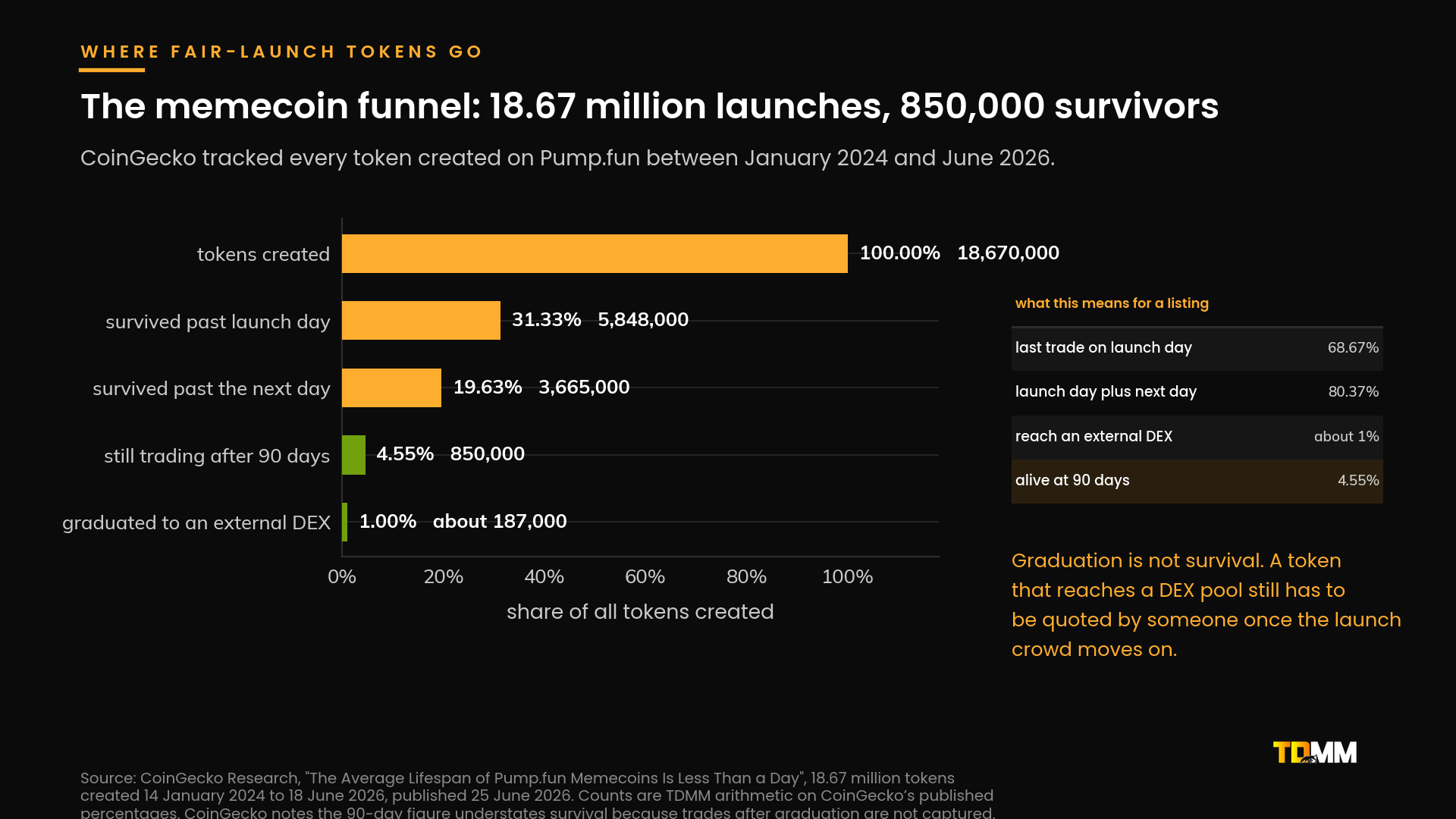
That figure describes memecoins that survive. CoinGecko Research examined all 18.67 million tokens created on Pump.fun between January 2024 and June 2026 and found 68.67% recorded their last trade on the day they were created, about 1% graduated to a DEX, and 4.55% survived past ninety days. Graduation is not survival: a constant-product pool always quotes, but it quotes from its own reserves and cannot widen when a large seller arrives.
What changed in 2026
On 25 March 2026 Binance published market maker guidelines telling issuers to report their market maker’s details, legal entity and contract terms to the listing platform, to define the permitted use of tokens in any loan agreement, and prohibiting profit-sharing and guaranteed-profit models between an issuer and its market maker. Six red flags are named, including volume unbalanced against order book depth. Binance said it will act against misconduct including blacklisting market makers.
The market making contract is now a listing document. A firm that will not be named is a listing risk.
The founder’s test
Ask for depth, not volume. Real quoting leaves an order book that an exchange, an aggregator and a competing trader can all see independently, at any moment, without the market maker’s cooperation. Printed volume leaves a number and nothing underneath it. In October 2024 the US Department of Justice charged four market making firms over wash trading for token issuers; CLS Global was sentenced in April 2025 and Gotbit’s founder in June 2025.
Where TDMM fits
TDMM (TradeDog Market Maker) has been active in crypto markets since 2015, with $10 billion-plus in trading volume, 100-plus CEX and DEX integrations, 200-plus markets integrated, 24-hour operations and 30-plus people across five continents, covering DeFi, GameFi, L1 and L2 infrastructure, RWAs, DEXs, stablecoins, memecoins and NFT finance.
For a new listing that means live two-sided quotes from the first second on every venue, a tightening schedule set before the bell rather than improvised during it, inventory structured for the mandate with the option value priced in dollars before signing, one reference price across CEX, DEX and perpetual venues, and reporting the issuer can verify against public order book data.
TDMM does not promise a price or a volume number. The data above is the reason.
Disclaimer: published by TDMM for information and education. Not investment, legal or tax advice, not an offer of any service, and not a recommendation on any digital asset. TDMM figures are measurements of public market data taken 25 September 2026, drawn from a single venue unless noted, and are historical; order book figures are single-instant snapshots. Associations reported are associations only, with no causal relationship implied. Cost examples are illustrative arithmetic on stated assumptions, not a quote. Third-party figures are reproduced as published. Legal charges referenced are allegations unless a conviction or sentence is stated. Digital assets are volatile and you may lose the entire value of a position.
#MarketMaking #TokenListing #Liquidity #Memecoins #CryptoTrading