

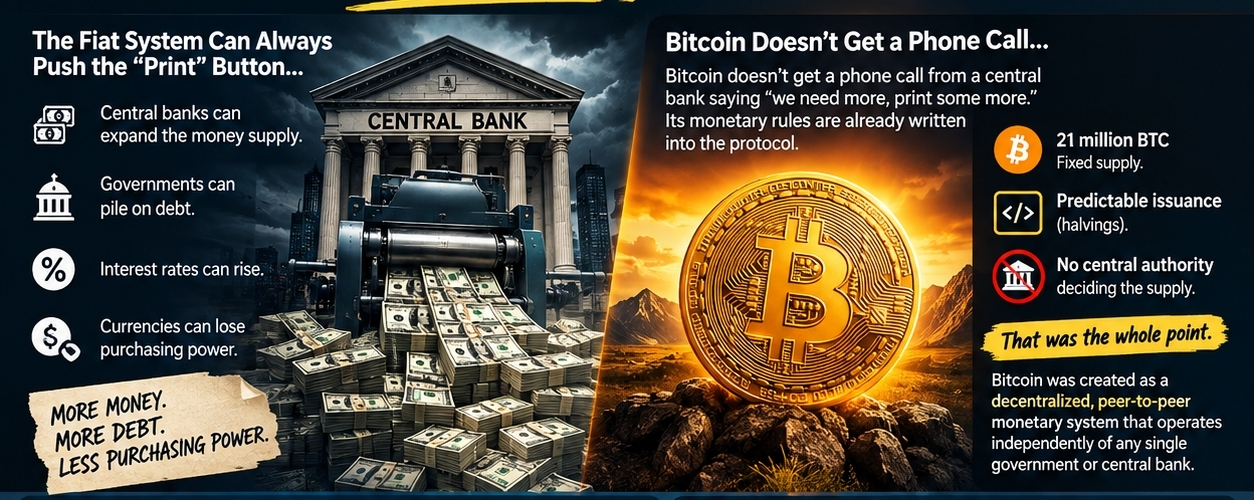


Central banks can expand the money supply. Governments can pile on debt. Interest rates can rise. Currencies can lose purchasing power.
But Bitcoin doesn't get a phone call from a central bank saying "we need more, print some more." Its monetary rules are already written into the protocol: 21 million BTC, predictable issuance, no central authority deciding the supply. That was the whole point.
Bitcoin was created as a decentralized, peer-to-peer monetary system that operates independently of any single government or central bank.
Why the Narrative Resonates
When people start worrying about:
💵 Currency debasement
📈 Growing government debt
🏦 Monetary expansion
🌍 Financial instability
📉 Loss of purchasing power
...the Bitcoin narrative becomes increasingly interesting.
But Here's the Part We Shouldn't Ignore
Bitcoin isn't automatically a perfect hedge just because fiat money can be expanded. BTC can still fall 20%, 30%, or more while inflation is rising. Markets are complicated — liquidity, interest rates, leverage, risk appetite, regulation, and investor positioning can all influence Bitcoin's price.
So I wouldn't say: "Fiat is broken, therefore Bitcoin must go up."
I'd say: Bitcoin was designed so that its monetary rules aren't controlled by the same institutions controlling fiat monetary policy. And after more than a decade, that experiment is still running.
The Real Question
The bigger question isn't whether Bitcoin follows the rules — it does.
The bigger question is: 👉 As global debt and monetary uncertainty continue, will more people decide that predictable scarcity is valuable?
That's where the real Bitcoin debate begins. 🟠
Is Bitcoin primarily a hedge against fiat debasement, or is it still mainly a risk asset driven by liquidity? 👇
#BitcoinFallsBelow$83,000 $BTC
