

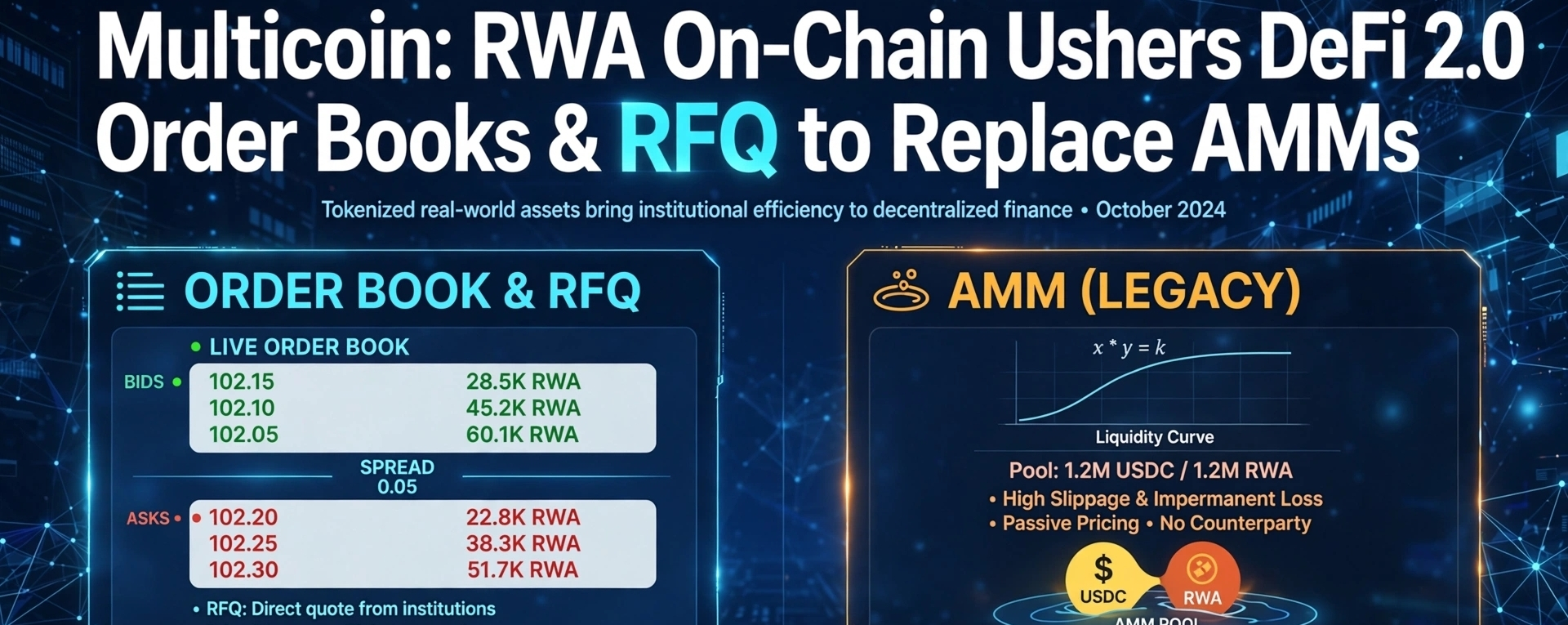

DeFi is about to grow up, and Real World Assets are the reason.
That's the core thesis from Multicoin Capital in its latest outlook. According to the firm, tokenization is not just bringing more assets on-chain - it's forcing DeFi to rebuild its entire market structure. The result will be DeFi 2.0, an era defined less by AMMs and liquidity pools, and more by order books and RFQ systems.
Why? Because the first era of DeFi was built for crypto-native assets. Uniswap and AMMs worked great for volatile, long-tail tokens where anyone could be a liquidity provider. But they don't work for $30+ billion in tokenized T-bills, private credit, gold, and equities now sitting on-chain.
Those assets are held by institutions, not traders. They need tight spreads, NAV-based pricing, KYC-compliant settlement, and deep order-book depth - not 0.3% AMM slippage. Multicoin argues RWA holders behave like balance sheets, not degens. The flow is slow, stable, and resembles stablecoins, not meme coins.
This is why the infrastructure is shifting:
1. Order books are back. For secondary trading of tokenized Treasuries and commodities like XAUT and PAXG, protocols need real order-book depth and market makers who can quote within basis points of underlying NAV. AMMs can't do that efficiently.
2. RFQs will replace pools. For large RWA trades, institutions will use Request-for-Quote systems, where qualified market makers compete to fill an order privately, similar to TradFi. This is already how private credit on Maple and Centrifuge moves.
3. RWA as reusable collateral. Right now, only about $2.4B of the $30B+ in RWA is actually active as DeFi collateral, according to recent data. Most is still sitting idle in storage-style vaults. DeFi 2.0 is about turning that static holding into reusable liquidity - collateral for lending on Aave, Morpho, Kamino, where TVL for RWA is already around $1.6B and growing.
Multicoin sees this as the "second curve" of crypto. The first curve ended with the massive liquidations of late 2025, where zero-sum leverage games broke down. The second curve is pragmatic: on-chain asset management, tokenized real yield, T+0 settlement, and fractional ownership for things like real estate that finally get global liquidity.
Forecasts now put tokenization at nearly $20 trillion by 2033 and BCG estimates $16 trillion by 2030. The opportunity is no longer minting an asset, it's building the rails that let it move.
In Multicoin's view, the winners won't be the platforms that just tokenize, but the infrastructure that provides pricing, credit lines, and compliant execution - dark-pool perps, money markets, and RFQ networks that turn RWA from a held certificate into real DeFi money.
AMMs started DeFi 1.0. Order books and RFQs will run DeFi 2.0.
#BinanceWillListHyperliquid(HYPE) #BitcoinFallsBelow$83,000 #BitcoinFallsToAround$84,600ThisWeek #ETHBreaksAbove$2,700 #ETHBreaksAbove$2,700 #BitcoinRejectedAt$87,300Twice