Why Integrator Economics Can Affect User-Facing Quotes
The quote shown by a wallet is not always the raw market quote. When an application integrates STONfi and Omniston, a business layer can sit between liquidity and the user, influencing the final number shown on screen.
🏗 WHAT AN INTEGRATOR DOES
An integrator can be a wallet, trading bot or aggregator using STONfi infrastructure. Pools and resolvers produce the raw route, while the integrator can add its own revenue model.
Common approaches include:
- Flat markup — reducing the output.
- Referral or affiliate fee — adding a supported routing fee.
- Spread — showing a less favorable exchange rate.
Liquidity may be identical. The difference can come from the business layer.
🔎 SAME LIQUIDITY, DIFFERENT QUOTE
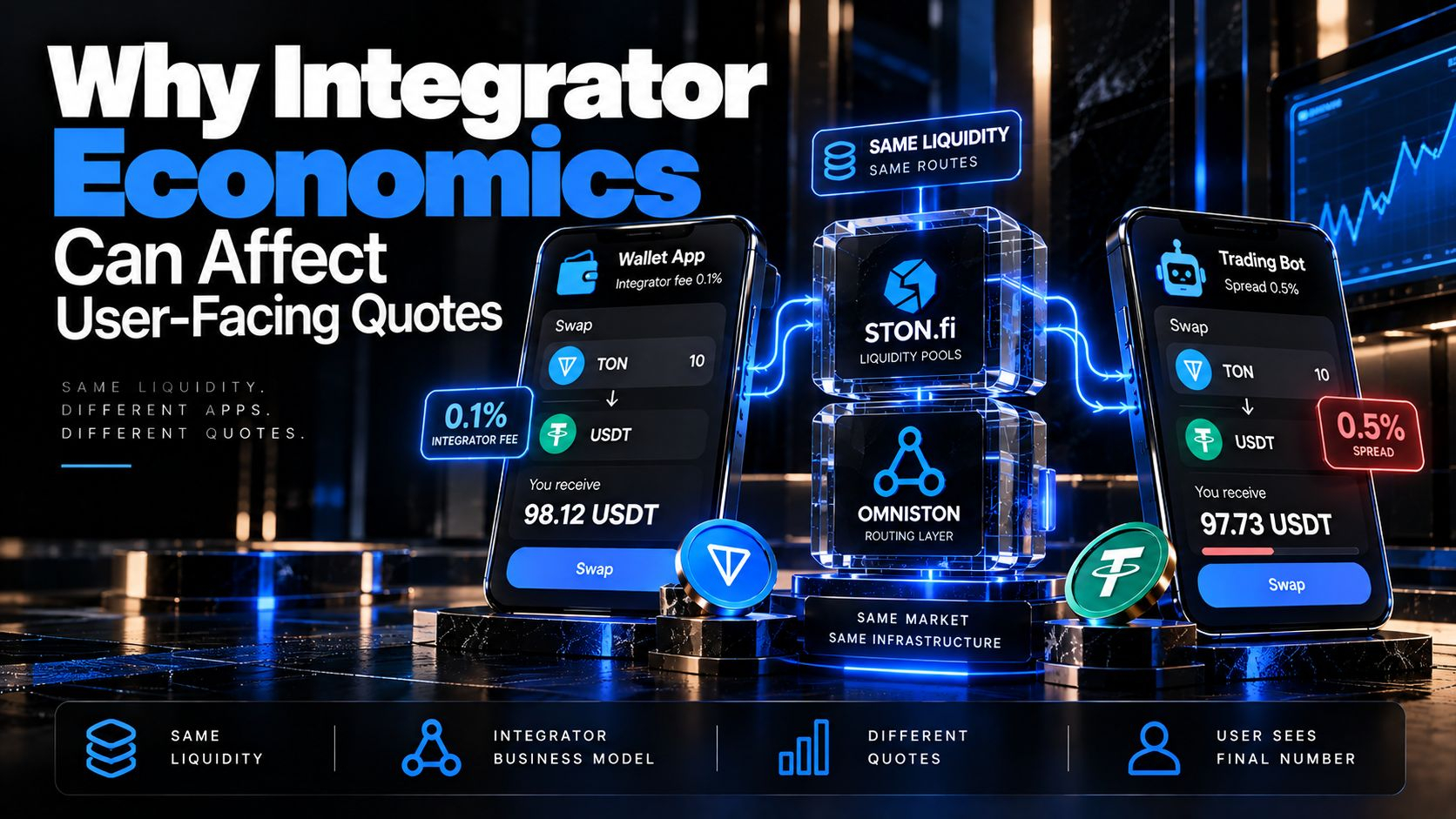
Imagine two apps routing the same TON → USDT trade through the same STONfi and Omniston sources. One applies a 0.1% integrator fee while another uses a 0.5% spread.
Both access the same liquidity while showing different results. On a small swap the difference may be minor; on a large trade, it can become meaningful.
So “best price” needs context. It can mean the best result after that integrator's economics have been applied.
🧭 TRANSPARENCY IS THE KEY
An integrator taking a fee is not automatically a problem. A disclosed fee can be a legitimate business model.
The key question is whether the user can understand the final cost before confirming. For larger trades, compare the same transaction across interfaces, check fee information and, when possible, compare with STONfi directly.
DeFi composability makes integrations powerful, but the quote on your screen can pass through another business layer first.
Liquidity creates the opportunity. Integrator economics can shape the price you finally see.
Not investment advice - research on your own! 🚀
$GRAM
The quote shown by a wallet is not always the raw market quote. When an application integrates STONfi and Omniston, a business layer can sit between liquidity and the user, influencing the final number shown on screen.
🏗 WHAT AN INTEGRATOR DOES
An integrator can be a wallet, trading bot or aggregator using STONfi infrastructure. Pools and resolvers produce the raw route, while the integrator can add its own revenue model.
Common approaches include:
- Flat markup — reducing the output.
- Referral or affiliate fee — adding a supported routing fee.
- Spread — showing a less favorable exchange rate.
Liquidity may be identical. The difference can come from the business layer.
🔎 SAME LIQUIDITY, DIFFERENT QUOTE
Imagine two apps routing the same TON → USDT trade through the same STONfi and Omniston sources. One applies a 0.1% integrator fee while another uses a 0.5% spread.
Both access the same liquidity while showing different results. On a small swap the difference may be minor; on a large trade, it can become meaningful.
So “best price” needs context. It can mean the best result after that integrator's economics have been applied.
🧭 TRANSPARENCY IS THE KEY
An integrator taking a fee is not automatically a problem. A disclosed fee can be a legitimate business model.
The key question is whether the user can understand the final cost before confirming. For larger trades, compare the same transaction across interfaces, check fee information and, when possible, compare with STONfi directly.
DeFi composability makes integrations powerful, but the quote on your screen can pass through another business layer first.
Liquidity creates the opportunity. Integrator economics can shape the price you finally see.
Not investment advice - research on your own! 🚀
$GRAM