



Guys, let’s talk about something pretty cool.
You’ve played card games before, right? Hearthstone, Magic, Yu-Gi-Oh! Well, we all know the fun of pulling cards, building decks, and going head-to-head. But have you ever thought about this —
What if the Boss in the game could learn your playstyle, then become your mirror image and challenge other players?
What if every card was not just a set of stats, but had AI dynamically tuning it in the background, automatically generating skill variants based on your win rate and usage habits?
What if I told you that a map, a storyline, or a Boss design you created could be officially adopted, and continue to generate rewards for you afterward?
That is Opsyite.
▎First, let’s talk about the bigger picture: gaming is changing, and fast
According to Newzoo, the global gaming market exceeded USD 184 billion in 2024, with more than 3.2 billion users worldwide. Gaming is no longer just a “content product.” It is a social space, an economic system, and a virtual world.
But the real shift is happening in two directions:
First, Web3 gaming is moving from “financialization 1.0” to “playability 2.0.” Over the past few years, most blockchain games attracted users through asset speculation, but lacked gameplay depth. Players came and left quickly. Grand View Research predicts that the blockchain gaming market will grow from USD 13 billion in 2024 to USD 300 billion by 2030. But to truly capture this market, projects must solve the problem of being fun.
Second, AI is evolving from an “assistive tool” into a “content engine.” MarketsandMarkets predicts that from 2023 to 2028, the gaming AI market will grow at a compound annual growth rate of more than 30%, expanding from USD 2 billion to nearly USD 15 billion. AI turns games from “static products” into dynamic systems that can evolve in personalized ways.
And Opsyite sits right at the intersection of AI × Web3 × cards.
▎It is not just a “blockchain game”but an AI-driven card metaverse
Opsyite is not a traditional card game with an NFT skin placed on top.
It is a Web3-based, deeply AI-driven trading card game (TCG) metaverse.
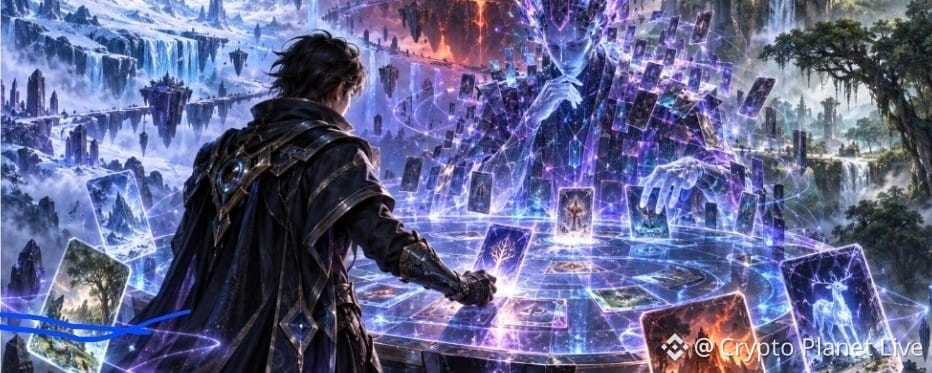
You play as an “Arcane Master,” traveling across multiple dimensions, like the Everfrost Tundra, the Molten Heart, Ancient Ruins, and the Mistwood Forest, collecting “Primal Cards” and influencing the direction of the universe through strategic battles.
But the real focus is not simply “playing cards.”
The focus is this: the world changes because of the actions of you and other players.
If most players concentrate on battling in the “Molten Heart,” then the storyline of that dimension automatically advances, the Boss evolves, and the map expands. Other dimensions enter a “suppressed” state, with resources, storylines, and strategies all changing accordingly.
You are not just playing a game. You are participating in a world that continues to evolve.
▎AI is not just a “smart NPC” here; it is the engine of the entire game
Opsyite’s AI system includes several designs that made me think, “Okay, this is actually something.”
Mirror AI Opponents: The system records your battle actions, deck combinations, and skill-release logic to train a “Mirror AI.” You can upload your own behavior model and let other players challenge your AI avatar. If you win, the owner of the mirror can also receive behavior-based revenue sharing.
What does this mean? It means the better you play, the stronger your AI avatar becomes. The more other players want to challenge it, the more you can earn even while you are offline.
Adaptive Boss Evolution: Bosses can imitate the deck strategies of the most active players and combine them into advanced AI lineups. Each week, the system generates new “Rift Challenge Maps” based on server-wide data. You never know whose playstyle next week’s Boss will learn before coming after you.
AI Dynamic Balancing: The skills of high-tier cards are automatically balanced or turned into variants by AI based on usage frequency, win rate, and map distribution. There is no fixed meta forever — the environment moves on its own.
▎Creator economy: you are not just a player; you are a world-builder
This is the part of Opsyite that excites me the most.
In traditional games, players create mods, maps, and guides out of passion, while the platform captures the revenue.
Opsyite says: no, you should earn from it.
It includes a built-in AI editor. You do not need to know programming. You can create map dungeons, story branches, and quest modules using natural language. Once completed, you can upload them to the platform. When other players experience your content, you earn revenue sharing.
If your content is officially adopted and enters the main storyline, limited-time events, or even the AI training system? Continuous earnings + governance rights + honor NFTs.
If the map you designed is played repeatedly, the system records usage frequency and automatically settles rewards.
If the skill or card module you created enters the blind box system, you receive a share every time it is drawn.
In Opsyite, you can be an Arcane Master, but you can also be a builder, narrator, trainer, or even someone who determines the future direction of the story.
▎Technical foundation: off-chain execution + on-chain verification, balancing performance and cost
The old problems of blockchain games are familiar: slow, expensive, and laggy.
Opsyite’s solution is to deploy on a high-throughput, low-gas, EVM-compatible Layer 2. High-frequency operations use a hybrid architecture of “off-chain execution + on-chain verification,” with final results recorded on-chain through Merkle Tree or ZK mechanisms.
The user experience is not compromised, and security is not sacrificed.
All high-rarity cards, skill modules, map dungeons, and story modules are confirmed as NFTs, supporting authorization, leasing, revenue sharing, and derivative creation.
▎Roadmap: four stages, from core gameplay to an open universe
Stage One: Complete the worldbuilding, core gameplay, card system, and blind box mechanism design; build basic maps; deploy the internal AI battle simulation framework; and launch a small-scale closed test.
Stage Two: Develop core PvE dungeons and Mirror AI battles (PvM); release Creator Editor V1; open access for map, story, and skill creation; introduce map tickets and content rights confirmation.
Stage Three: Enable AI content recommendation and assisted creation systems; upgrade the Mirror AI learning model; achieve personalized tactical fitting and PvM leagues; integrate the creator achievement system and automated on-chain revenue sharing.
Stage Four: Launch the map interoperability protocol; support external projects connecting to the Opsyite editor ecosystem; introduce an on-chain content cross-authorization system; launch the “Story Incubation Platform”; promote a mainline evolution mechanism co-created by AI and players; and ultimately establish a fully on-chain governance structure.
▎Team: gaming veterans + AI engineers + blockchain builders
Opsyite’s core members come from multiple fields, including game development, AI engineering, blockchain technology, and interactive narrative design. The founder previously worked on core gameplay and numerical frameworks at strategy and card game studios. The technical director has experience in smart contracts and on-chain performance optimization. The AI lead has worked on NPC behavior trees and reinforcement learning battle models. The creative director has more than ten years of experience in interactive narrative design.
This is not a project imagined on a whim by a few programmers. It is something being seriously built by a team that understands games, AI, and blockchain.
▎My honest take
Opsyite is still in its early stage. Its roadmap is divided into four phases, moving from core gameplay construction to the creator editor, then to AI recommendation systems and cross-project interoperability protocols.
Can it succeed? No one knows. But the direction it is heading in makes sense.