


The data supposedly obtained from the recruitment systems of the FBI has done more than just expose personal information. It may also reveal what the individual employees do at the bureau.
A review by Reuters looked into a 5,000-line sample of personal information purportedly belonging to thousands of people in the FBI, according to the hackers. The group claimed that the sample is only a small part of a 2-3TB data trove.
While Reuters has independently verified details for over 22 individuals, the FBI has yet to confirm how many employees were involved in the hacking incident.
Why a jobs portal holds spy-grade identity data
The sensitivity of the leak comes from the fact that certain documents seem to link named staff members to activities related to intelligence. People linked to assignments concerning Russia and China, as well as surveillance and human intelligence functions, were found by Reuters.
The FBI’s Privacy Impact Assessment clarifies why a recruitment platform possesses such important information. FBIJobs.gov and its Candidate Gateway hold “sensitive but unclassified” information such as name, Social Security number, date of birth, citizenship, gender, and veterans-preference eligibility.
Existing employees may also use the system to apply for positions available only to the internal workforce through their accounts connected to the bureau HR systems.
The FBI is aware of a cybercriminal enterprise group claiming a compromise of the fbijobs.gov portal and alleged impact to FBI employee personally identifiable information (PII).
— FBI National Press Office, FBI Statement on Compromise of fbijobs.gov Portal and Alleged Impact to FBI Employee PII, September 23, 2026
According to its statement, the FBI has not yet established whether the initial breach occurred in an FBI system or through a third-party supplier that supports the portal.
ShinyHunters, PeopleSoft, and the risk context
As per the FBI’s privacy documentation, the recruitment platform relies on Oracle PeopleSoft, Oracle Database, and Drupal. Google’s Mandiant had earlier linked ShinyHunters to attacks on Oracle PeopleSoft systems using CVE-2026-35273, a vulnerability rated as the most critical issue by Oracle at 9.8 out of 10.
But that does not establish how the FBIJobs.gov breach happened. There is no public evidence that CVE-2026-35273 or ShinyHunters was responsible. Google said it warned more than 100 organizations potentially exposed in the broader campaign, most in the United States, with 68% in higher education.
How stolen personnel data can supercharge AI-enabled attacks
Furthermore, there is no indication whatsoever that AI was behind the FBI breach. The more urgent concern is how the detailed personal information can be exploited afterward.
Google threat intelligence report suggests that hackers are doing more than simple prompts and are now working more independently. For example, one hacking group used a compromised cloud service to launch a huge attack to gather people’s credentials in less than 6 hours.
“Threat actors are increasingly relying on GenAI to assist them with various stages of their attacks.” — Verizon, 2026 Data Breach Investigations Report (DBIR)
This warning from Verizon’s 2026 DBIR puts the risk in perspective. Verizon conducted analysis on over 31,000 security incidents and more than 22,000 confirmed breaches across 145 nations.
The report shows that vulnerabilities are the means of initiating breaches in over 31% of the cases. However, the aftermath does not necessarily stop at the breaching stage. The stolen personal data may also be used to launch other attacks.
Microsoft emphasizes this risk in its guidance regarding the National Public Data breach in early 2024. They highlight that any email address that gets exposed can lead to a heightened risk of phishing and account takeover, while the compromised phone numbers can be used for phishing over calls and text messages.
In the case of the FBI, the situation might get worse due to the fact that information leaked seems to go beyond employee contact details, connecting their identities with information about their roles and assignments.
This combination may provide attackers with improved tools for reconnaissance, impersonation, and highly tailored social engineering. AI can potentially speed up and scale these efforts by assisting attackers with processing stolen information, creating convincing strategies, and automating their operations.
Cryptopolitan has also reported worries over using autonomous AI agents that could operate much faster than organizations can govern them.
The spending the breach could accelerate
The broader market is already responding to that pressure. The World Economic Forum found that 94% of surveyed leaders expect AI to be the biggest driver of change in cybersecurity, while 87% identified AI-related vulnerabilities as the fastest-growing cyber risk.
At the same time, Gartner expects worldwide AI spending to reach $2.67 trillion in 2026, including $51.35 billion on AI cybersecurity.
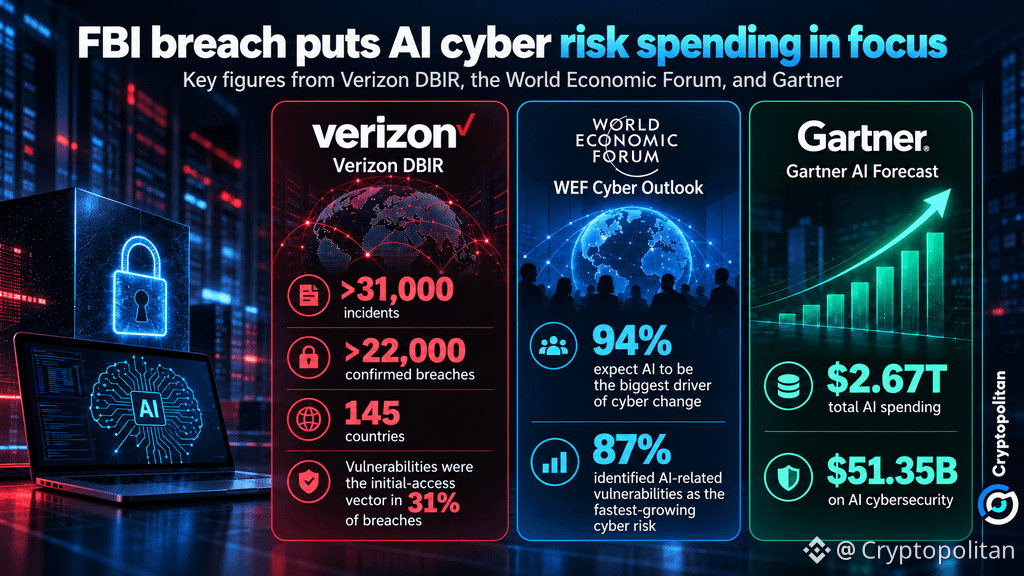 FBI Data Breach Highlights Rising AI Cybersecurity Risks and Spending
The FBI leak does not create those trends by itself. But it shows why identity protection, threat detection and AI-assisted defense are becoming harder for governments and enterprises to treat as optional.
If you're reading this, you’re already ahead. Stay there with our newsletter.