
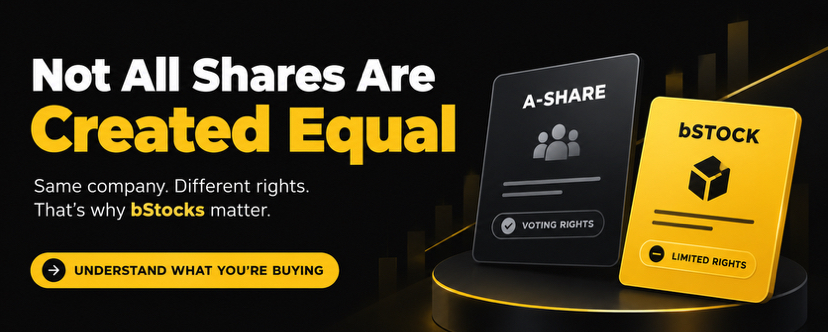

Most beginners think buying a stock means owning the same thing as everyone else.
That’s not always true.
That’s why bStocks matter.
A lot of people hear the term and ignore it because it sounds technical. But the idea is actually simple: some companies issue different classes of shares, and those shares can come with different rights.
In many cases, the biggest difference is voting power.
That means two people can invest in the same company, own shares in the same business, and still have very different levels of control.
One shareholder may get a stronger voice in big company decisions.
Another may get much less influence.
That’s the part most beginners miss.
When people start investing, they usually focus on price, hype, momentum, and whether the company looks strong. But smart investors look deeper. They ask: what kind of ownership am I actually buying?
That’s where bStocks become important.
bStocks are usually a share class created alongside another class, such as A-shares. Both may represent ownership, but they do not always give the same power. In some companies, founders or insiders hold shares with stronger voting rights, while public investors hold shares with weaker ones.
Why would a company do that?
Usually for one reason: control.
It allows a company to raise money from investors while keeping more decision-making power in the hands of founders or insiders. Supporters say that helps protect long-term vision. Critics say it can reduce accountability.
Neither side should be ignored.
The main takeaway is simple:
Not all shares are created equal.
bStocks are not automatically good or bad. The real issue is whether investors understand what they are buying. If you only look at the ticker and the price chart, you might miss one of the most important details behind the stock.
So before investing, do not just ask, “Is this company strong?”
Also ask, “What rights come with these shares?”
Because in markets, what looks the same on the surface can be very different underneath.