

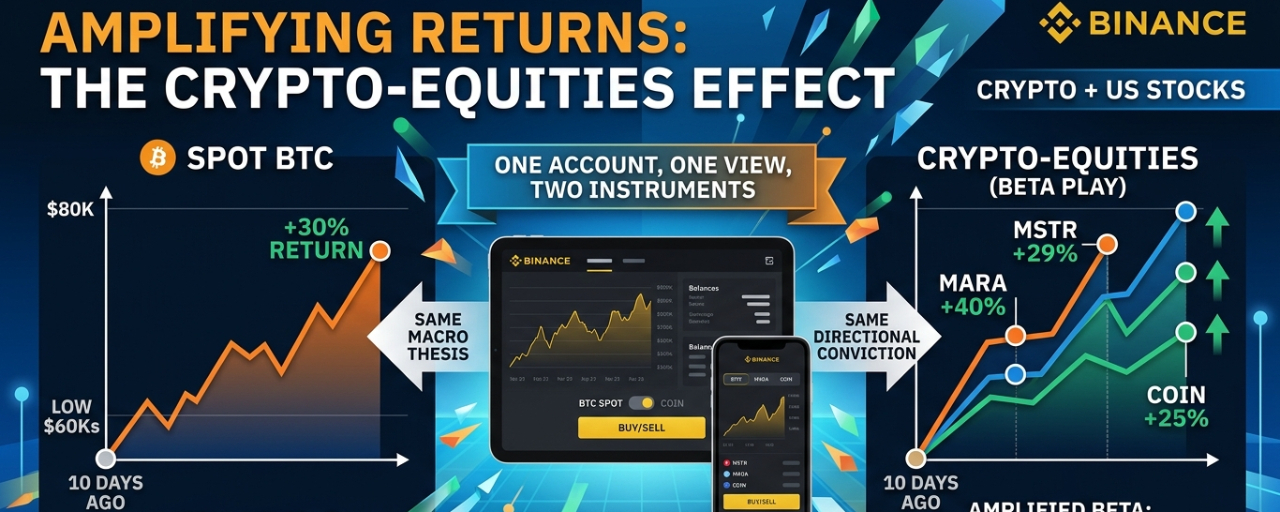

Bitcoin moved from the low $60Ks to above $80K in ten days. If you held BTC spot, that was a strong return by any measure. But if you were also watching the equities side of that same rally, you saw something interesting happen. MSTR gained 29%. MARA was up 40%. COIN added 25%. The same macro thesis, the same directional conviction, but the returns in crypto-equities ran well ahead of the underlying asset.
That gap is not a glitch. It is beta. And understanding it is the difference between having a view and fully expressing one.
Why Crypto-Equities Move Differently Than Spot
When Bitcoin rallies, it does not move in isolation. A network of companies whose revenues, treasuries, and business models are directly tied to BTC prices moves with it — and often moves harder. Miners like MARA operate with significant financial leverage to Bitcoin's price: their revenues rise sharply when BTC goes up while their fixed costs stay roughly constant, which amplifies the gain relative to spot. Strategy (MSTR) holds hundreds of thousands of Bitcoin on its balance sheet, so its stock price reflects BTC exposure plus a premium that can expand dramatically during bull moves. Coinbase earns trading fees, and volume surges when markets run hot.
In a strong directional move, these equities carry higher beta than spot BTC. They can also fall harder in the other direction. That is the trade-off. But for a trader with a clear directional conviction, ignoring the equities layer means leaving meaningful upside on the table.
The Problem Until Now
Acting on this insight used to require two accounts. You held your BTC, ETH, and altcoins on a crypto exchange. You held MSTR, MARA, and COIN through a separate brokerage. When a catalyst hit, you were managing positions across platforms, dealing with different interfaces, different liquidity, and capital sitting idle on whichever platform the opportunity wasn't on.
The more fundamental problem was that you could not size a unified position across both sides of the same thesis. You had a view. You could only partially express it.
One Account, One View, Two Instruments
Binance now removes that friction entirely. With U.S. stock trading live on the platform alongside the full suite of crypto spot and derivatives, a single thesis "crypto is running, I want exposure across the stack" can now be expressed as a multi-instrument allocation from one account.
Long BTC spot. Long MSTR. Long MARA. Long COIN. Different beta levels, different risk profiles, different mechanics, all executing from the same interface, the same balance, with no transfers, no second login, and no capital trapped on the wrong platform when the market moves.
That is not just a convenience upgrade. It is a structural change in how individual traders can construct and manage multi-instrument crypto views. Institutions have always been able to do this. Now anyone on Binance can.
How to Think About It
The key is not choosing between spot crypto and crypto-equities. It is understanding what each one gives you and sizing accordingly.
BTC spot gives you clean, direct exposure with no counterparty structure beyond the exchange itself. It is liquid, liquid around the clock, and the purest expression of a Bitcoin view.
Crypto-equities give you amplified beta with the additional variables of company operations, capital structure, and equity market sentiment layered on top. They trade during market hours with the extended windows Binance now offers. They respond to the same macro catalyst but with a different return profile.
A trader who understands those differences can build a position that uses both deliberately, sizing the spot leg for base exposure and the equities leg for leveraged upside on the same conviction, without touching derivatives or managing margin.
That is a sophisticated allocation strategy. It now requires exactly one account.
Trade crypto and U.S. stocks on Binance
Explore Binance Stocks
Follow Binance Research on Binance Square
#BinanceStocks #Bitcoin #MSTR #MARA #Coinbase #CryptoEquities #BTC #Crypto2026 #BinanceSquare #Trading