

The AI energy bottleneck is no longer theoretical.
The real question is whether the same technology driving the power demand can also solve it.
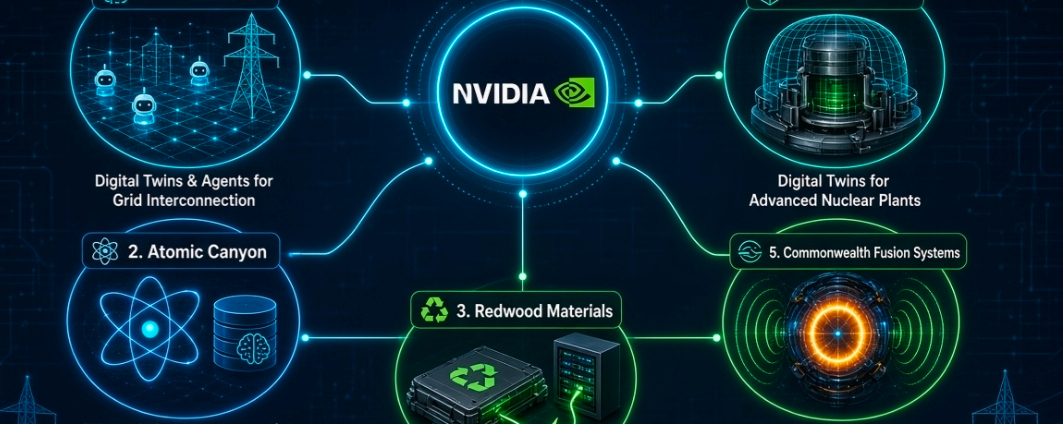
From fusion reactors to recycled EV batteries, five companies are using NVIDIA AI, digital twins and accelerated simulation to accelerate the build-out of a lower-carbon grid. At New York Climate Week, NVIDIA spotlighted these innovators moving research into commercial reality.
ThinkLabs AI is using digital twins and agents on the NVIDIA CUDA platform to speed up grid interconnection reviews. Southern California Edison cut evaluation times from 30–45 days to roughly two minutes by running physics-informed simulations that identify bottlenecks and recommend solutions in near real time.
Atomic Canyon is bringing AI-powered knowledge management to nuclear operations. Its Neutron workbench and NIVA (Nuclear Industry Virtual Assistant) turn decades of procedures, regulatory documents and operating experience into a searchable, citation-backed knowledge layer. The platform is now available fleet-wide across North American nuclear plants after collaboration with INPO, EPRI and NEI.
Redwood Materials is repurposing 100% recycled EV batteries into large-scale, flexible power systems for AI factories. These second-life packs, managed with an AI intelligence layer running on NVIDIA Blackwell, act as onsite storage that can come online in months rather than years, firming intermittent renewables and reducing reliance on new grid infrastructure.
TerraPower is developing NVIDIA Omniverse-powered digital twins to accelerate siting and delivery of its Natrium advanced nuclear plants. The platform compresses early-stage site engineering work from 18 months to as little as eight weeks by analysing thousands of variables simultaneously in a shared 3D environment.
Commonwealth Fusion Systems is using NVIDIA Omniverse libraries and OpenUSD to compress years of fusion experimentation into weeks. Its SPARC tokamak digital twin enables rapid virtual optimisation of plasma behaviour and machine design, advancing the timeline toward commercial fusion power plants in the 2030s.
The opportunity is clear: AI is no longer just a consumer of power — it is becoming a tool that removes the very bottlenecks holding clean energy back.
The risk is equally clear.
These projects still sit at different stages of commercial maturity. Fusion remains years from grid connection. Advanced nuclear faces licensing and construction realities. Battery reuse depends on supply of suitable packs and long-term performance data. Grid AI tools must prove reliability at scale under real utility constraints.
My view
I’m selectively bullish on the intersection of AI and clean energy infrastructure.
The demand signal is real. Data centres need firm, low-carbon power faster than traditional timelines allow. The companies using NVIDIA’s stack to shorten research, interconnection, operations and deployment cycles are addressing the actual constraint rather than just talking about it.
But the next phase will be decided by execution metrics — actual megawatts connected, interconnection study times reduced, uptime of second-life systems, and regulatory progress — not press releases.
If these five companies (and others following the same path) convert digital-twin speed into physical assets at commercial scale, the AI power crisis becomes a solvable engineering problem.
If timelines slip or costs fail to compress, the gap between compute demand and clean supply will keep widening.
For me, the clean-energy AI trade is no longer about whether the technology works.
It’s about whether the deployment velocity can match the demand curve.
What is your view?
🟢 Bullish — AI is accelerating the grid solutions we need
🔴 Bearish — execution risk still outweighs the promise
⚖️ My view — bullish on the tech stack, selective on commercial timelines
If you’re sharing an actual position, use the trade-sharing widget with your real entry and risk levels.