

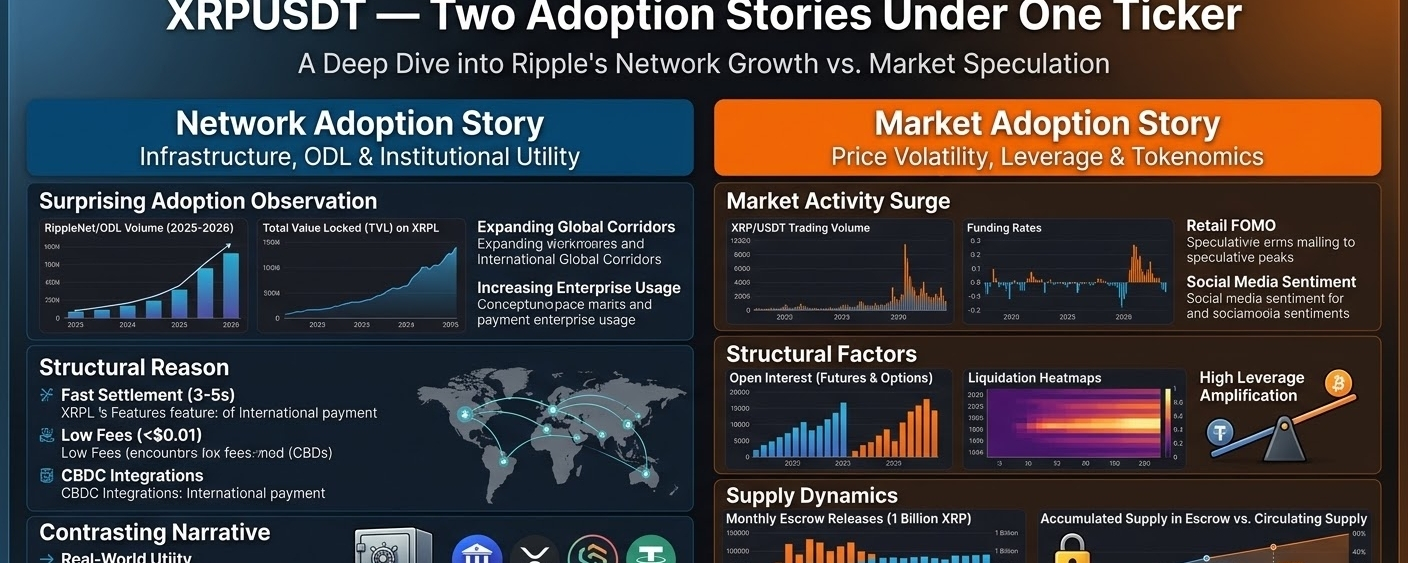

XRP is continuously positioned as the primary settlement asset for cross-border institutional payments and enterprise liquidity solutions. Ripple’s On-Demand Liquidity (ODL) network, alongside ongoing developments on the XRP Ledger—such as native Automated Market Maker (AMM) pools, stablecoin integrations (RLUSD), and EVM-compatible sidechains—targets real-world settlement velocity and institutional financial infrastructure. Recent platform data shows expanding ledger activity and growing custody integration across enterprise banking products.
But there is another XRP story happening at the same time — and it is happening in the market.
The token has experienced substantial volatility and recurring speculative expansions. In late September 2026, XRP surged above $1.50 with single-day gains exceeding 6% to 8%, lifting its market capitalization back toward the $90B+ tier and sparking intense derivatives activity. That move brought renewed institutional and retail attention back to XRP/USDT.
The important part is that institutional infrastructure adoption and market price action are not necessarily the same thing.
One side of XRP is the actual XRP Ledger (XRPL) utility story: low-cost cross-border settlement, enterprise liquidity bridges, institutional tokenization, and expanding decentralized finance infrastructure. The other side is the capital market dynamic around the token itself, where institutional investors access spot ETFs—holding over 1.12 billion XRP in vault custody—while active traders express directional leverage across spot, futures, and options markets.
Then comes the supply structural question.
XRP has a maximum supply cap of 100 billion tokens, with a substantial portion held in Ripple's programmatic monthly escrow accounts. While a significant portion of monthly unlocked tokens is regularly re-escrowed, programmatic monthly releases continue to introduce systematic supply flows into the ecosystem. Simultaneously, central exchange reserves have fluctuated near multi-year lows, creating a tight floating supply that collides directly with spot ETF accumulation and institutional vault inflows.
That creates two forces running underneath the same ticker.
One is demand: regulated US spot ETF inflows, institutional payment corridors, enterprise treasury custody, and growing on-chain DeFi settlement volume.
The other is supply and distribution: structured monthly escrow releases, periodic treasury sales, and shifts in exchange inventory reserves.
So the central XRP question is not simply “Can XRP go higher?”
It is:
Can institutional utility and spot ETF vault accumulation absorb the ongoing supply releases and market liquidity demands?
That distinction matters because a successful global payments framework does not automatically guarantee continuous token price appreciation unless circulating supply is absorbed faster than it is distributed. Transparency reports and analytical filings emphasize that net ETF flows, payment volume velocity, escrow lockup ratios, and secondary exchange liquidity remain crucial variables in the XRP economic model.
There is also a third factor: leverage.
Recent XRPUSDT derivatives data showed futures open interest surging past $3.5 billion alongside massive option implied volatility skew and multi-million dollar liquidation cascades. These metrics highlight how heavily stacked short or long positioning can rapidly amplify both upward squeezes and downward pullbacks.
So XRP currently has two adoption stories running in parallel:
One is the institutional utility story — enterprise payment rails, spot ETFs, and financial infrastructure integration.
The other is the market story — a high-liquidity asset attracting heavy speculative leverage, structural ETF inflows, and periodic escrow emissions.
The next phase will reveal whether structural ETF demand and real-world payment velocity can become a dominant floor, or whether speculative leverage and market supply distributions remain the main drivers of price.
For XRPUSDT traders, the key metrics to watch are: spot ETF net flows/vault reserves, XRPL cross-border transaction volume, exchange reserve balances, futures open interest, liquidation heatmaps, and monthly escrow re-lockup rates.
This is an informational market analysis, not financial advice.