
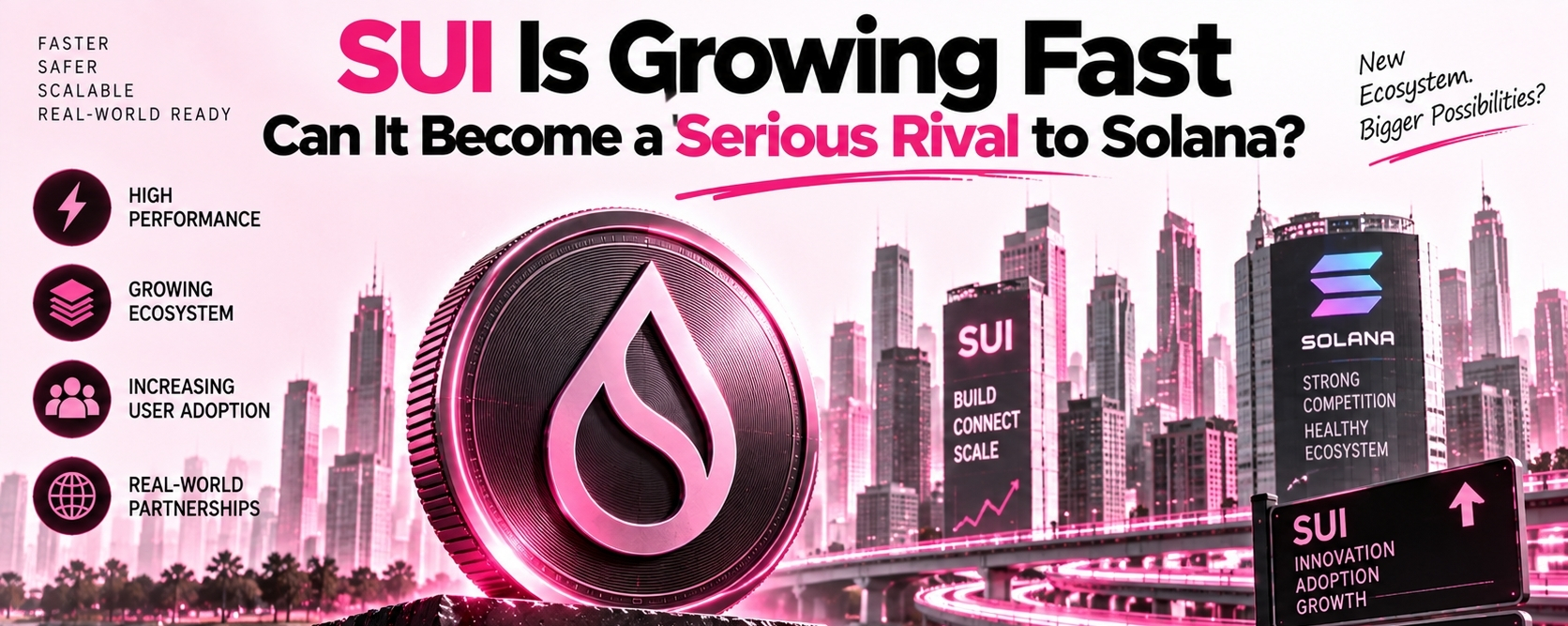


For a long time, Solana has been one of the first names people mention when talking about fast Layer-1 blockchains.
But another network is increasingly entering that conversation: Sui.
SUI has recently attracted fresh market attention, with the token gaining around 9% during a broader rotation toward Layer-1 assets on September 20. But price is only one part of the story. The more interesting developments are happening underneath the network.
Sui was built differently from many traditional blockchains.
Instead of treating everything as balances inside accounts, Sui uses an object-based model. Assets can exist as individual programmable objects, allowing transactions involving unrelated objects to be processed in parallel.
Think about it like a supermarket.
One checkout line forces everyone to wait behind the person in front. Multiple checkout lines allow unrelated customers to be served at the same time.
That parallel-processing idea is one of Sui's biggest technical advantages.
Sui's Mysticeti consensus system is another important part of the story. The network says Mysticeti can achieve roughly 300ms consensus latency, while certain transactions involving owned objects can be processed even faster through Sui's fast path.
And Sui has continued improving it.
Mysticeti v2 removed some unnecessary processing steps and introduced a new Transaction Driver. During testing, Sui reported transaction-latency reductions of roughly 35% on Asia-based full nodes and 25% on European nodes.
But speed alone isn't enough.
Crypto has seen plenty of technically impressive networks struggle because developers and users never arrived.
That's where Sui's growing ecosystem becomes more interesting.
One major focus is DeFi.
Sui's DeepBook provides an on-chain central limit order book directly within the ecosystem. Sui has also introduced gasless transfers for multiple stablecoins, meaning users can move supported stablecoins without separately needing SUI to cover gas.
That sounds like a small improvement, but it addresses one of crypto's most annoying user-experience problems.
Imagine receiving a stablecoin and then discovering you can't move it because you don't own the network's native token for transaction fees.
Removing that friction makes blockchain applications feel more like normal financial apps.
Sui is also trying to become more than a blockchain execution layer.
During 2025, projects including Walrus, Seal and Nautilus expanded its technology stack into decentralized storage, access control and off-chain data processing.
Walrus itself had stored more than 467TB of unencoded data by its first mainnet anniversary in March 2026, according to Sui.
So the bigger ambition is becoming clearer.
Sui doesn't simply want developers to execute transactions.
It wants to provide more of the infrastructure developers need to build complete decentralized applications.
This is where comparisons with Solana naturally begin.
Both networks are designed around high throughput, inexpensive transactions and consumer-facing applications.
But they approach those goals differently.
Solana uses a shared account-based architecture and has spent years building a large ecosystem around DeFi, payments and consumer crypto applications. Sui is newer and relies on its object-centric architecture and parallel processing as major differentiators.
And this highlights Sui's biggest challenge.
Solana already has distribution.
It has deeper liquidity, a more mature ecosystem and considerably more developers than Sui. One 2026 comparison counted more than 10,000 developers around Solana versus roughly 1,400 around Sui, though developer counts vary depending on methodology.
That gap cannot be solved simply by having faster technology.
Developers go where users are.
Users often go where liquidity and good applications already exist.
And liquidity tends to follow both.
That creates a powerful network effect for established ecosystems such as Solana.
Sui therefore doesn't necessarily need to become a "Solana killer."
It needs to prove that its technical advantages can create applications or experiences that are meaningfully better.
Gaming could be one area where its object model becomes useful. DeFi is another. Stablecoin payments, digital assets and data-heavy decentralized applications could also benefit from the network's architecture.
There are still important risks.
Sui is much younger than Solana and hasn't experienced the same level of long-term real-world stress. Its ecosystem and liquidity also remain smaller. High theoretical transaction capacity doesn't automatically translate into real demand.
And importantly, network growth doesn't guarantee that the SUI token itself will rise in value.
The stronger long-term signal would be sustained growth in developers, active users, stablecoin liquidity, applications and real economic activity.
So can Sui become a serious rival to Solana?
Technologically, Sui is building infrastructure that makes the comparison increasingly reasonable.
But technology is only the first battle.
The much harder battle is users, developers and liquidity.
Solana already has those advantages at scale. Sui now has to prove that its speed and architecture can attract them.
Sui doesn't need to beat Solana on a TPS chart. It needs to give people a reason to actually use Sui instead.
That could be the real competition to watch.