

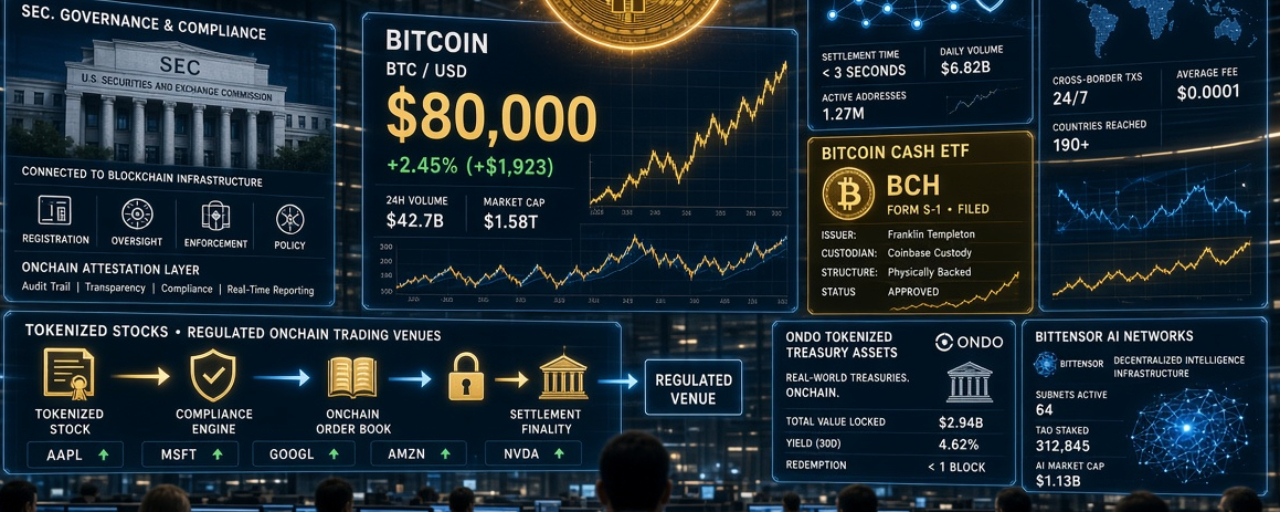

The crypto market is entering the final part of September with two very different stories developing simultaneously.
Bitcoin has recovered toward the $80,000–$81,000 region, while several altcoins have posted sharp rebounds following the volatility created by the Federal Reserve's rate hike and the Senate's failure to advance the CLARITY Act. At the same time, regulators and financial institutions are moving forward with blockchain-based financial infrastructure.
The most important development may be the SEC's new Innovation Exemption, which creates a temporary regulatory pathway for certain tokenized stocks to trade on approved blockchain-based venues.
This combination of price recovery and infrastructure development is creating a new phase for the digital-asset market.
1. Bitcoin Recovers Above $80,000
Bitcoin entered the week after a sharp period of uncertainty.
The Federal Reserve raised interest rates by 25 basis points, while the Senate's attempt to advance the CLARITY Act failed. Those events initially pressured Bitcoin and altcoins as traders reassessed both monetary policy and U.S. regulatory prospects.
Yet the market subsequently reversed.
By September 18, Bitcoin had climbed above $80,000, while Ether, XRP and Solana also recorded substantial gains. CoinDesk reported that Bitcoin rose nearly 6% during the session, while Ether gained around 7.3%, XRP 8.9% and Solana 12.7%.
The rebound shows how quickly crypto liquidity can rotate after a major sell-off.
But the macro backdrop has not disappeared.
The Fed remains restrictive, Treasury yields are elevated and the dollar remains sensitive to expectations for further rate increases. This means the crypto market can still react sharply to inflation, employment data, central-bank decisions and liquidity conditions.
2. The SEC's Innovation Exemption Changes Tokenization
The more structural development is taking place in U.S. securities markets.
On September 17, the SEC announced an Innovation Exemption designed to facilitate the trading of certain tokenized national-market-system stocks on approved onchain venues.
The temporary relief allows qualifying Tokenized Securities Venues to operate under defined conditions without being treated in exactly the same way as traditional exchanges.
The SEC's framework includes requirements covering transparency, recordkeeping, technology safeguards and trading limitations. The agency described the measure as a way to allow controlled experimentation while it develops longer-term rules for blockchain-based securities markets.
That is important because the CLARITY Act had just failed to advance in the Senate.
Instead of waiting for comprehensive legislation, regulators are using existing authority to create a limited testing environment.
This does not mean all stocks can suddenly be traded freely on public blockchains.
It does mean that the U.S. securities market is moving another step toward testing blockchain-based settlement and trading infrastructure.
3. ONDO Is Directly Connected to the Tokenization Narrative
Ondo Finance is one of the crypto projects most closely associated with the real-world-asset and tokenized-securities sector.
ONDO recently surged more than 12% as the market reacted to the SEC's new framework for tokenized stocks. Trading data also showed a substantial increase in daily volume during the move.
ONDO was around $0.43 on September 21, compared with roughly $0.37 on September 17.
The price movement illustrates how quickly crypto markets can respond when a regulatory development directly relates to a project's core narrative.
Ondo's broader strategy involves bringing traditional financial assets onto blockchain-based infrastructure.
That includes tokenized U.S. Treasuries and other financial products.
The SEC's Innovation Exemption does not specifically endorse Ondo.
However, a clearer regulatory pathway for tokenized securities potentially increases the importance of the infrastructure being developed by companies and protocols operating in this sector.
4. TRON Is Taking the Institutional ETF Route
TRON represents a different institutional pathway.
The Canary Staked TRX ETF, trading under the ticker TRXS, recently launched in the United States, providing investors with brokerage-based exposure to TRX and staking-related returns.
This is significant because ETF structures can make digital assets accessible through traditional investment accounts without requiring investors to directly manage blockchain wallets.
TRON is also deeply connected to the stablecoin economy.
Its network has become one of the major settlement layers for USDT, giving TRX an ecosystem narrative that extends beyond simple token speculation.
CoinDesk's Q2 research noted that TRON's stablecoin share had risen to approximately 28.7%, while USDT supply on the network reached about $89 billion.
The combination of stablecoin activity and regulated investment products gives TRON a distinctly institutional market narrative.
5. Stellar's Protocol Upgrade Adds Another Payment Layer
Stellar is approaching the market from the payments and settlement side.
Its Protocol 28 upgrade went live on mainnet on September 16. The upgrade introduces new protocol functionality and consensus-related tooling for the network.
XLM recovered toward $0.20 during the recent crypto rebound.
Stellar is also involved in real-world payment infrastructure.
MoneyGram has announced a stablecoin-based debit-card initiative powered by Stellar, demonstrating how blockchain networks can be used underneath consumer payment products without requiring users to interact directly with the underlying blockchain.
This is an important distinction.
The blockchain itself can become invisible infrastructure.
A consumer may simply see a payment card or mobile application while Stellar handles settlement underneath.
6. Bitcoin Cash Gets an ETF Catalyst
Bitcoin Cash has also returned to the institutional conversation.
Grayscale filed paperwork seeking to convert its Bitcoin Cash Trust into a spot ETF and pursue a listing on NYSE Arca. The filing is not an approval; the proposed listing remains conditional on the relevant regulatory process.
Nevertheless, the announcement produced an immediate market reaction.
CoinMarketCap reported that BCH rose more than 10% around September 18 as traders responded to the ETF filing and a broader rotation into older payment-focused cryptocurrencies.
The development illustrates how ETF narratives continue to affect crypto markets.
Bitcoin, Ethereum and other large assets have already demonstrated how regulated investment products can create new channels for institutional capital.
The market is now watching whether similar structures can develop around a wider group of digital assets.
7. AI Crypto Is Returning to the Spotlight
The current rebound is not only about financial tokenization.
Artificial intelligence remains another major crypto narrative.
Bittensor's TAO climbed from around $232 on September 17 to more than $263 on September 19, while its market capitalization approached $3 billion.
Bittensor is attempting to create an open network for decentralized machine intelligence, connecting different AI-related subnets and participants.
The recent move highlights how capital is rotating between several narratives rather than concentrating entirely in Bitcoin.
Tokenization, AI, stablecoins, DeFi and blockchain payments are all competing for attention.
That diversification is one reason altcoin markets can move dramatically even when the overall macro environment remains uncertain.
8. Regulation Is Still the Biggest Variable
The failed CLARITY Act remains an important part of the September market story.
The Senate's 49–50 vote fell short of the 60 votes needed to advance the legislation, leaving comprehensive market-structure legislation unresolved.
The result does not mean U.S. crypto regulation has stopped.
The SEC's Innovation Exemption demonstrates that regulators can still make targeted changes within their existing authority.
At the same time, the European Union is reviewing aspects of its MiCA framework, including questions around staking, DeFi, lending, stablecoins, custody and tokenized deposits. The current consultation is scheduled to close on September 30, 2026.
Therefore, regulatory development is continuing on multiple fronts even as major legislation remains unresolved in Washington.
Outlook: Crypto Is Becoming a Multi-Theme Market
The September 21 market is difficult to describe with one narrative.
Bitcoin is recovering toward $80,000.
TRON is gaining an ETF-based institutional channel.
Stellar is upgrading its payment infrastructure.
Bitcoin Cash has an ETF filing.
Ondo is benefiting from the tokenization narrative.
Bittensor is attracting attention from the AI sector.
These projects are not competing for exactly the same use case.
Instead, they represent different parts of the emerging digital-asset economy.
TRX: stablecoin settlement and institutional exposure.
XLM: payments and financial settlement.
BCH: peer-to-peer payments and ETF access.
ONDO: tokenized real-world financial assets.
TAO: decentralized AI infrastructure.
The market's next phase may therefore be less about one universal crypto narrative and more about individual networks proving where blockchain technology can provide practical infrastructure.
Closing Thought
The September market has produced an interesting contradiction.
Congress has struggled to establish comprehensive crypto market-structure legislation, yet the financial system continues moving toward blockchain.
The SEC's Innovation Exemption is one example.
Tokenized stocks are being tested.
Stablecoins are becoming increasingly important for global settlement.
ETF structures are expanding to additional crypto assets.
AI networks are attracting capital.
And blockchain infrastructure is gradually becoming integrated into traditional financial products.
Bitcoin remains the center of the market, but the broader transformation is happening underneath it.
The next stage of crypto may therefore be defined not simply by how high Bitcoin trades, but by how many real financial activities eventually move onto blockchain rails.
Financial disclaimer: This article is for informational and educational purposes only and is not financial, investment, trading or legal advice. Cryptocurrency markets are highly volatile, and prices can change rapidly. Always conduct your own research and consider your own risk tolerance before making financial decisions.

In a sleek institutional trading floor overlooking a glittering city skyline, asset managers monitor a constellation of transparent holographic dashboards that fuse traditional finance with on-chain infrastructure. Tokenized U.S. equities flow through illuminated blockchain liquidity pools, while the TRON USDT settlement network processes millions of transactions in seconds and Stellar’s global payment corridors pulse with cross-border volume. A Bitcoin Cash ETF terminal tracks live price action beside Ondo’s real-world-asset vaults holding multi-billion-dollar Treasuries and credit instruments; nearby, Bittensor’s decentralized AI nodes hum with computational activity. Floating SEC registration documents underscore the regulated nature of this new market architecture, all bathed in cinematic blue, silver, and gold light that captures the sophisticated Wall Street atmosphere of September 2026.