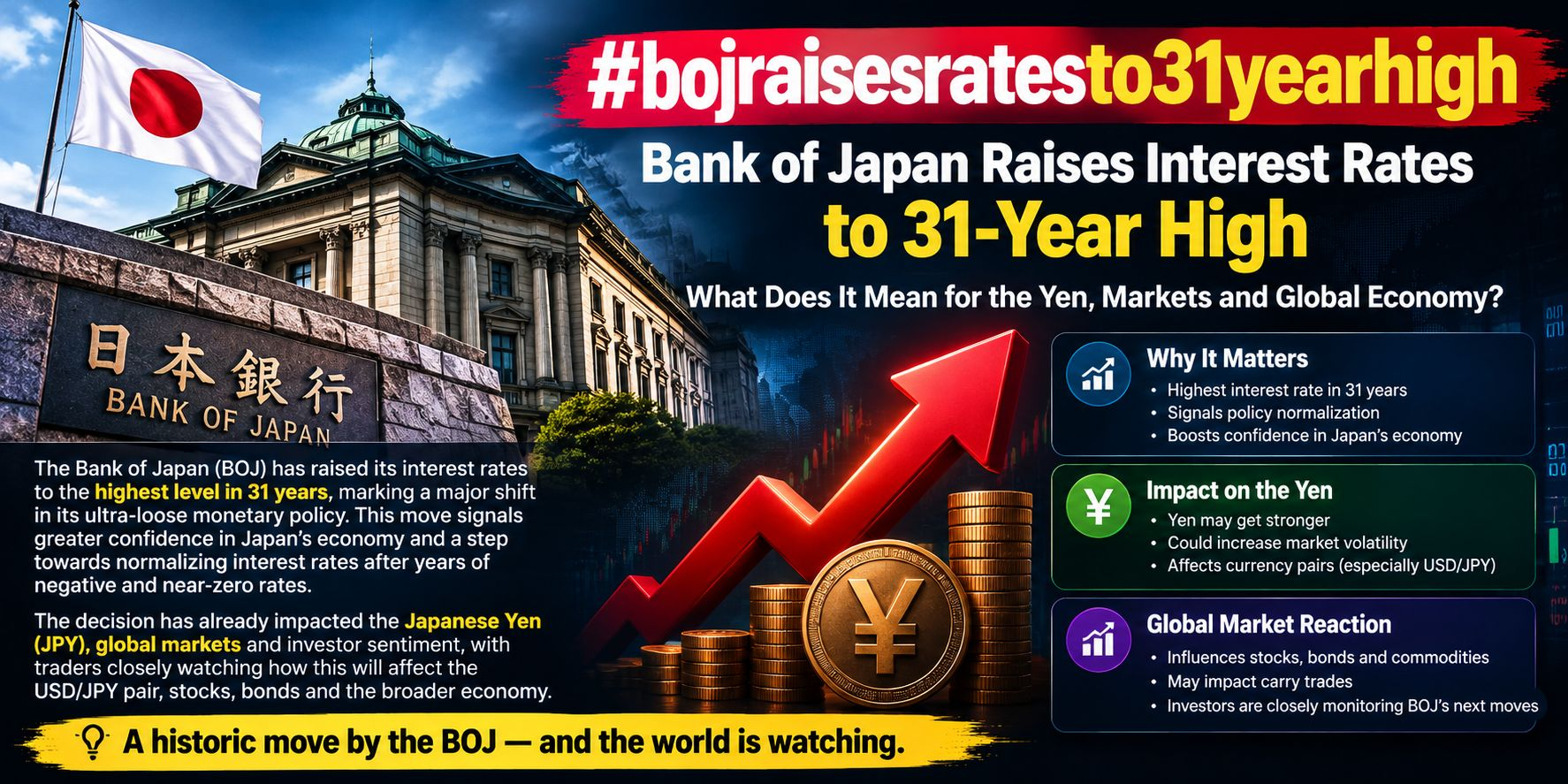

#BOJRaisesRatesTo31YearHigh — What Does It Mean for Japan and Global Markets?
The Bank of Japan (BOJ) remains at the center of global financial-market attention as Japan continues moving away from the ultra-loose monetary policy that characterized much of the previous decade.
The hashtag #BOJRaisesRatesTo31YearHigh highlights an important development for financial markets: higher Japanese interest rates can influence not only the Japanese economy but also the yen, global bond markets, equities, currency trading and international investment flows.
🇯🇵 Why Is the BOJ Rate Decision Important?
For many years, Japan maintained exceptionally low interest rates compared with other major economies. This environment encouraged borrowing at relatively low costs and played an important role in global financial markets.
A move toward higher interest rates represents a change in that environment. When a central bank raises its policy rate, borrowing costs can increase, financial conditions can become tighter, and investors may reassess where they want to keep their capital.
For Japan, the BOJ must balance several factors, including inflation, wage growth, economic activity, consumer spending and financial stability.


💴 What Could Happen to the Japanese Yen?
Interest-rate changes can have a significant effect on currency markets.
Higher Japanese interest rates can make yen-denominated assets relatively more attractive, depending on how Japanese rates compare with rates in other major economies. This can influence demand for the Japanese yen and currency pairs such as USD/JPY.
However, currency movements are never determined by one factor alone. Traders also consider U.S. interest rates, Federal Reserve policy, Japanese economic data, inflation expectations, government bond yields and overall market sentiment.
This means the yen can react differently depending on what investors were already expecting before the BOJ announcement.
🌎 Why Are Global Investors Watching?
Japan is one of the world's major economies and a significant participant in global financial markets. Changes in Japanese monetary policy can therefore have effects beyond Japan.
One area investors watch closely is the so-called carry trade, where market participants borrow in a relatively low-interest-rate currency and invest in assets offering potentially higher returns elsewhere.
If Japanese interest rates rise, the cost of maintaining such positions can change. If investors decide to reduce these positions, financial-market volatility can increase.
📈 Possible Impact on Stock Markets
Higher interest rates can affect stock markets because they change borrowing costs and influence how investors value future corporate earnings.
Japanese companies may experience different effects depending on their business models. Banks and financial institutions can respond differently from highly leveraged companies, exporters, or businesses that depend heavily on domestic consumer spending.
International markets can also react if investors adjust portfolios because of changing Japanese monetary conditions.
💰 What About Bonds?
The bond market is another important area to watch.
When central banks raise interest rates, government-bond yields can respond as investors reassess future monetary policy and inflation expectations. Japanese Government Bonds (JGBs) are particularly important because the BOJ has historically played a major role in Japan's bond market.
Changes in Japanese yields can also influence global bond markets because international investors compare returns across different countries.
📊 What Does This Mean for the Global Economy?
The BOJ's policy direction is important because Japan has been an unusual case among major developed economies for many years.
A gradual normalization of monetary policy could indicate that Japanese policymakers believe economic conditions have changed enough to move away from extremely accommodative settings.
At the same time, higher rates can create challenges. Businesses and households may face higher borrowing costs, while financial markets must adjust to a different interest-rate environment.
🔎 What Should Investors Watch Next?
The most important things to monitor include:
• Future BOJ interest-rate decisions
• Japanese inflation data
• Wage-growth figures
• Japanese economic growth
• USD/JPY movements
• Japanese Government Bond yields
• Federal Reserve policy
• Global stock-market reactions
• Changes in carry-trade positions
• Statements from BOJ officials
These factors can provide more context than the rate decision alone.
⚠️ One Important Point
A rate hike does not automatically mean that the Japanese yen or Japanese stock market will move in one particular direction. Financial markets react not only to the decision itself but also to expectations.
If investors already expected a rate increase, the market reaction could be relatively limited. If the decision or future guidance differs from expectations, the reaction could be much stronger.
🌐 The Bigger Picture
The #BOJRaisesRatesTo31YearHigh discussion is ultimately about more than a single interest-rate decision. It reflects a broader change in Japan's monetary-policy environment and its potential connection with global financial markets.
As Japan gradually adjusts its monetary policy, investors around the world will continue watching the yen, Japanese bonds, equities and international capital flows.
The next phase will depend heavily on inflation, wage growth, economic activity and the BOJ's future policy guidance.
For traders and market observers, the key question is not simply whether rates have risen, but how quickly Japan continues to normalize monetary policy and how global markets adapt to the changing environment.