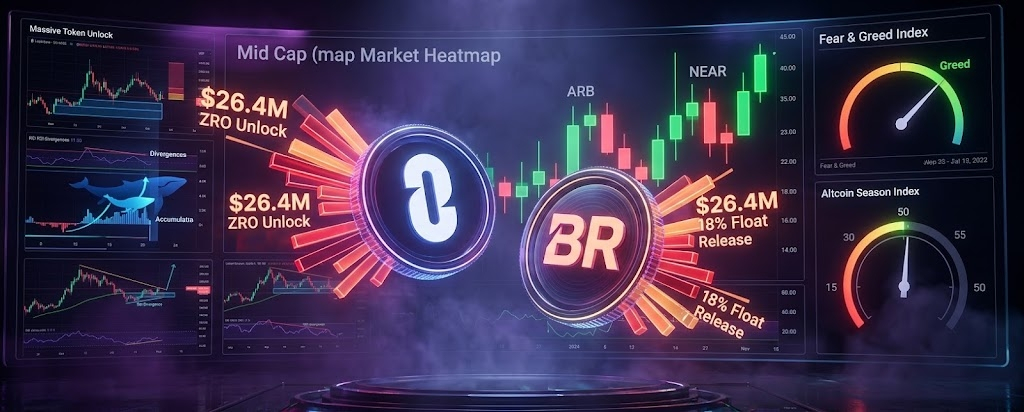


Scheduled unlocks rarely arrive at convenient times. Today’s cluster is no exception. LayerZero’s ZRO faces a roughly $26.4 million unlock, equal to about 4.22% of unlocked supply. Bedrock’s release is more aggressive relative to float, with an estimated 18% float impact. Fear & Greed is sitting in Greed territory. The altcoin season index is approaching 50. Mid-caps such as ARB and NEAR have already posted strong weekly moves. That is the backdrop: risk appetite is present, secondary names are active, and fresh supply is landing into the market anyway.
The important distinction is not the headline dollar amount. It is relative float. A $26 million unlock can be routine in a deep book and disruptive in a thin one. An 18% float release is a different category of event. Traders and holders are deciding whether current greed-driven flow is strong enough to absorb that supply—or whether the releases create a lasting overhang.
Why These Unlocks Matter Now
Unlock risk is always about timing and context. In a fearful market, even modest unlocks can accelerate downside because buyers are scarce. In a greedy market, the same unlocks can be absorbed if momentum and inflows are strong enough. The danger is assuming greed automatically solves supply. It often helps. It does not guarantee clearance.
What stands out here is the contrast between the two names. ZRO’s unlock is meaningful but still in a range the market has learned to process when conditions are supportive. Bedrock’s elevated float release is larger relative to what is already trading. Absolute value gets the social-media attention. Relative float usually decides the price path. That is the core angle for both pro traders and longer-term holders watching today’s session and the next several.
Supply Mechanics and Historical Pattern
Vesting events increase circulating supply by definition. The market impact depends on who receives the tokens, whether those recipients are structured sellers, and how quickly inventory reaches exchanges. Rising exchange reserves around an unlock window are the cleaner caution signal. Stable or declining reserves after the event suggest more of the supply is being held or routed carefully rather than dumped into the bid.
Historical patterns in similar FDV-heavy names are mixed but familiar. Markets often sell the rumor into the unlock, then stabilize if broader flow remains supportive. Sometimes the opposite happens: price holds into the event and weakens after, once the new float is actually available. The common mistake is treating the unlock timestamp as the only risk moment. Distribution can begin before and continue after. The window matters more than the single print.
For names with large fully diluted valuations relative to float, each unlock is also a referendum on whether earlier valuations still make sense once more tokens are free to trade. That pressure is structural. It does not require a change in narrative to matter.
On-Chain and Derivatives Context
Around unlock windows, whale behavior becomes more informative than usual. Accumulation into weakness can support the absorption case. Distribution into strength, especially if paired with rising exchange balances, argues for patience rather than aggressive buying. Active addresses and transfer volume often spike into these events. Some of that is noise—wallets repositioning, custodial moves, market-maker inventory. Some of it is real supply seeking liquidity.
On the derivatives side, positive funding around ZRO and related pairs complicates the picture. Positive funding means longs are paying to stay in. That can be sustainable in a strong tape. It becomes expensive and fragile if spot demand fades right as new tokens hit circulation. Open interest elevated into an unlock raises the odds of a fast move once the first wave of supply lands, because leveraged positioning and spot inventory interact. RSI divergences and order-block retests are the practical technical map for that process. If price loses key post-impulse supports while funding stays positive, the unwind can be disorderly. If the book absorbs the float and those supports hold, the unlock can pass as a digested event rather than a regime change.
Risks, Opportunities, and Positioning
The main risk is straightforward. New supply meets a market that has already rewarded mid-caps hard. Late longs financed by positive funding are vulnerable if absorption fails. For Bedrock, the relative float size makes that risk more acute. For ZRO, the risk is less about a single catastrophic percentage and more about whether repeated unlocks steadily cap upside.
There is also opportunity in the same structure. Greed-range conditions and active altcoin flow can clear inventory that would overwhelm a weaker tape. Markets that successfully absorb unlocks sometimes reset positioning and continue higher once forced or scheduled selling is out of the way. That outcome is possible. It should be earned by the order book, not assumed from the sentiment index.
For pro traders, the cleanest approach is event-based discipline: watch relative float, exchange-reserve direction, funding, and whether price can reclaim or hold the pre-unlock range. For longer-term investors, the question is whether these unlocks are ordinary vesting progress or the start of a multi-month supply ceiling. That answer depends less on today’s candle and more on recipient behavior over subsequent sessions.
Closing View
LayerZero and Bedrock are testing the same market quality from different angles. ZRO brings a sizable but more conventional unlock into a constructive sentiment regime. Bedrock brings a much heavier relative float release into the same regime. Altcoin momentum and greed readings improve the odds of absorption. They do not eliminate overhang risk.
What the setup suggests is a sorting event. If bids remain deep and exchange reserves do not persistently rise, these unlocks may be remembered as noise inside a broader mid-cap advance. If supply shows up faster than demand and technical supports give way under positive funding, the market will be reminded that float math still overrides narrative when inventory is large enough. Relative float, not the headline dollar figure, remains the variable to respect.