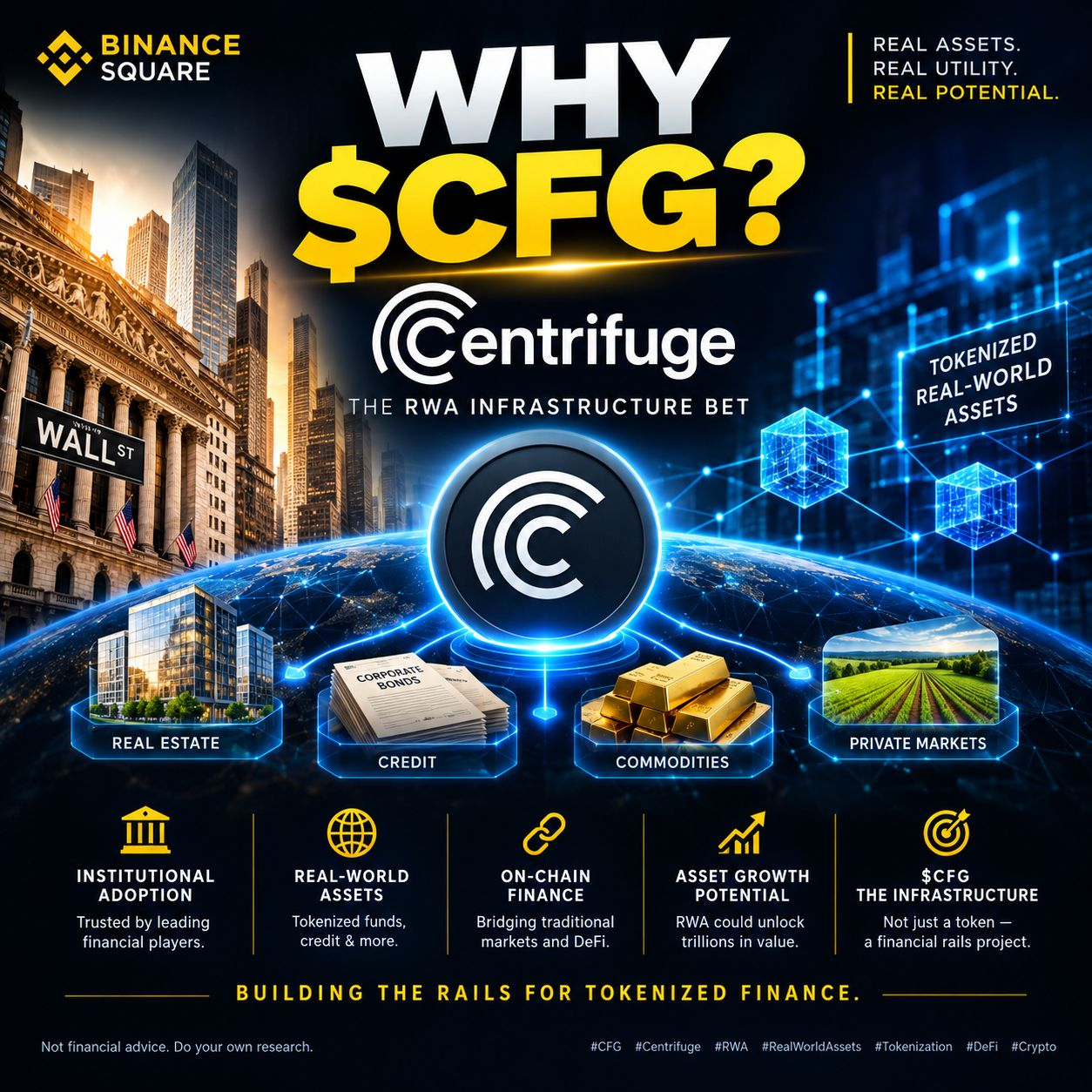

If the next major crypto narrative is tokenization of real-world assets, I want to understand the infrastructure behind it — not just the tokens representing the assets.
That’s where $CFG — Centrifuge gets interesting.
🏦 1. Institutional RWA infrastructure
Centrifuge is building infrastructure for bringing real-world financial assets on-chain, targeting areas such as credit and tokenized funds.
🌎 2. RWA is bigger than a narrative
The thesis is straightforward:
Traditional finance → tokenized assets → on-chain settlement → deeper liquidity.
If that transition continues, the infrastructure supporting it could become increasingly important.
🤝 3. Institutional traction
Centrifuge has attracted attention from established financial institutions, giving $CFG exposure to a sector where traditional finance and blockchain are increasingly converging.
💰 4. Real-world utility
The interesting part isn't simply the ticker.
It's the underlying infrastructure and the role Centrifuge aims to play in connecting traditional capital markets with DeFi.
📈 5. Asymmetric potential
$CFG doesn't need to become the biggest crypto asset.
It needs the RWA sector to grow and Centrifuge to capture meaningful activity within that ecosystem.
⚠️ But there are risks
• Token unlocks/dilution
• Competition within RWA infrastructure
• Regulatory uncertainty
• Adoption may take longer than expected
• Crypto market volatility
So this isn't a guaranteed moonshot.
It's a long-term infrastructure thesis.
My view:
If tokenization becomes one of the major bridges between Wall Street and blockchain, $CFG is a project worth keeping on the radar.
RWA isn't just about putting assets on-chain.
It's about building the rails that move capital on-chain.
$CFG 👀
Not financial advice. Do your own research.
#CFG #Centrifuge #RWA #RealWorldAssets #Tokenization #DeFi #Crypto