
Ethereum’s roadmap is starting to look less like a collection of upgrades and more like a long-term security transition.
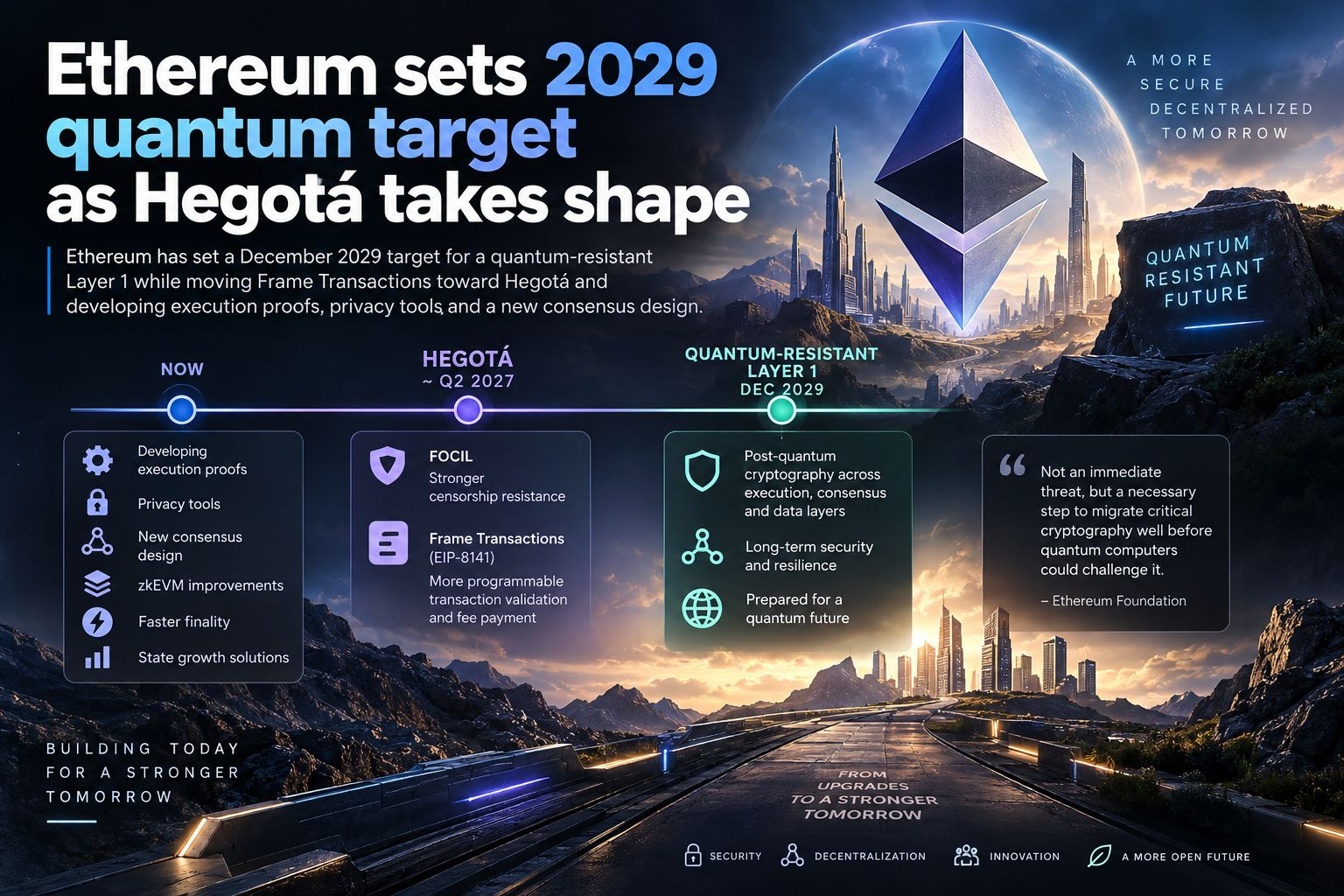
The Ethereum Foundation has set December 2029 as the target for making Ethereum’s Layer 1 quantum-resistant across execution, consensus and data layers. The reason is not an immediate quantum threat, but the need to migrate critical cryptography well before sufficiently powerful quantum computers could challenge it.
The nearer milestone is Hegotá, currently expected around Q2 2027. Two major pieces are already scheduled: FOCIL, which strengthens censorship resistance, and Frame Transactions (EIP-8141), which makes transaction validation and fee payment more programmable.
What interests me most is Frame Transactions. By allowing accounts to define their own validation logic and potentially adopt alternative signature schemes, Ethereum can create a smoother path toward post-quantum cryptography without requiring every new signature scheme to arrive through another hard fork.
At the same time, Ethereum is researching execution proofs, privacy, faster finality, state growth and zkEVM improvements. So Hegotá is not simply another feature upgrade—it is becoming an important bridge between Ethereum’s current architecture and its longer-term security design.
The interesting question now is whether Ethereum can execute this multi-fork transition without sacrificing stability while the cryptographic threat remains mostly theoretical.
$PIEVERSE
$Fartcoin
The Ethereum Foundation has set December 2029 as the target for making Ethereum’s Layer 1 quantum-resistant across execution, consensus and data layers. The reason is not an immediate quantum threat, but the need to migrate critical cryptography well before sufficiently powerful quantum computers could challenge it.
The nearer milestone is Hegotá, currently expected around Q2 2027. Two major pieces are already scheduled: FOCIL, which strengthens censorship resistance, and Frame Transactions (EIP-8141), which makes transaction validation and fee payment more programmable.
What interests me most is Frame Transactions. By allowing accounts to define their own validation logic and potentially adopt alternative signature schemes, Ethereum can create a smoother path toward post-quantum cryptography without requiring every new signature scheme to arrive through another hard fork.
At the same time, Ethereum is researching execution proofs, privacy, faster finality, state growth and zkEVM improvements. So Hegotá is not simply another feature upgrade—it is becoming an important bridge between Ethereum’s current architecture and its longer-term security design.
The interesting question now is whether Ethereum can execute this multi-fork transition without sacrificing stability while the cryptographic threat remains mostly theoretical.
$PIEVERSE
$Fartcoin