


REX Launches 2x Leveraged ETF Tied to Strive: A Double Bet on Bitcoin Treasury as the Market Lives on Short Liquidations
25,000 Bitcoin. That is how much BTC Strive — a name few people mention among the "Bitcoin treasury whales" — currently holds, putting it at the fifth-largest publicly traded company Bitcoin holder globally. And in just one Friday trading session, Strive shares jumped +6.4% to $30.09, slightly above the 12-month average price target of $29.40 tracked by S&P Global.
Right on top of that move, REX Shares and Tuttle Capital Management launched a product that traders would call a straight-up "double-edged sword": the T-REX 2X Long ASST Daily Target ETF, ticker ASSX, listed on Cboe, targeting 200% of the daily performance of Strive stock, before fees and expenses.
This is not a spot Bitcoin ETF. This is leverage on top of leverage — an artificial layer of beta stacked on a company whose core asset is already one of the most volatile assets on the planet.
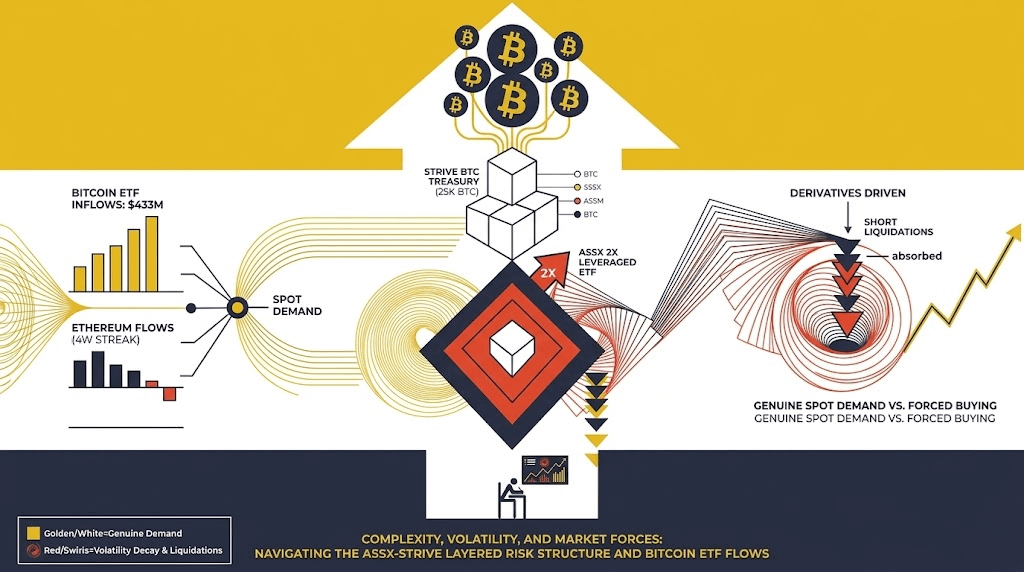
And it arrives in the exact week when Bitcoin ETFs pulled in $433 million in net inflows on Friday alone, while Ethereum funds ended a four-week streak of consecutive net inflows — and Bitcoin's strongest rally in two years was, according to on-chain data, driven almost entirely by short liquidations.
Four pieces. One picture. And one fair question for every trader: Is this flow structure being built with concrete — or with inflatable air?
FACT BREAKDOWN & TIMELINE
Friday, September 19, 2026 — 19:14 UTC. Cointelegraph reported that REX and Tuttle officially launched ASSX on Cboe. The product structure is straightforward — and also brutally unforgiving:
Target: 200% of Strive's daily stock-price performance, before fees and expenses.
Daily leverage reset. This is the detail that 90% of leveraged ETF buyers don't read carefully enough: returns over periods longer than one trading session can deviate significantly from a simple 2x return. Volatility decay eats into the account during sideways or choppy markets.
It does not hold Bitcoin. ASSX does not track BTC's price. It tracks Strive stock. All Bitcoin exposure is indirect, through the balance sheet of a publicly traded company.
This is the critical difference versus a spot Bitcoin ETF. An ASSX investor is accepting three stacked layers of risk: Bitcoin price risk → Bitcoin treasury company stock risk (which can trade at a premium/discount to BTC NAV) → 2x leveraged structure with a daily reset.
REX and Tuttle's product lineup does not stop here. The pair already offers 2x ETFs tied to Strategy, BitMine, Cipher Mining, Circle, and SharpLink. In other words, they are building a full-spectrum leveraged product suite covering the entire "crypto-adjacent equity" ecosystem — from Bitcoin treasuries, to miners, to stablecoin issuers, to infrastructure.
On Strive's side: the company currently holds 25,000 BTC, ranking fifth among publicly traded companies holding Bitcoin, according to BitcoinTreasuries.NET. Its latest purchase of 469 BTC was financed through the issuance of SATA — the company's perpetual preferred stock.
This is a detail worth pausing on. Strive did not use free cash flow or convertible debt to buy BTC. It used preferred equity — a hybrid instrument sitting somewhere between debt and common equity, paying a fixed dividend with no maturity date. Structurally, this is a way to buy Bitcoin with "capital that never has to repay principal," but it comes with a permanent cost of capital. If BTC rises fast enough, this can be extremely cheap leverage. If BTC moves sideways or falls, the preferred dividend becomes a cash-flow burden.
Same-day ETF flow context — 18:01 UTC. The Block reported that Bitcoin ETFs pulled in $433 million in net inflows on Friday alone, enough for the entire week to close slightly positive. But the pivot point was on the other side: Ethereum funds ended a four-week streak of consecutive net inflows. This creates a flow divergence between the two largest crypto assets — capital is concentrating in Bitcoin and moving away from Ethereum.
Price-structure context — 16:01 UTC. Decrypt published a striking analysis: Bitcoin's strongest rally in two years ran almost entirely on short liquidations. Not fresh spot buying. Not sustained institutional inflows. But a short squeeze — the mechanism where rising prices force shorts to close positions, and those closures push prices even higher, creating a self-reinforcing loop.
This is a rally with a very specific technical signature: fast, steep, but lacking a solid foundation of genuine spot demand. Once forced buying dries up, the structure often struggles to hold.
Sentiment context — 12:13 UTC. CoinDesk reported that Michael Saylor responded to a venture capitalist who had written a "Bitcoin obituary", with a short answer: "The orange tie stays." The symbolic message is clear: institutional maximalists are not backing down, despite repeated cycles of skepticism.
MULTI-DIMENSIONAL ANALYSIS: WHY THIS PRODUCT EXISTS, AND WHAT IT SAYS ABOUT THIS CYCLE
Layer 1 — The Maturation of the "Bitcoin Treasury Company" as a Distinct Asset Class
The most interesting part of this story is not ASSX itself. It is the fact that ASSX can exist as a logical consequence of the market's evolution.
For a 2x leveraged ETF on Strive stock to exist, the market must already have accepted that "Bitcoin treasury companies" are a large enough, liquid enough, closely watched enough asset class to generate demand for derivatives.
REX and Tuttle are not doing charity. They launch products when there is demand for leverage. And that demand exists because a group of investors wants higher beta than the beta of the treasury company stock itself — which is already higher beta than Bitcoin.
The current layered structure:
Bitcoin spot — the underlying asset, already highly volatile.
Bitcoin treasury company stock (Strive, Strategy, BitMine...) — often trading at a premium to BTC NAV, plus operational, governance, and capital-cost risks.
2x leveraged ETF on that stock (ASSX) — doubling the daily volatility of Layer 2.
Each layer adds its own structural risk, not just price risk. This is what retail investors often overlook when they see the attractive "2x" headline.
Layer 2 — Strive's Cost of Capital and the Preferred Stock Equation
Strive financing its 469 BTC purchase through the issuance of SATA perpetual preferred stock is a capital-structure decision worth analyzing.
Perpetual preferred stock has several defining characteristics: no maturity, fixed dividends, senior to common equity in the capital stack but junior to debt. For a company whose primary asset is Bitcoin, this instrument allows it to buy BTC without creating scheduled principal repayment pressure.
The trade-off is permanent cost of capital. If Strive issues preferred shares with a dividend, the company must generate sufficient cash flow or grow BTC NAV quickly enough to support that obligation. In a high-interest-rate environment or a sideways Bitcoin market, this creates a double burden: the company has to pay the dividend while receiving no capital appreciation from BTC.
This is a model increasingly used by treasury companies — and it transforms them into structurally leveraged Bitcoin investment vehicles, rather than simply operating companies.
Layer 3 — Bitcoin vs. Ethereum ETF Flow Divergence
The figure of $433 million in net Bitcoin ETF inflows on Friday alone, combined with Ethereum funds ending their four-week inflow streak, paints a fairly clear picture: institutional flows are concentrating in Bitcoin rather than being distributed evenly.
There is a deeper structural implication here. In previous cycles, ETF flows often spread outward — Bitcoin led, with Ethereum following on a lag. Ethereum losing its inflow momentum while Bitcoin continues attracting substantial capital suggests that institutional investors are currently distinguishing more clearly between "digital gold" and the "smart-contract platform" thesis.
For traders, this represents internal crypto rotation: capital is not necessarily leaving the market, but it is being reallocated toward Bitcoin.
Layer 4 — The Nature of the Rally: Short Squeeze or Genuine Demand?
Decrypt's analysis is perhaps the most important piece when it comes to the quality of the rally.
A rally driven almost entirely by short liquidations has several technical characteristics:
High speed and steep momentum — because short squeezes create positive feedback.
A lack of durable spot demand — because the primary buying comes from forced position closures, not investors buying to hold.
Higher reversal risk once forced buying runs out — once there are fewer shorts left to liquidate, the upward catalyst disappears.
Combined with strong Bitcoin ETF inflows, the picture becomes more complicated: there is real institutional capital entering through ETFs, but the short-term price momentum is being amplified by derivatives positioning.
This is the environment traders might describe as "a rally with a skeleton but no muscle" — there is an underlying flow foundation, but short-term upside can be exaggerated by leverage structures.
Layer 5 — Institutional Sentiment: Saylor and "The Orange Tie"
Saylor's response to the "Bitcoin obituary" is a signal of institutional conviction remaining publicly intact.
In previous cycles, negative media pressure often caused some institutions to reduce exposure. The fact that institutional maximalists are publicly maintaining their position suggests that the belief structure among long-term holders remains intact.
This matters because it affects circulating supply. When large institutions do not sell, the effective market float can become tighter, making price action more sensitive to marginal flows.
TRADING ANGLE
1. Who Is ASSX For — and Who Is It Not For?
ASSX is not a long-term holding product. Its daily leverage reset makes it primarily suited to intraday trading or short multi-session trades, where a trader has a clear directional view on Strive stock over a short horizon.
In a sideways or choppy market, volatility decay can erode ASSX's value even if Strive ultimately ends the period at roughly the same price. That is the mathematics of leveraged ETFs, not an opinion.
2. Price Levels to Watch on Strive
$30.09 — Friday's closing price, which moved slightly above the $29.40 average analyst target.
Trading above the average target creates a psychological resistance zone: some analysts may raise targets, while investors following "sell at target" models may also create profit-taking pressure.
$29.40 becomes a psychological support level if the stock pulls back — a level where the market can test whether genuine demand exists.
3. ASSX ↔ Bitcoin ↔ Treasury Stock Correlation
Because ASSX tracks Strive, and Strive gains Bitcoin exposure through its balance sheet, ASSX effectively represents a third-order beta on Bitcoin.
That means:
If Bitcoin rises 2%, Strive could rise 3–5% depending on its premium/discount, while ASSX could rise 6–10%.
If Bitcoin falls 2%, the decline can be amplified similarly in the opposite direction.
During a liquidation cascade, correlations can move toward 1 — everything gets sold simultaneously, and leverage gets wiped out faster than expected.
4. Liquidation Levels and Derivatives Structure to Watch
With the latest rally driven by short liquidations, traders should monitor:
Bitcoin futures funding rates — if funding turns sharply positive, it means longs are paying to maintain positions, signaling crowded longs and increased long-squeeze risk.
Open interest — if OI rises alongside price, that suggests new capital entering. If OI falls while price rises, that is more consistent with short position closures, not fresh buying.
Areas where shorts are concentrated — after a major squeeze, the next short-liquidation zones are typically higher, but thinner, meaning the rally increasingly needs real spot demand to continue.
5. ETF Flows — The Most Durable Signal of the Week
The $433 million Friday net inflow is a higher-quality signal because ETFs represent spot exposure, without leverage or forced liquidation. This is genuine demand from institutions and retail investors through regulated channels.
The divergence with Ethereum — ending a four-week inflow streak — reinforces the argument for rotation toward Bitcoin. Traders should monitor the BTC ETF flow / ETH ETF flow ratio as a capital-allocation indicator.
6. Forward Scenarios
Bull scenario: Bitcoin ETF flows remain positive, funding rates stay neutral, and Strive holds above $29.40 → ASSX could attract speculative flows, creating a liquidity feedback loop between the treasury stock and its derivatives products.
Base scenario: Bitcoin trades sideways and Strive fluctuates around $29–31 → volatility decay erodes ASSX, flows gradually leave, and the product becomes primarily a tool for day traders.
Bear scenario: Bitcoin corrects after the short-squeeze rally and ETF inflows slow → Strive falls, ASSX falls roughly twice as much on a daily-target basis, and if a liquidation cascade develops, ASSX liquidity could thin quickly because leveraged ETFs typically have smaller AUM than conventional ETFs.
7. What Traders Need to Remember About the New Product
Newly listed leveraged ETFs can experience wider spreads during their first few weeks as liquidity develops. These hidden trading costs can sometimes matter more than the headline management fee.
With ASSX, traders should check the bid-ask spread before entering a position, especially during high-volatility sessions.
SHORT CONCLUSION
ASSX is not an investment product. It is a trading instrument — and like every leveraged instrument, it amplifies both the right call and the wrong one.
Its launch says something important about this cycle: the market has matured enough to create derivatives demand around Bitcoin treasury-company stocks, but it is also speculative enough to produce products whose daily-reset mechanics many buyers may not fully understand.
At the same time, Bitcoin ETF flows remain positive, Ethereum has lost momentum, and the latest rally was built heavily on short liquidations.
Put those three signals together and the message is straightforward: real demand is present, but short-term upside is being amplified by leverage structures.
A disciplined trader does not argue with flows. But they distinguish between spot flows and forced flows.
And they always know which layer of the leverage structure they are standing on.
REFERENCES
Cointelegraph: REX launches 2x leveraged ETF tied to Bitcoin treasury firm Strive
The Block: Bitcoin ETFs eke out positive week with $433 million Friday inflow as ether funds snap four-week inflow streak
Decrypt: Bitcoin's Sharpest Rally in Two Years Ran Almost Entirely on Short Liquidations
CoinDesk: "The orange tie stays": Michael Saylor responds to venture capitalist's Bitcoin obituary
💡 Disclaimer: This article compiles financial-media data and open-source market intelligence for independent research purposes (DYOR). Crypto markets are highly volatile; the analysis and market views presented here do not constitute investment advice or a recommendation to trade any financial asset.
#CryptoNews #BinanceSquare #MarketUpdate #Bitcoin #ETF