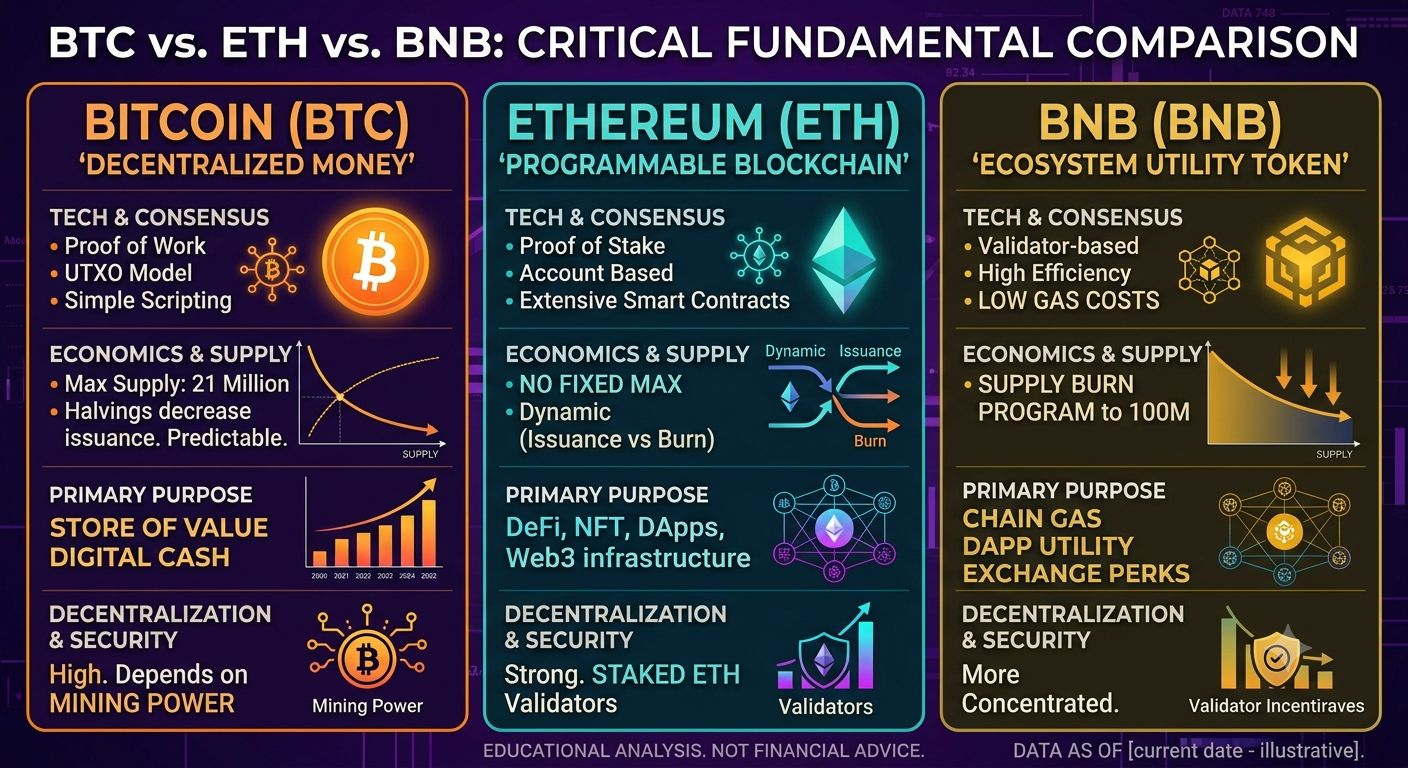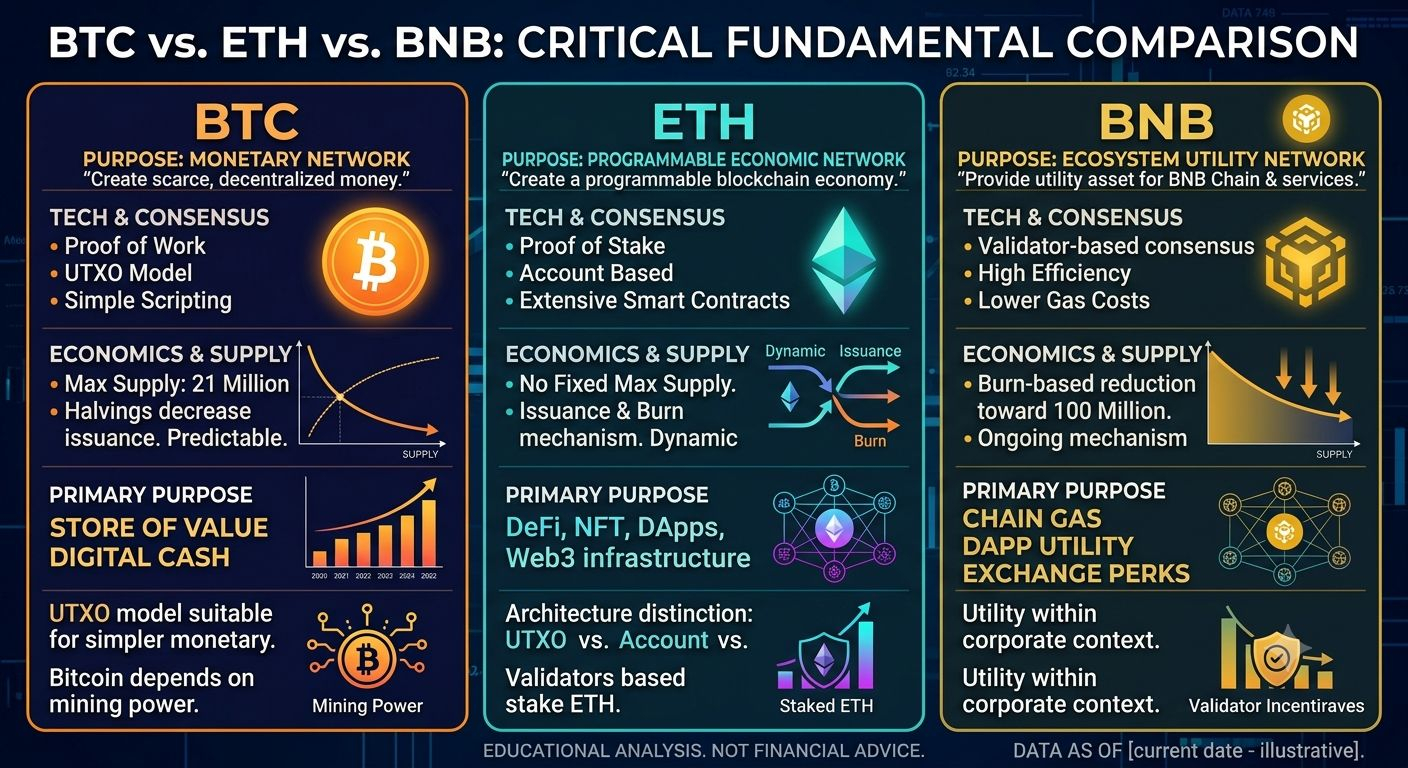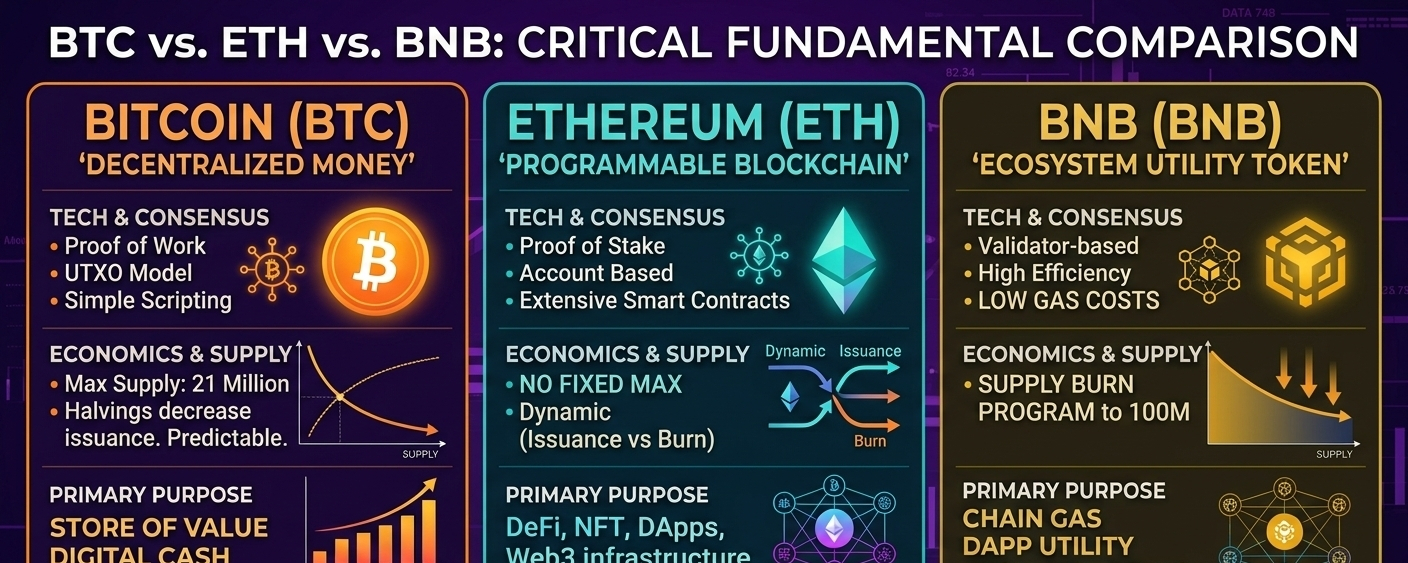

Below is a fundamental and critical comparison of $BTC , $ETH , and $BNB . I am focusing on technology, economics, utility, decentralization, security, supply, ecosystem, and major risks. This is educational analysis, not a recommendation to buy or sell.
1. @Bitcoin, BTC
Bitcoin is primarily designed as decentralized digital money and a scarce digital asset. Its protocol deliberately keeps its functionality relatively simple. Bitcoin uses Proof of Work, where miners compete to secure the network.
Core characteristics:
Purpose: Decentralized peer to peer money and a scarce digital asset.
Consensus: Proof of Work.
Maximum supply: 21 million @BTC. New issuance decreases approximately every four years through the halving mechanism. The current block subsidy is 3.125 BTC following the 2024 halving.
Transaction model: UTXO, or Unspent Transaction Output.
Smart contracts: Bitcoin has scripting capabilities, but programmability is deliberately more limited than Ethereum.
Security model: Bitcoin relies on computational work and the economic cost of controlling sufficient mining power.
Major strength: Its monetary policy is extremely predictable. Nobody can simply vote to increase the maximum supply above 21 million under the existing protocol rules.
Major limitation: The base Bitcoin network prioritizes security and decentralization over high transaction throughput and complex application functionality.
Critical point: Bitcoin's investment thesis depends heavily on scarcity, monetary credibility, network security, adoption, and demand. It does not need a huge DeFi ecosystem to fulfil its primary purpose.

2. Ethereum, @ETH
Ethereum is fundamentally different from Bitcoin. Ethereum is designed as a programmable blockchain where developers can build smart contracts and decentralized applications. ETH is the native asset used within this ecosystem.
Core characteristics:
Purpose: Programmable blockchain infrastructure.
Consensus: Proof of Stake.
Supply: ETH does not have Bitcoin's fixed 21 million maximum. New ETH is issued to validators, while part of transaction fees is burned. Therefore, the relationship between issuance, network activity, and burn determines ETH's supply dynamics.
Smart contracts: A central feature.
Major applications: DeFi, stablecoins, tokenization, NFTs, decentralized applications, and other blockchain-based systems.
Security model: Validators stake ETH. Dishonest behavior can result in loss of staked ETH, known as slashing. Ethereum's consensus mechanism can reach economic finality through validator agreement.
Major strength: Ethereum has a much broader computational purpose than Bitcoin.
Major limitation: Greater programmability creates greater complexity. Smart contracts can contain bugs, applications can fail, and the broader ecosystem creates additional technical and economic risks.
Critical point: ETH is simultaneously a cryptocurrency and the economic asset powering a programmable blockchain economy. Its value proposition therefore depends heavily on actual usage of Ethereum and its surrounding ecosystem.

3. BNB
BNB is the native asset associated with the BNB Chain ecosystem. It has several functions, including paying transaction fees, interacting with decentralized applications, staking, and participating in various BNB Chain services.
Core characteristics:
Purpose: Network utility token and ecosystem asset.
Blockchain: BNB Chain, including BNB Smart Chain and related infrastructure.
Consensus: BNB Smart Chain uses a validator-based consensus architecture rather than Bitcoin's Proof of Work.
Utility: BNB can be used for transaction fees, staking, DeFi applications, and other ecosystem functions.
Supply mechanism: BNB has an ongoing burn mechanism. BNB Chain states that its Auto-Burn system targets a reduction toward 100 million BNB. Gas-fee burning also removes some BNB from circulation.
Major strength: BNB has extensive utility inside its own ecosystem and is closely connected to one of the largest crypto infrastructure ecosystems.
Major limitation: Its ecosystem has greater dependence on a particular corporate and organizational environment than Bitcoin's permissionless monetary architecture.
Critical point: BNB should not be analysed simply as "another cryptocurrency." A large part of its economic value comes from its utility within the BNB Chain ecosystem and the wider Binance-related ecosystem.

4. The fundamental difference
Think about their underlying designs this way:
BTC: "Create scarce, decentralized digital money."
ETH: "Create a programmable blockchain economy."
BNB: "Provide an ecosystem utility asset for BNB Chain and related services."
This distinction is extremely important.
Comparing BTC, ETH, and BNB solely by price can hide the fact that they represent three different technological and economic models.
5. Technology comparison
Bitcoin:
Architecture: UTXO.
Consensus: Proof of Work.
Programmability: Limited compared with Ethereum.
Primary design priority: Security, decentralization, predictable monetary policy.
Ethereum:
Architecture: Account based.
Consensus: Proof of Stake.
Programmability: Extensive smart-contract functionality.
Primary design priority: Programmability, decentralized applications, economic infrastructure.
BNB:
Architecture: Smart-contract capable account-based ecosystem.
Consensus: Validator-based.
Programmability: Extensive.
Primary design priority: High utility, ecosystem activity, applications, and transaction efficiency.
Ethereum's account model is particularly suited to smart contracts, while Bitcoin's UTXO model contributes to its simpler monetary architecture.
6. Supply economics
BTC has the clearest supply policy.
Maximum supply: 21 million.
Issuance: Predictably decreases through halvings.
This creates a highly transparent monetary schedule.
ETH is different.
There is no fixed maximum supply equivalent to Bitcoin's 21 million limit. ETH is issued to validators and burned through the fee mechanism. Network activity therefore affects the balance between issuance and burn.
BNB uses another model.
BNB Chain has an explicit burn program intended to reduce supply toward 100 million BNB.
So:
BTC: Fixed maximum supply.
ETH: Dynamic issuance plus burning.
BNB: Burn-based supply reduction with a stated target.
7. Decentralization
This is one of the most important differences.
Bitcoin's architecture strongly emphasizes permissionless participation, predictable rules, and independent nodes. Its Proof of Work system distributes block production through mining competition.
Ethereum also operates as a decentralized permissionless network, but its security depends on validators staking ETH. Ethereum also emphasizes client diversity and distributed participation.
BNB Chain uses a more concentrated validator structure. This can support efficiency and lower transaction costs, but it creates a different decentralization tradeoff.
This is a classic blockchain design tension:
More decentralization can make coordination and scaling harder.
More concentration can make coordination and efficiency easier, while increasing dependence on a smaller validator or organizational structure.
The BIS also identifies decentralization, security, and scalability as interconnected tradeoffs across blockchain consensus designs.
8. Transaction fees
Bitcoin fees are strongly influenced by demand for limited block space. Bitcoin transaction fees are based on transaction size and prevailing demand for block space.
Ethereum uses a base fee plus priority fee structure. The base fee is burned, while the priority fee goes to the validator.
BNB Smart Chain generally operates with lower gas costs than Ethereum mainnet, although actual costs depend on network conditions.
This produces an important distinction:
BTC: Designed primarily around secure settlement and monetary transactions.
ETH: Designed around programmable transactions.
BNB: Designed around relatively inexpensive ecosystem transactions.
9. Ecosystem
BTC has an ecosystem built around:
Store of value Payments Settlement Custody Bitcoin-based financial products Layer 2 systems such as Lightning
Ethereum has a much broader application ecosystem:
DeFi Stablecoins NFTs Tokenization DAOs Web3 applications Layer 2 networks
Ethereum's broader programmability is explicitly one of the major differences between it and Bitcoin.
BNB Chain has an ecosystem around:
DeFi DEXs Payments Staking Gaming Tokenized assets Other decentralized applications
BNB itself is required for transaction fees on BNB Chain.
10. The major risk of each
BTC risk:
The main question is whether demand for Bitcoin as decentralized money and a scarce digital asset continues to justify its market valuation.
Its technology is comparatively conservative, which reduces some forms of complexity but also limits what the base layer is designed to do.
ETH risk:
Ethereum's strength is also a source of risk.
Smart contracts create enormous functionality, but they introduce complexity. The ecosystem depends on developers, applications, scaling infrastructure, liquidity, and continued technological development.
ETH therefore has more moving parts than BTC.
BNB risk:
BNB's major structural consideration is ecosystem and organizational dependence.
Its utility is deeply connected with BNB Chain and the broader Binance ecosystem. That creates a different risk profile from Bitcoin's more independent monetary architecture.
11. Security comparison
BTC: Security is based primarily on Proof of Work and mining economics.
ETH: Security is based on staked ETH and validator economics.
BNB: Security depends on its validator-based consensus and the economic incentives governing those validators.
There is no universal "best" security architecture. Each makes different tradeoffs between decentralization, capital requirements, energy consumption, throughput, governance, and complexity.
12. What gives each coin its value?
BTC:
Scarcity Network security Brand and recognition Decentralization Liquidity Demand for a non-sovereign digital asset
ETH:
Ethereum network usage Smart-contract activity DeFi Stablecoins Tokenization Staking Developer ecosystem Demand for ETH to pay network costs
BNB:
BNB Chain activity Transaction fees DeFi usage Staking Ecosystem applications BNB-related services Burn mechanisms
This is perhaps the most important analytical distinction.
BTC derives much of its thesis from monetary properties.
ETH derives much of its thesis from blockchain economic activity.
BNB derives much of its thesis from ecosystem utility and network activity.
13. Critical comparison
Instead of declaring one "best," consider what each network is optimized to do.
Decentralized monetary asset: BTC is specifically designed around this objective.
Programmable blockchain: ETH is specifically designed around this objective.
Low-cost ecosystem utility: BNB is specifically designed around this objective.
Fixed monetary supply: BTC has the clearest fixed maximum.
Smart-contract capability: ETH is central to this design.
BNB Chain utility: BNB is central to this design.
Proof of Work: BTC.
Proof of Stake: ETH.
Validator-based BNB Chain architecture: BNB.
Maximum supply: BTC, 21 million.
Dynamic supply: ETH.
Burn-based supply reduction: BNB.
Energy intensity: BTC's Proof of Work requires substantially more energy than Proof of Stake systems. Ethereum states that its move to Proof of Stake substantially reduced energy requirements.
14. The most important conceptual distinction
If you study these three deeply, I would separate them into three categories:
BTC = monetary network
ETH = programmable economic network
BNB = ecosystem utility network
That framework is more useful than simply saying "BTC is bigger, ETH is second, BNB is third."
Their underlying economic models are different.
15. One important caution about comparing prices
A coin's price by itself tells you very little.
For example, a token priced at $1 is not automatically cheaper than a token priced at $100,000.
You need to examine:
Market capitalization Circulating supply Fully diluted valuation Token issuance Token burns Network revenue Active users Transaction activity Developer activity Liquidity Security Decentralization Actual utility
For serious crypto analysis, market capitalization and network economics matter much more than the nominal price of one coin.
16. My analytical framework for studying them
If you want to understand BTC, ETH, and BNB properly, I would examine them in this order:
1. What problem does the network solve?
2. How does the blockchain reach consensus?
3. Who controls validation?
4. How decentralized is it?
5. What creates demand for the native token?
6. How is the token supplied?
7. How is the token destroyed or burned?
8. How much real network activity exists?
9. How much economic value flows through the network?
10. What happens if the ecosystem loses users?
11. What are the major regulatory and technical risks?
12. Does the token actually need to exist for the network to function?
That last question is especially important when analysing smaller cryptocurrencies. A project can have impressive technology while its token has weak economic necessity.
For BTC, ETH, and BNB, the native tokens have substantially different relationships with their respective networks. BTC is the monetary asset of Bitcoin. ETH is deeply integrated into Ethereum's execution and security economics. BNB functions as the utility asset of BNB Chain and related ecosystem services.
If you want to go one level deeper, the next useful analysis would be a #BTC vs ETH vs BNB comparison based on actual metrics such as market cap, circulating supply, transaction volume, fees, active addresses, TVL, staking, token burns, and historical volatility. That would show how the three economic models perform in practice rather than only comparing their technology.
#BTC #ETH #BNB #TrendingTopic #Binance