

Hyperliquid has quickly developed a powerful on-chain swap and trading infrastructure. It has the potential to evolve into a transformative decentralized financial ecosystem. However, to accomplish this, it needs to move beyond providing just perpetual futures and swap contracts. It needs the technology to quickly process spot transactions, house sophisticated market maker operations, issue tokens, and support derivative instruments, while still connecting to HyperCore.
Kinetiq’s Elysium offers a solution for this.
Currently, Hyperliquid does not have the capability to quickly process spot transactions. Combined with other HyperEVM limitations, such as poor transaction throughput, high fees, and the complexity created by its dual-block structure, HyperEVM swaps can cost up to $20. From HyperEVM’s perspective, these swaps are not economically viable at these prices. For DeFi users, these transaction fees are excessive. For professional traders who use high frequency trading and market making strategies, this creates a significant obstacle for them to achieve best execution.
Elysium is positioned to provide an execution environment specifically for these high frequency trading strategies and improve execution. It is designed for applications that require high speed and low latency, as well as access to localized market data feeds.
One of the choices Elysium made is to use HYPE as gas rather than introduce a new gas token. The connected ecosystem will make it easier for traders and builders to navigate and reduce the trade friction. Using HYPE also keeps Elysium economically connected to the wider Hyperliquid ecosystem rather than creating another separate gas asset.
Elysium has not been able to fully validate these speed and latency improvements in a production environment. Improvements in design and architecture do little to address the key remaining question of performance.
From Token Launch to Perpetuals
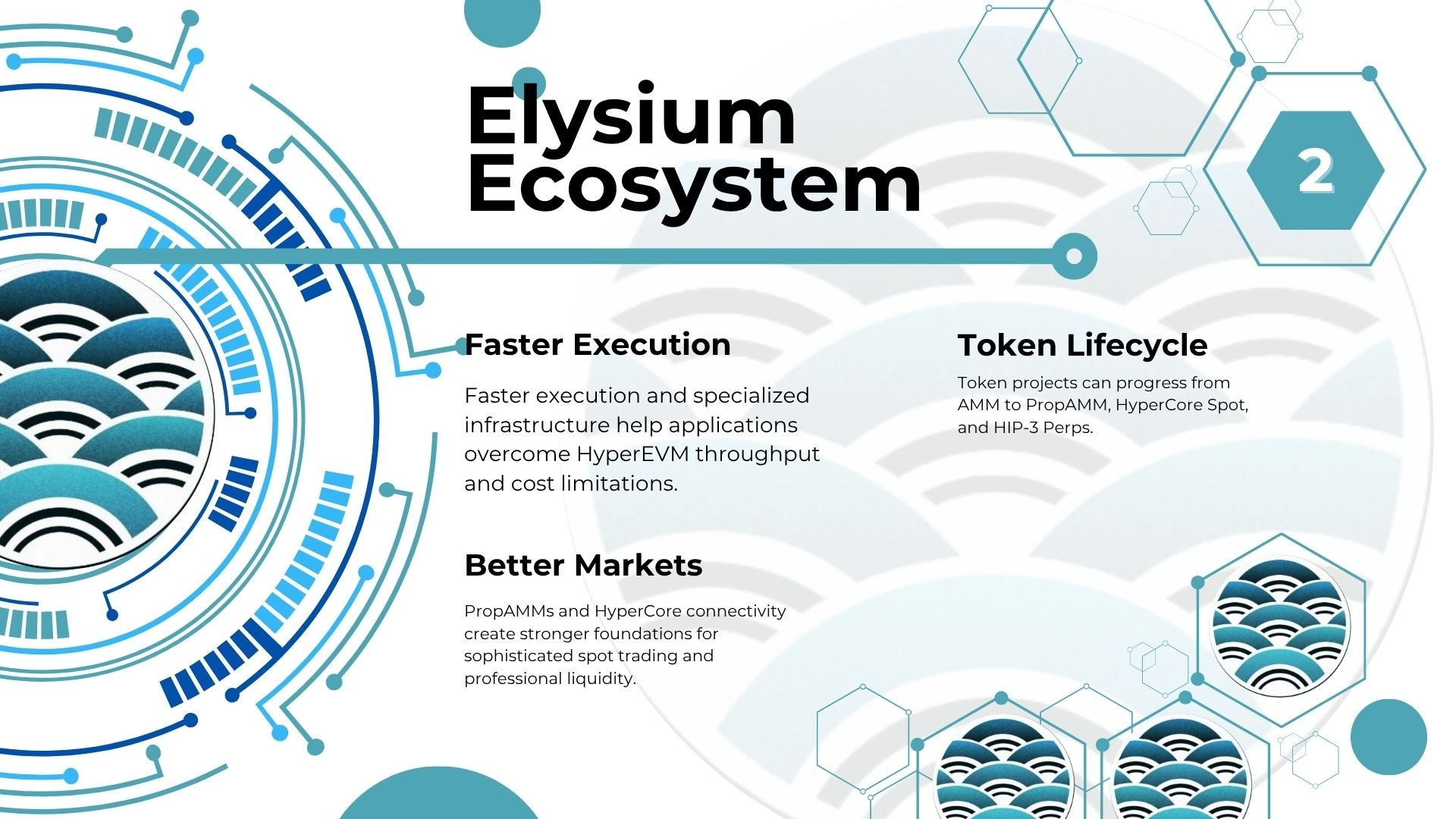
The Elysium team has also proposed an interesting token lifecycle, which includes AMM → PropAMM → HyperCore Spot Market → HIP-3 Perpetuals.
This token lifecycle gives projects the ability to launch a token through an AMM, gain professional liquidity through a PropAMM, and eventually gain access to Spot and Perpetual Markets.
For builders, this creates a pathway for taking a token from initial liquidity through more sophisticated market infrastructure. For traders, the combination of PropAMMs, spot markets, and perpetual markets is intended to create a more complete trading environment.
Value-Add Difference
Elysium’s most interesting element may be its Sequencer-Fee model.
Through this model, 25% of the fees go to builders, 25% to the Kinetiq treasury, and 50% is used to buy and burn KNTQ.
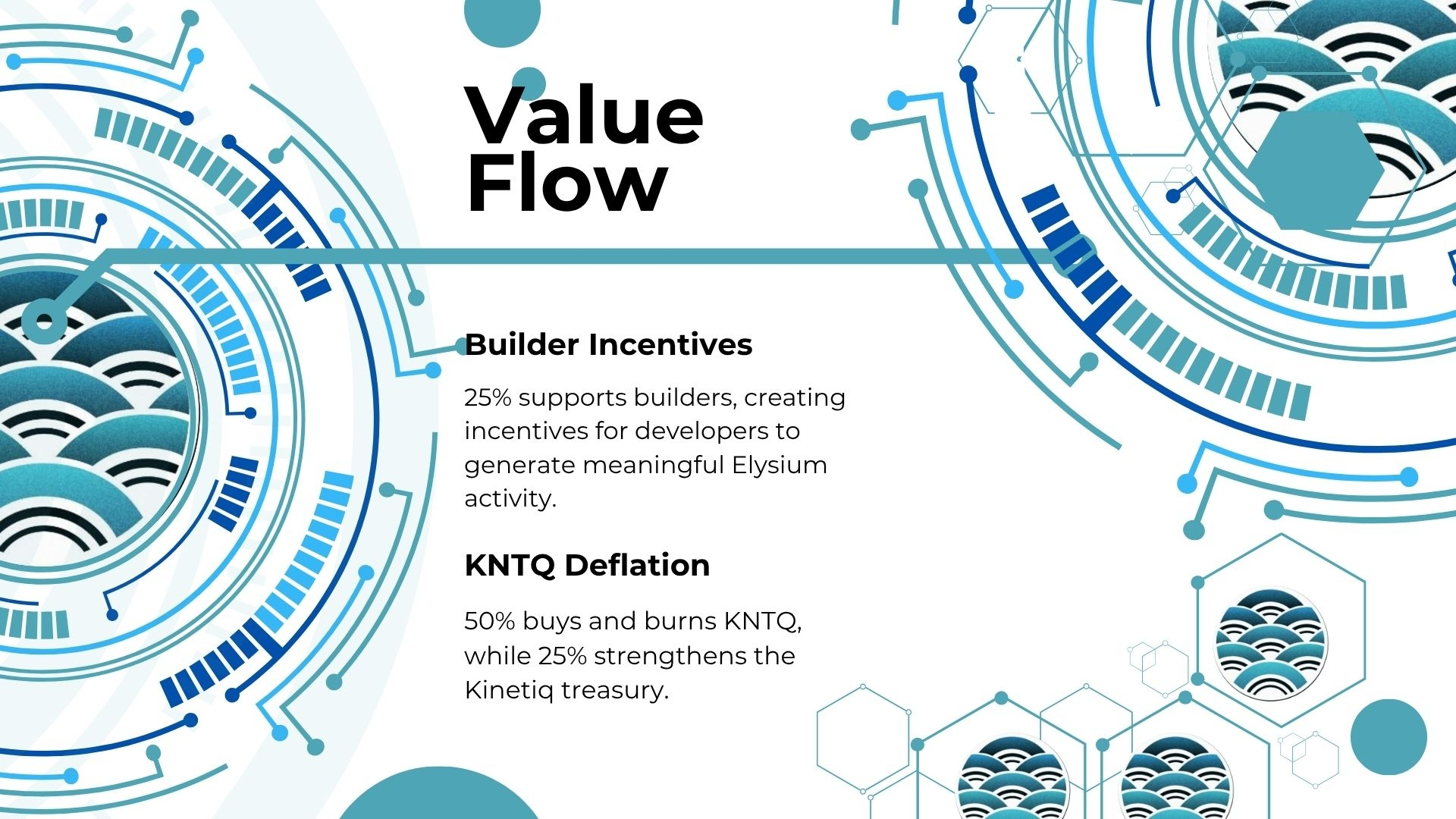
This creates a different value flow from traditional Layer 2 models where network activity and sequencing can primarily accrue value to the L2 itself. Elysium instead attempts to create a more direct alignment between ecosystem activity, builders, the Kinetiq treasury, and KNTQ.
Builders have an economic interest in the long-term success of the Elysium ecosystem, while the Kinetiq treasury also benefits from network activity. At the same time, 50% of sequencer fees being used to buy and burn KNTQ creates a mechanism through which increased activity can reduce the available KNTQ supply.
This is the crux of the value-accretion thesis.
Elysium's success will positively impact Hyperliquid and Kinetiq as well. HYPE will remain the gas asset. Elysium's activities will deplete the KNTQ supply and increase revenue. HyperCore, on the other hand, will remain part of Elysium’s trading infrastructure.
For KNTQ holders, the important part of the model is the relationship between network activity and the token supply. If Elysium generates more sequencer fees, 50% of those fees are directed toward KNTQ buy-and-burn activity. This does not automatically mean an increase in token value, but it does create a mechanism for network activity to have a deflationary effect on KNTQ supply.
Ultimately, the success of Elysium will depend on its ability to attract builders. How active the network is will dictate how much revenue is generated and how much KNTQ will be burned.
My Take
Elysium isn’t just another L2.
The team has taken a crack at consolidating executional and liquidity layers with ecosystems to launch tokens and integrate $HYPE r Core and token economics.
Other features of the ecosystem include a proprietary AMM that supports the creation of other tokens, and the ability to provide on-ramp/off-ramp liquidity for tokens, as well as spot and/or perpetual tokens.
Elysium will have a sequencer-fee model to reward builders and generate value for the treasury and burn KNTQ.
Although a lot of things are in place for Elysium, proof of concept and product-market fit will come from builders and developers creating products on the platform and from real world trading and liquidity activity on the network.
If the product does gain traction, and activities on HyperEVM increase, Elysium will help integrate and connect the activities on Hyperliquid and kinetiq
Source
Kinetiq official website:
https://kinetiq.xyz/
Kinetiq documentation:
https://kinetiq.xyz/docs
Kinetiq official X:
https://x.com/Kinetiq_xyz
Official Elysium announcement:
https://x.com/Kinetiq_xyz/status/2091888509472932145
Hyperliquid documentation:
https://hyperliquid.gitbook.io/hyperliquid-docs
Hyperliquid official website:
https://hyperliquid.xyz/