


For years, crypto traders have been trained to fear two words:
Rate hike.
Higher interest rates usually make life harder for risk assets. Money becomes more expensive, government bonds become more attractive, and speculative markets can lose liquidity.
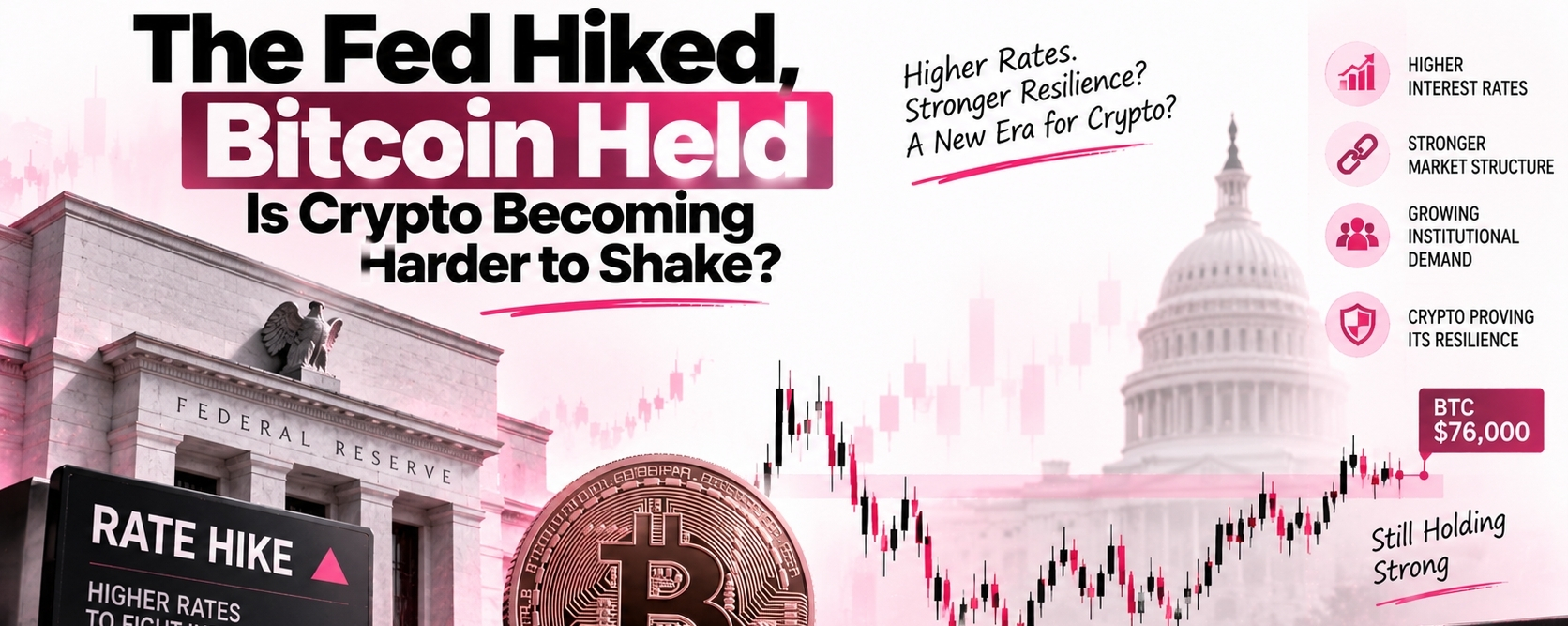
So when the Federal Reserve raised rates by 25 basis points on September 16, taking its target range to 3.75%–4.00%, another sharp Bitcoin sell-off would not have been surprising. It was the Fed's first increase since 2023.
But Bitcoin didn't collapse.
Instead, BTC absorbed the announcement and remained around $76,000 the following day.
That raises an interesting question.
Is crypto becoming harder to shake?
Bitcoin Knew the Hike Was Coming
The first explanation is probably the simplest.
The rate increase wasn't a major surprise.
Before the decision, markets had already assigned a very high probability to a 25-basis-point hike. In other words, traders had days to adjust their positions before the Fed actually announced anything.
Markets don't simply react to good or bad news.
They react to surprises.
If everyone expects bad news and prepares for it beforehand, the actual announcement can sometimes produce a surprisingly small reaction.
That appears to be part of what happened with Bitcoin.
The Fed hiked.
BTC moved around.
But there was no immediate macro-driven collapse.
Bitcoin Had Already Been Tested
The Fed wasn't Bitcoin's first problem this month.
BTC had already fallen roughly 4% after the U.S. Senate failed to advance major crypto legislation earlier in the week.
Before that, traders were dealing with persistent inflation, high Treasury yields and expectations that tighter monetary policy was returning.
Bitcoin had also experienced a much larger decline before September.
After trading above $126,000 in October 2025, BTC fell toward $60,000 in late August 2026 before recovering above $70,000.
That context matters.
The market entering the Fed meeting was very different from one sitting at fresh highs with extreme optimism.
A lot of fear and selling had already happened.
Buyers Are Still Showing Up
Another important change is the structure of Bitcoin demand.
Bitcoin is no longer driven only by crypto-native traders.
Spot ETFs have created another channel through which traditional investors can gain exposure to BTC.
That doesn't guarantee permanent buying. ETF flows can move in both directions.
In fact, U.S. Bitcoin ETFs recorded about $450 million of net outflows on September 15 as BTC weakened around the failed crypto legislation vote.
But zoom out slightly and the picture becomes more complicated.
Reuters reported that Bitcoin ETFs attracted nearly $2 billion during the week of August 17 after eight consecutive weeks of outflows during May and June.
That tells us demand isn't simply disappearing.
It's moving with sentiment.
The Market Is Learning to Separate News From Price
This may be one of the most important developments.
A negative headline does not automatically equal a negative market reaction.
The Fed can hike rates while Bitcoin holds.
Regulatory legislation can suffer a setback while buyers eventually return.
Inflation can remain elevated while individual altcoins still outperform.
Zcash offered an extreme example after the Fed decision. ZEC jumped roughly 23% while Bitcoin gained less than 1%, with SOL, BNB and several other large cryptocurrencies also advancing.
That doesn't mean macro conditions no longer matter.
It means crypto is reacting to multiple forces at once.
Liquidity matters.
Institutional demand matters.
Regulation matters.
Narratives matter.
Positioning matters.
And expectations matter.
But One Fed Meeting Doesn't Prove Bitcoin Is Invincible
This is where traders need to be careful.
Bitcoin surviving one expected rate hike doesn't mean monetary policy has stopped affecting crypto.
The Fed itself says inflation remains elevated. Its latest projections put 2026 PCE inflation at 3.7% and core PCE inflation at 3.4%, both still above its 2% objective.
More importantly, the Fed isn't necessarily finished.
Sixteen of 18 policymakers projected at least one additional rate increase before the end of 2026.
The September hike may have been easy for markets to absorb because it was widely expected.
An unexpected change in inflation or monetary policy could produce a very different reaction.
Watch the Bond Market
There is another market crypto traders shouldn't ignore.
Treasuries.
Higher bond yields increase the return investors can earn from relatively lower-risk assets. That creates competition for capital that might otherwise move into Bitcoin, stocks or other risk assets.
Before the Fed meeting, long-term Treasury yields were approaching 5%, creating another potential obstacle for Bitcoin's recovery.
After the decision, Treasury yields initially rose alongside the dollar before easing somewhat on September 17.
If yields continue climbing, Bitcoin's resilience could face another test.
If yields cool, some of that pressure could ease.
This is why watching BTC alone doesn't tell the entire story.
Stability Could Open the Door for Altcoins
There is another interesting consequence if Bitcoin continues holding.
Capital may start looking elsewhere.
We are already seeing hints of selective rotation.
ZEC's 23% move is one example. Solana, BNB and HYPE also outperformed BTC following the Fed decision.
That doesn't confirm altseason.
But a stable Bitcoin can sometimes create a better environment for altcoins than a Bitcoin that is violently pumping or crashing.
When BTC becomes quieter, traders start searching for movement elsewhere.
That's when individual narratives can suddenly take control.
So Is Crypto Really Becoming Harder to Shake?
Maybe — but we need more evidence.
Bitcoin absorbing an expected Fed hike is a sign of resilience, not proof that BTC has become immune to macro pressure.
The stronger test would be what happens when the market receives something it hasn't already priced in.
A surprise inflation reading.
An unexpected change in Fed policy.
A sharp move in Treasury yields.
A major liquidity shock.
Those events would tell us much more about how durable Bitcoin's current strength really is.
For now, though, September has delivered an interesting message.
The Fed tightened.
The dollar jumped.
Treasury yields reacted.
Bitcoin stayed near $76,000.
Crypto hasn't become impossible to shake.
But shaking it may be getting harder than many traders expected.