
Hong Kong’s regulated stablecoin experiment has just moved beyond simple payments.
On September 18, China Asset Management (Hong Kong), Standard Chartered and OSL completed what they described as a first investment use case in Hong Kong involving a regulated HKD stablecoin — HKDAP — for subscribing to and redeeming units of a digital money market fund.
That sounds like a technical transaction.
But from a crypto-market perspective, it could represent something much bigger:
Stablecoins are gradually moving from being “digital cash” to becoming financial infrastructure.
And whenever the infrastructure layer expands, the market eventually starts looking for the next group of projects that can benefit from increased on-chain activity, liquidity, trading and tokenized finance.
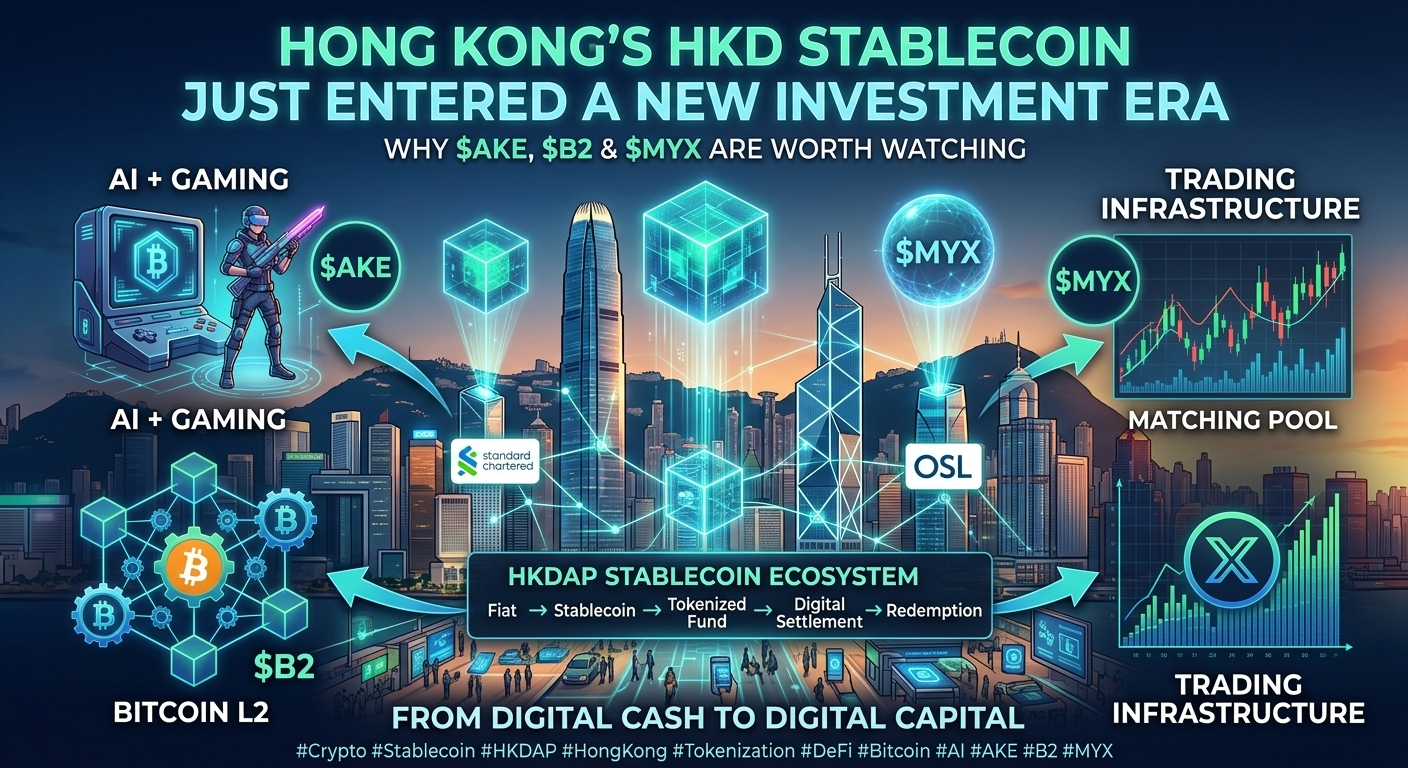
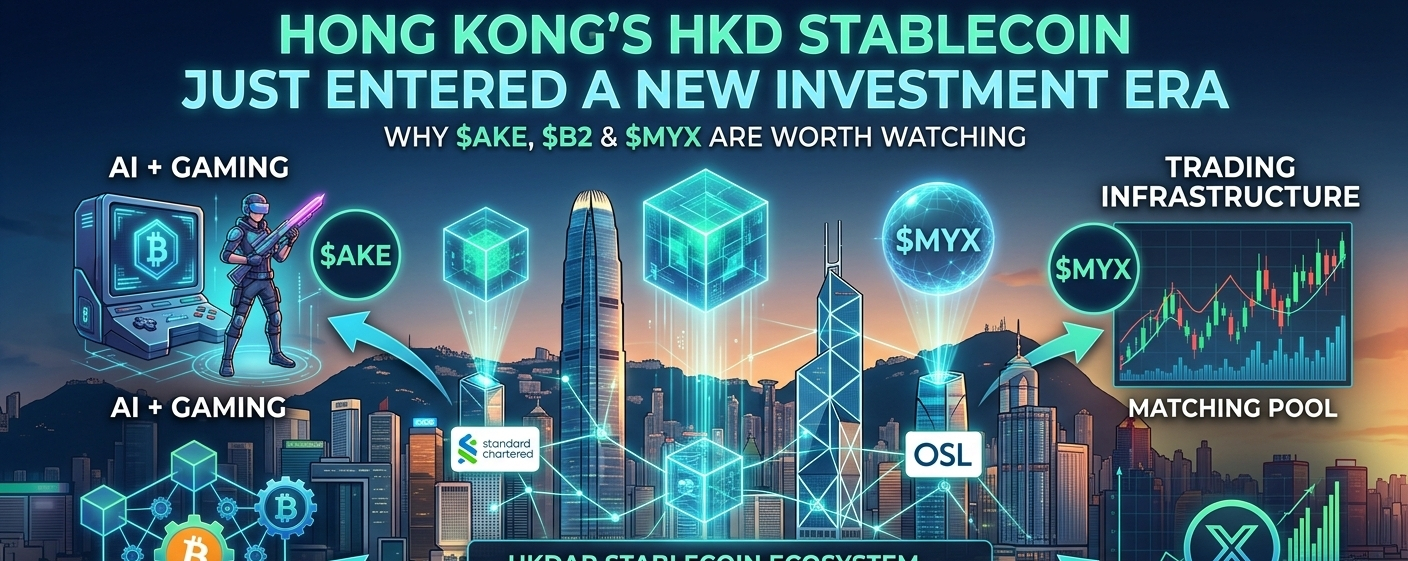
That is where AKE, B2 and MYX become interesting names to keep on the radar — not because HKDAP directly powers these three tokens, but because they sit inside broader narratives around AI/Gaming, Bitcoin infrastructure and decentralized trading.
🇭🇰 HKDAP Just Passed an Important Real-World Test
HKDAP, or HKD At Par, is issued by Anchorpoint Financial, which holds Hong Kong’s stablecoin issuer licence FRS01.
Anchorpoint says HKDAP is designed to maintain a 1:1 peg with the Hong Kong dollar and is backed by reserve assets whose value must at least match the HKDAP in circulation.
The important part is not simply the existence of another stablecoin.
The important part is what institutions are actually doing with it.
In the latest transaction, HKDAP was used through OSL’s licensed digital-asset exchange to subscribe for and redeem units in ChinaAMC Hong Kong’s digital money market fund, with Standard Chartered involved as custodian.
That creates a potentially important bridge:
HKD → Stablecoin → Digital Fund → Redemption
This is very different from the usual crypto narrative of:
Stablecoin → Trading → Speculation
The first model is closer to traditional financial infrastructure moving onto blockchain rails.
And that distinction matters.
🏦 Why Tokenized Finance Could Become the Bigger Story
Hong Kong has been building a regulated digital-asset framework rather than simply allowing everything to grow organically.
The HKMA received 36 stablecoin licence applications and granted the first two licences in April 2026, to Anchorpoint and HSBC.
HKDAP entered institutional beta access in August, initially targeting corporates and professional investors. Anchorpoint says full launch, including retail access, is targeted as early as the end of 2026, subject to readiness.
That means the current phase is still an experiment.
But it is an experiment with real financial institutions.
And that is precisely why investors should watch the number and quality of real-world use cases, rather than simply watching the token price.
HKDAP has already been tested in areas such as payments, trade settlement and now digital fund operations. OSL and Anchorpoint have also announced enterprise B2B settlement applications.
If these experiments continue to expand, the market could gradually move toward a world where:
Stablecoins become settlement infrastructure.
Tokenized funds become financial products.
Blockchain becomes the settlement layer.
And decentralized protocols compete for the liquidity and activity generated by that broader digital-finance ecosystem.
🤖 $AKE — AI + Gaming Meets the On-Chain Economy
The first ticker I would keep on the watchlist is AKE.
AKE is associated with AKEDO, an AI-focused gaming and content-creation ecosystem on BNB Chain. The project positions AI agents as a way for users to create games and digital content more efficiently.
Why does this fit the bigger picture?
Because blockchain adoption does not necessarily come from one sector.
Tokenized finance can bring institutions.
Stablecoins can bring liquidity.
AI can bring users.
Gaming can bring transactions.
And decentralized applications can create recurring on-chain activity.
That does not mean HKDAP adoption automatically creates demand for AKE. There is no direct connection established by the HKDAP transaction.
But from a narrative perspective, AKE sits at the intersection of two major crypto themes:
AI + GameFi
That combination can attract attention during periods when investors rotate from large-cap assets toward higher-risk emerging narratives.
However, this is also where investors need to be careful.
AKE has a large maximum supply relative to its circulating supply, meaning future unlocks and dilution deserve serious attention. Public market commentary has also highlighted the difference between circulating and maximum supply.
So for AKE, the question is not simply:
“Can AI + Gaming pump?”
The more important question is:
Can real ecosystem usage grow faster than token supply and selling pressure?
That is the metric I would watch.
₿ $B2 — Bitcoin Infrastructure Could Become More Important
The second ticker is B2, associated with B² Network.
Unlike a stablecoin or DeFi exchange, the B² narrative is much closer to Bitcoin infrastructure and scaling.
This matters because Bitcoin is increasingly becoming more than just a store-of-value asset.
The broader ecosystem is gradually looking for ways to bring smart contracts, DeFi applications and additional utility around Bitcoin liquidity.
If Bitcoin liquidity becomes increasingly connected with broader on-chain financial applications, infrastructure projects attempting to extend Bitcoin's functionality can become part of the market's infrastructure narrative.
But again, there is an important distinction:
HKDAP is not directly connected to B² Network.
The investment thesis here is thematic rather than causal.
The broader thesis is:
More tokenized assets → more stablecoin settlement → more blockchain activity → greater demand for scalable infrastructure.
Whether B2 captures any meaningful portion of that activity depends on adoption, ecosystem growth, liquidity and token economics.
Binance currently describes B2 as an Alpha asset rather than a Binance spot-listed asset, and specifically warns that Alpha assets can have higher volatility and cannot be withdrawn from the Binance exchange in the same way as spot-listed assets.
That makes risk management particularly important.
⚡ $MYX — The Trading-Liquidity Angle
Then comes MYX.
MYX Finance focuses on decentralized perpetual trading and uses its Matching Pool Mechanism as a core part of its trading infrastructure.
The interesting part is the relationship between stablecoins and derivatives liquidity.
Stablecoins are already one of the primary settlement and collateral instruments in crypto markets.
If regulated stablecoins expand into institutional finance while crypto-native stablecoins continue supporting decentralized trading, the overall stablecoin economy could become increasingly important to market liquidity.
That is the environment in which protocols like MYX can become interesting to watch.
But once again:
HKDAP adoption does not automatically mean MYX adoption.
The connection is indirect.
The broader question is whether decentralized derivatives can capture meaningful trading volume as on-chain markets mature.
MYX has a maximum supply of 1 billion tokens, while its tokenomics include allocations for ecosystem incentives, airdrops, private investors, team/advisors and other categories.
That makes unlock schedules, circulating supply and actual protocol usage extremely important.
A rising token price alone is not enough.
For a sustainable thesis, I would want to see:
Growing trading volume
Increasing liquidity
Strong user retention
Sustainable protocol activity
Controlled token dilution
Healthy market structure
🔥 The Bigger Picture: Stablecoins Are Becoming Infrastructure
This is where the HKDAP story becomes much more interesting.
The old crypto model was:
Buy Bitcoin → Trade Altcoins → Hold Stablecoins
The emerging model is much broader:
Stablecoin → Payments → Treasury → Tokenized Securities → Funds → Settlement → DeFi
That is a major change.
Hong Kong appears to be building this infrastructure cautiously.
The regulator has chosen a limited licensing model, while HKDAP's current beta remains focused on institutions and professional investors.
That approach may slow adoption in the short term.
But it also creates a controlled environment where institutions can test settlement, custody, compliance and operational processes before mass-market expansion.
The September 18 fund transaction is therefore more significant than its size might suggest.
It demonstrates that a regulated HKD stablecoin can potentially become part of an actual investment workflow.
📊 What I Would Watch Next
For the broader market, I would monitor five things.
1️⃣ HKDAP circulation
Anchorpoint's latest transparency data showed more than 1 million HKDAP in circulation as of September 16, with beta-phase activity still relatively limited.
If circulation and transaction activity continue rising, that would provide evidence that institutional demand is moving beyond demonstrations.
2️⃣ More tokenized funds
One successful transaction is interesting.
Multiple independent funds using stablecoins would be much more meaningful.
3️⃣ Institutional settlement
Payments, trade finance, treasury management and fund subscriptions could become much larger use cases than retail crypto payments alone.
4️⃣ Stablecoin liquidity
Watch whether HKD-denominated liquidity can develop alongside the enormous existing USD-stablecoin ecosystem.
5️⃣ Altcoin infrastructure
This is where names such as AKE, $B2 and become worth monitoring.
Not because they are direct HKDAP plays.
But because they represent different parts of the broader crypto infrastructure story:
AKE → AI + Gaming
B2 → Bitcoin infrastructure
MYX → Decentralized derivatives + trading liquidity
Different narratives.
Different risks.
Different catalysts.
⚠️ The Risk Nobody Should Ignore
There is an important reality behind the bullish narrative.
Stablecoin adoption does not automatically create an altcoin bull market.
A regulated stablecoin can grow while speculative tokens remain weak.
Institutions may use stablecoins without buying the native tokens of unrelated protocols.
And increased blockchain activity does not guarantee that token value captures that activity.
For AKE, supply expansion and ecosystem adoption matter.
For B2, network utility, adoption and liquidity matter.
For MYX, trading volume, protocol economics and token unlocks matter.
So chasing a token simply because the words “stablecoin,” “institutional adoption” or “Hong Kong” appear in the same news cycle would be a dangerous strategy.
The smarter approach is to follow the actual data.
💎 Final Thought
Hong Kong's latest HKDAP transaction may look like a small institutional experiment.
But the direction is worth watching.
A regulated HKD stablecoin has now moved from:
Payments → Trade Settlement → Fund Operations
That is exactly the type of progression that could eventually make stablecoins a core component of tokenized financial markets.
And if blockchain infrastructure continues expanding, the market will have to decide which projects can generate genuine economic activity rather than simply attract temporary speculation.
That is why I am keeping AKE, B2 and MYX on the watchlist.
Not as guaranteed winners.
Not as direct HKDAP beneficiaries.
But as three different ways to monitor where the next phase of crypto infrastructure could develop.
The real question is no longer whether stablecoins will exist.
The question is how much of the traditional financial system will eventually run through them.
DYOR.
NFA.
Never chase a pump. Watch liquidity, unlocks, volume and real adoption before taking a position.
#BOJRaisesRatesTo31YearHigh #HKCompletesFirstHKDStablecoinUseCase #AKE #B2 #MYX