
Today's cryptocurrency market is fundamentally different from what it was just a few years ago. The era when price dynamics were driven solely by retail FOMO trading and memecoins is giving way to a period of deep institutionalization, macroeconomic dependence, and real technological utility.
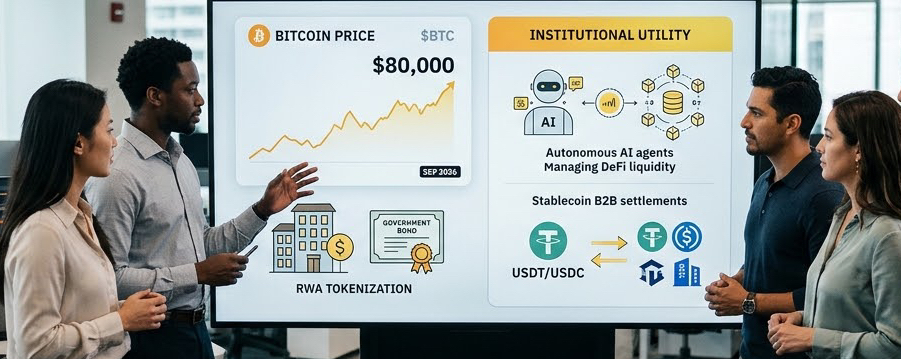
In September 2026, Bitcoin is holding steady in the $78,000–$81,000 range, reacting to key central bank decisions and global inflation data. What are the main growth vectors for the industry right now, and what are major market participants focusing on?
1. Institutional Fundamentals and the Macroeconomic Anchor
Bitcoin has firmly established itself as a mature financial asset. The adoption of spot ETFs and the integration of digital assets into the treasury balance sheets of major public companies have created a deep layer of liquidity.
Sensitivity to Macro Indicators: The market is pricing in Fed and ECB interest rate decisions with increasing precision. Macroeconomic reactions have become fast and predictable, similar to traditional stock indices.
Correlation with Safe-Haven Assets: $BTC price action increasingly correlates with gold, reinforcing its role as a "digital safe-haven asset" in the eyes of institutional investors.
2. The Era of Utility: RWA and Autonomous AI Agents
The primary focus of developers and investors has shifted to projects with proven business models.
Real-World Asset (RWA) Tokenization: Moving bonds, real estate, and credit instruments on-chain is no longer an experiment. Institutional players actively leverage smart contracts to lower costs and accelerate settlement times.
Integration of AI and On-Chain Operations: Autonomous AI agents built on smart contracts are taking over DeFi liquidity management, automated portfolio rebalancing, and real-time risk analytics.
3. Stablecoins as an International Settlement Standard
Regulatory clarity (including the full implementation of frameworks like MiCA) has transformed stablecoins from a purely trading tool into the backbone of B2B payments.
Cross-border corporate transfers in digital dollars and euros significantly reduce banking fees and settlement delays.
High-throughput networks (such as Solana and Ethereum L2 solutions) provide sub-second settlement finality with minimal transaction fees.
What Does This Mean for Investors?
The market has matured. Capital rotation is highly targeted—investors favor fundamentally strong ecosystems, infrastructure projects, and solutions with real revenue streams.
💬 Discussion for the Binance Square Community:
Which sector do you think will show the strongest performance by the end of the year—RWA tokenization, the AI segment, or classic L1/L2 infrastructure solutions?
Share your thoughts in the comments below!

