


Something strange is happening in the crypto market.
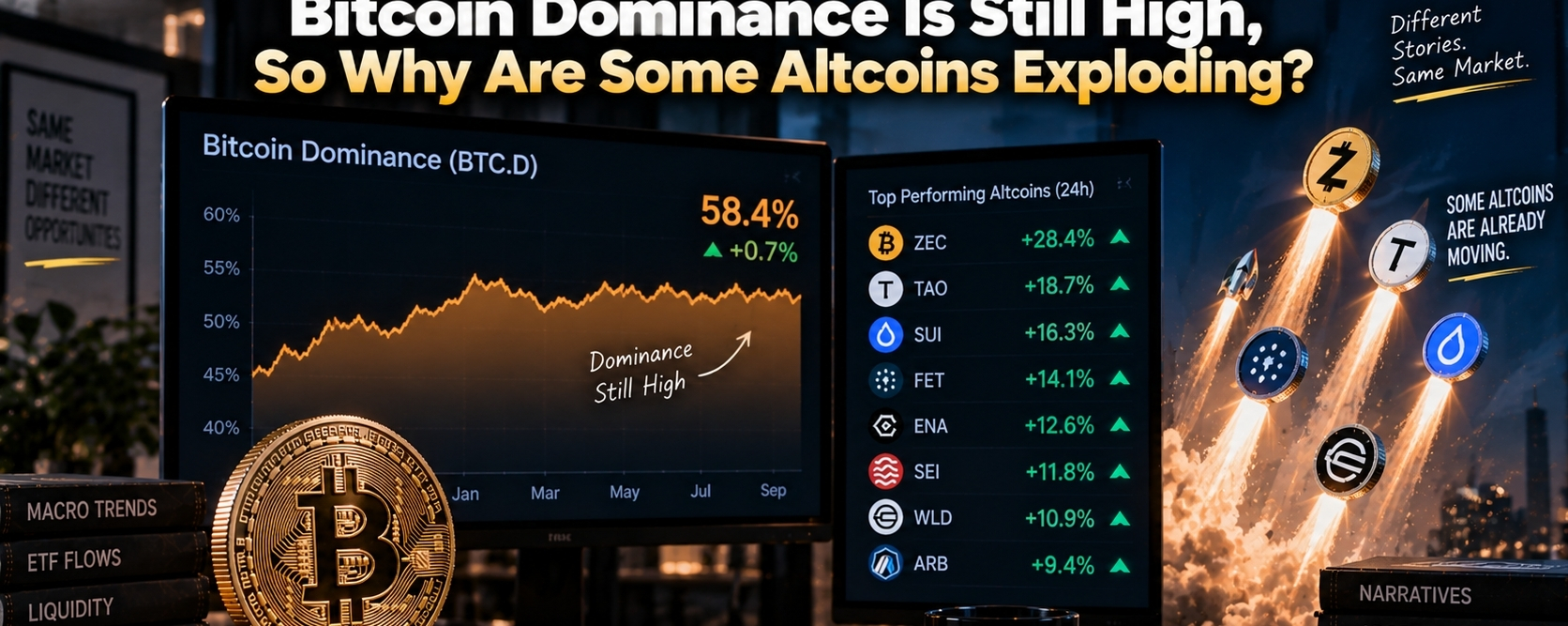
Bitcoin dominance remains close to 59%, which normally tells us that a huge share of crypto's total market value is still concentrated in BTC. Recent altseason indicators have also remained far below the levels usually associated with a full altcoin season.
Yet look at individual altcoins and you see a completely different picture.
ZEC recently jumped around 23% in a single day while Bitcoin moved less than 1%. Solana, BNB, HYPE and several other major coins also traded higher.
So how can Bitcoin dominance stay high while individual altcoins are exploding?
The answer is that altcoin rallies and altseason are not the same thing.
Bitcoin Dominance Doesn't Mean Alts Can't Pump
Bitcoin dominance measures Bitcoin's share of the total cryptocurrency market capitalization.
It doesn't tell us that every dollar entering crypto is flowing into Bitcoin.
And it certainly doesn't mean individual altcoins cannot outperform BTC.
Imagine Bitcoin remains relatively stable while a smaller altcoin jumps 20%.
That altcoin can produce a spectacular move without being large enough to significantly change Bitcoin's overall dominance.
This is exactly why traders can see huge green candles across certain altcoins while BTC dominance barely moves.
The Market Is Becoming More Selective
The bigger story may be where money is actually moving.
Instead of capital flowing equally across thousands of cryptocurrencies, investors appear to be concentrating on particular narratives and tokens.
Zcash is a good example.
ZEC's latest rally came alongside renewed attention around privacy, network developments and comments from Paradigm co-founder Matt Huang, who disclosed that the firm owns ZEC and described Zcash as a privacy-focused complement to Bitcoin.
That gives traders a specific reason to focus on ZEC.
And once one coin begins strongly outperforming the market, momentum itself can attract even more attention.
The result can be an explosive move even while the broader altcoin market remains much quieter.
Market Breadth Is Starting to Get Interesting
There are signs that strength is spreading beyond just one or two coins.
On September 17, 89 of the 100 assets in KuCoin's QC100 index were advancing, compared with only 12 a week earlier. Meme-related assets and DeFi were among the stronger sectors, while Bitcoin gained only around 1% in that snapshot.
That's worth watching.
It doesn't automatically confirm altseason, because one strong day isn't enough to establish a lasting market regime.
But it shows that traders are becoming more willing to move beyond Bitcoin.
If that breadth continues for weeks rather than days, the conversation becomes much more interesting.
Narratives Are Moving Faster Than the Whole Market
Crypto has always been driven partly by narratives.
But today's market has thousands of tokens competing for attention.
That makes it harder for everything to rally together.
Instead, capital can move from one narrative to another.
Privacy coins can become hot.
Then DeFi attracts attention.
Then Layer 1s.
Then AI-related projects.
Then meme coins.
The total amount of money moving may not initially be large enough to dramatically reduce Bitcoin dominance, but it can still create enormous percentage moves inside smaller markets.
That's why following where strength is developing can sometimes tell us more than watching dominance alone.
Smaller Coins Need Less Money to Move
Market capitalization also matters.
Bitcoin is enormous.
Moving BTC by 10% requires far more capital than producing the same percentage move in a much smaller cryptocurrency.
This creates an important effect during rotation periods.
Even a relatively small amount of fresh demand can create an aggressive move in a smaller altcoin, especially when available liquidity is limited.
That is one reason altcoins can suddenly print double-digit moves while Bitcoin appears almost asleep.
But the same effect works in reverse.
Lower liquidity can also mean much sharper declines when buyers disappear.
Big percentage gains therefore aren't automatically evidence of stronger long-term fundamentals.
Bitcoin Stability Can Actually Help Altcoins
There is another interesting part of this setup.
Altcoins don't necessarily need Bitcoin to fall.
In many cases, a violent BTC decline hurts the entire market because traders reduce risk everywhere.
A relatively stable Bitcoin can create a different environment.
Bitcoin was holding around $76,000 on September 17 despite the Federal Reserve's first rate hike since 2023.
When BTC isn't making a huge move in either direction, traders may start searching for stronger opportunities elsewhere in the market.
Attention shifts.
Volume follows.
And suddenly an altcoin that had been ignored for weeks becomes one of the most discussed assets in crypto.
Why This Still Isn't a Clear Altseason
This distinction is important.
Bitcoin dominance remained around 59% in recent September readings, while one altseason index stood around 34/100 on September 17. Different indexes use different methodologies, but those readings don't describe the broad, sustained altcoin leadership usually associated with classic altseason.
Individual winners are different from market-wide leadership.
For a stronger altseason argument, traders would want to see the strength become broader and more persistent.
More large and mid-cap altcoins would need to consistently outperform Bitcoin.
Bitcoin dominance would likely need to weaken.
And market breadth would need to stay strong rather than disappearing after a few sessions.
Until then, what we're seeing may be better described as selective rotation.
This Cycle Could Look Different
Previous crypto cycles trained traders to expect a simple sequence.
Bitcoin runs.
Ethereum follows.
Large caps move.
Then almost every smaller altcoin starts pumping.
But today's crypto market is much larger and more crowded.
There are more tokens, more narratives and more competition for liquidity.
That could mean the next major altcoin cycle doesn't arrive as one giant wave.
Instead, it could arrive as a series of smaller rotations.
One sector explodes.
Money moves somewhere else.
Another narrative takes over.
Then the cycle repeats.
The Bigger Signal to Watch
Bitcoin dominance remains important.
But watching it alone can hide what is happening underneath the surface.
Right now, Bitcoin still controls a huge portion of the crypto market.
At the same time, some altcoins are attracting concentrated capital and producing moves far larger than BTC.
Those two things aren't contradictory.
They're exactly what a selective rotation market can look like.
Bitcoin may still dominate the market.
But it doesn't have to dominate every opportunity inside it.