
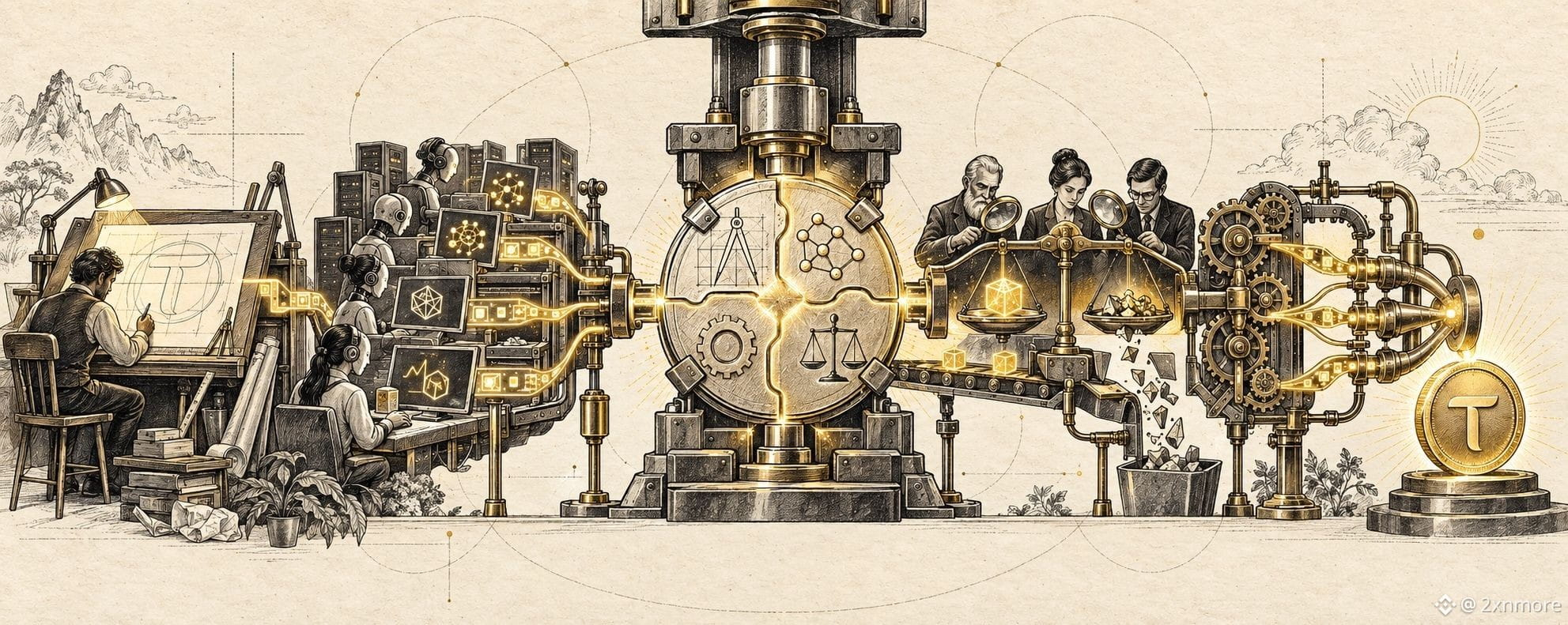

The market is pricing a red candle. Five companies are pricing the future of intelligence. Only one of those is a trade. OpenAI. Google. Meta. Microsoft. Anthropic. They own the models, the data, the GPUs, and the door you walk through to use any of it.
That is not an open future. That is a toll road with five owners and no second exit.
Most people still treat $TAO
like another AI ticker riding a hot narrative. They open the chart, see a token that spent 2026 well below its 2024 high near $758, and ask if they backed the wrong horse.
That is the expensive question.
The cheap question, the one that actually pays, is this. What happens when a network rebuilds the machine under the candle, then makes the machine impossible to capture, while the crowd is still arguing about whether the founder leaving killed the story?
Once you see that gap, you cannot unsee it.
Stop valuing an AI network like a meme $TAO
is still being priced like a narrative token. It is not.
It is not Airbnb for GPUs. It is not one team wrapping one chatbot and hoping the token stays useful. It is the index for 128 live subnet markets that all settle in and out of TAO. Every subnet that wins has to buy the base asset to exist. Every miner that registers burns TAO. Every emission slice that matters still denominates in TAO.
That is not a side feature. That is the entire economic design.
Bitcoin was money. Ethereum was apps. TAO is intelligence.
If that sentence sounds like branding, look at the category. Bittensor is not competing with other AI coins. It is competing with closed labs for the right to be the infrastructure layer intelligence runs on. Different bet. Different risk. Different payoff if the mechanism holds.
The part the resignation hid
In February 2026 Const and Ala gave up executive titles at the Opentensor Foundation. The timeline read it as the founder walking away.
Wrong frame.
Neither left the work. What got surrendered was the private room that ratifies upgrades. Most chains keep that room filled with friends, employees, or whoever bought the loudest campaign. Bittensor is trying to fill it with whoever the block height points at.
Two houses. Validators in one. Subnet owners in the other. A three seat committee drawn blind from the top of both sets, then rotated every six to eight months. Every objection doubles the delay. The first real use case is starving extractors. Cut emissions to subnets that farm rewards and ship nothing the network wants.
A founder giving up a title is theatre if the same people stay in the room. A lottery that rotates the room is a product.
In a market that pays whoever produces the most useful intelligence, being impossible to capture is not a feature. It is the thing serious capital was waiting to see before it sizes in.
The chart will be the last place this shows up.
The rebuild almost nobody priced
While holders stared at $220, the rules that decide who earns changed.
The first halving already hit. December 2025. Daily issuance dropped from roughly 7,200 TAO to 3,600. Hard cap still 21 million. No premine. No VC carve out. Fair launch scarcity applied to an AI commodity instead of a hash commodity.
dTAO turned every subnet into a tiny economy. Each one has an alpha token that trades against TAO. The smoothed alpha price feeds emissions. Strong markets pull more of the 3,600. Weak ones hit the emission gate and get throttled. The market, not a committee chat, decides where the reward pool goes.
Root Reborn killed a silent leak. Nearly half of TAO sits on root. Alpha dividends used to sell into TAO automatically, every day, whether anyone wanted the sale or not. Now they accrue in validator linked baskets and only convert when someone claims. Mechanical sell pressure got dialled down. That is plumbing. Plumbing is how networks survive.
Growth now tightens supply. Neuron registration burns TAO through dynamic pricing. New subnets cost TAO. Owners can burn alpha. Three contraction mechanisms run at once, and they accelerate if the network actually grows. Most tokens have one burn gimmick. TAO has a system where demand structurally requires scarcity.
128 markets. About 25 will matter.
Think of TAO as the S&P 500 of decentralised AI. Each subnet is a stock competing for emissions. The index sits in the pool opposite every alpha token, so when a subnet wins, TAO wins with it.
Around 100 of those markets will never matter. The other 25 are the entire reason the token exists. Most people cannot tell them apart. The market eventually will.
The filter is not cool repo. Dynamic TAO turned every subnet into an investment vehicle overnight. Emissions are not revenue. Usage tweets are not invoices. Alpha market cap is not audited business value. A category can print a billion dollars of quoted subnet value and still have thin exits and no outside customers.
Watch the names that already look like companies, not contests.
Chutes, SN64. Inference at scale, the subnet that keeps showing up wherever developers actually pay for tokens out.
Targon, SN4. Compute and confidential hardware, the privacy wall.
Score, SN44. Computer vision leaving the terminal and walking into physical sites.
Templar, SN3. Permissionless pre training in public, the Bitcoin of AI thesis running live instead of sitting in a thread.
Ridges and the coding markets. The ones that have to beat funded labs on engineering benchmarks, not vibes.
If a subnet cannot explain the difference between runway and revenue, it is dead weight wearing a whitepaper.
What the smartest capital already did
Barry Silbert did not sprinkle TAO into a basket. Through DCG he stood up Yuma, a company whose job is to accelerate and finance the Bittensor stack. That is a statement, not a trade.
Stillcore, with Jason Calacanis in the mix, framed 2026 TAO against ETH in 2016 and BTC in 2013, and set out to own a real slice of supply plus the highest conviction subnets. Mark Jeffrey called it a foundational layer. Grayscale ran the old playbook. Fund first, trust second, ETF paperwork after that. Polychain was early. Jensen Huang talking about decentralised training did not create the network. It told the last group of skeptics the architecture was no longer a crypto in joke.
None of that is a guarantee. All of it is the opposite of nobody serious is here.
The people with the best track records are not scrolling past the ticker. They are building permanent vehicles around one network while the timeline debates a daily candle.
The only number the chain still cannot show you
Bittensor is gorgeous onchain. Stake, emissions, pools, alpha prices, validator weight. You can audit the internal economy in real time.
It cannot yet hand you a complete, audited ledger of customer cash arriving from outside the loop. AI requests and commercial contracts still live off chain. Token throughput is not a receipt. Partnerships are not margins. A widely circulated 43 million dollar Q1 revenue line should stay in the rumor pile until it can be checked.
That is not a reason to leave. It is the reason to watch the right variable.
Price tells you how the crowd feels. Six signals tell you whether emissions are becoming a business.
Does TAO hold gains while 3,600 new tokens still hit the market every day.
Do subnet gains broaden, or is it five names with everyone else illiquid.
When does custom root weight setting actually go live.
Which subnets lose share under the emission gate.
Independent proof of customer payments and margins. Cash. Not tokens processed.
ETF status as a stage, not a vibe. Filing, amendment, effectiveness, launch. Do not mix them up.
A subnet can look rich in alpha and still bleed you against TAO. The risk sits one layer deeper than the price might fall.
The hook you should keep
Five companies own the toll road.
Bittensor is trying to be the alternative route. Open markets for intelligence, Yuma Consensus scoring work no other chain can score, 21 million hard cap, post halving issuance already cut in half, 128 competing subnets, two voting houses, a committee the chain picks and then fires.
The network always leads. The price always follows. It just runs late.
You do not learn $TAO by watching $TAO
. You learn it by reading the mechanism, then checking whether the 25 subnets that matter are turning emissions into invoices.
The people who read the docs always buy before the people who read the price.
The candle is weather.
The machine is the trade.
Explainer, not advice. Figures move. Verify subnets on Taostats, read filings as filings, and never size a position off a hook, even this one.