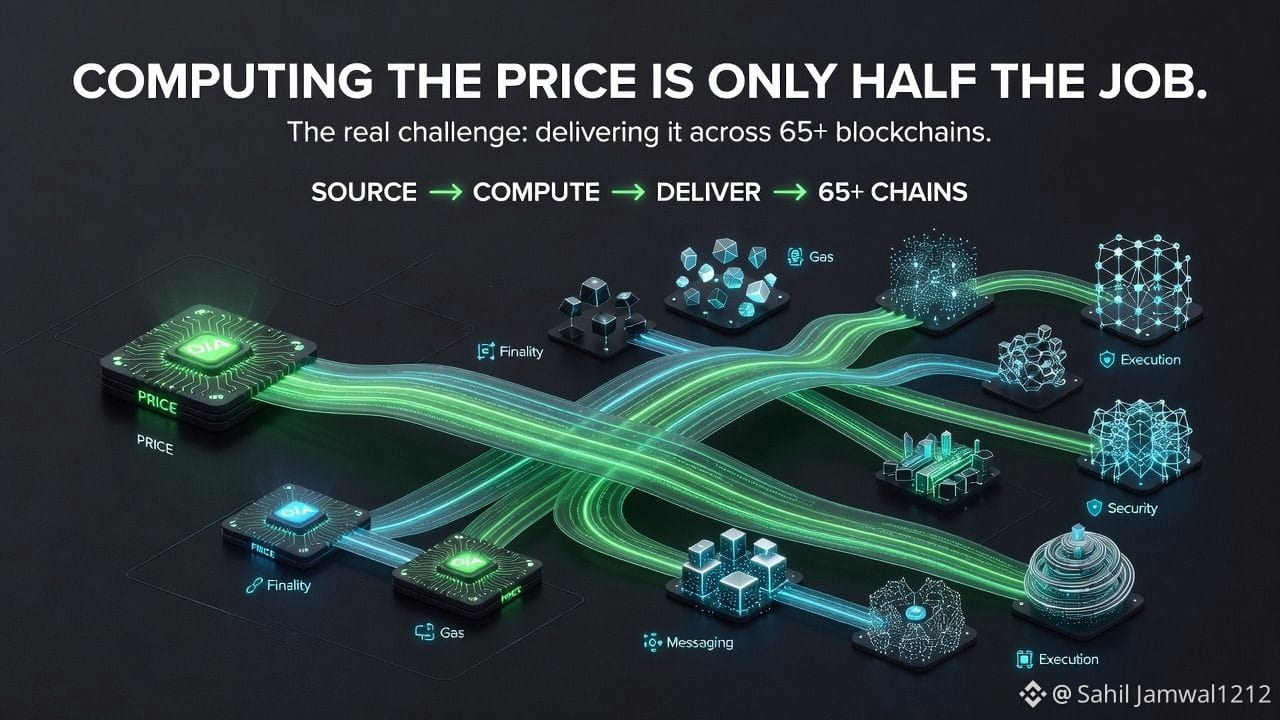
An oracle doesn't become useful just because it can calculate a price.
The harder question is:
How do you deliver that price reliably across dozens of different blockchains?
DIA currently supports oracle delivery across 65+ L1/L2 networks.
Every chain brings its own constraints:
→ Different finality times
→ Different gas economics
→ Different execution environments
→ Different messaging systems
→ Different security assumptions
The basic architecture is interesting.
DIA processes market data and applies configurable pricing methodologies, then publishes feeds through chain-specific oracle contracts.
So a dApp on one chain doesn't need to reinvent the pricing logic while another chain uses a completely different methodology.
That becomes even more important for DIA Value.
For assets such as stable coins, yield-bearing tokens or other assets whose fundamental value can come from reserves or redemption mechanisms, DIA can calculate a fundamental value and distribute that valuation across chains.
Cooper Labs specifically described $DIA
Value as solving cross-chain pricing fragmentation for USDp by producing one verifiable fundamental price.
One important caveat: cross-chain delivery still introduces bridge and messaging security considerations. DIA's own documentation acknowledges this.
That's what makes the engineering interesting to me.
Computing the number is one problem. Making that number usable across fragmented blockchain infrastructure is another.
Not financial advice. DYOR.
The harder question is:
How do you deliver that price reliably across dozens of different blockchains?
DIA currently supports oracle delivery across 65+ L1/L2 networks.
Every chain brings its own constraints:
→ Different finality times
→ Different gas economics
→ Different execution environments
→ Different messaging systems
→ Different security assumptions
The basic architecture is interesting.
DIA processes market data and applies configurable pricing methodologies, then publishes feeds through chain-specific oracle contracts.
So a dApp on one chain doesn't need to reinvent the pricing logic while another chain uses a completely different methodology.
That becomes even more important for DIA Value.
For assets such as stable coins, yield-bearing tokens or other assets whose fundamental value can come from reserves or redemption mechanisms, DIA can calculate a fundamental value and distribute that valuation across chains.
Cooper Labs specifically described $DIA
Value as solving cross-chain pricing fragmentation for USDp by producing one verifiable fundamental price.
One important caveat: cross-chain delivery still introduces bridge and messaging security considerations. DIA's own documentation acknowledges this.
That's what makes the engineering interesting to me.
Computing the number is one problem. Making that number usable across fragmented blockchain infrastructure is another.
Not financial advice. DYOR.