
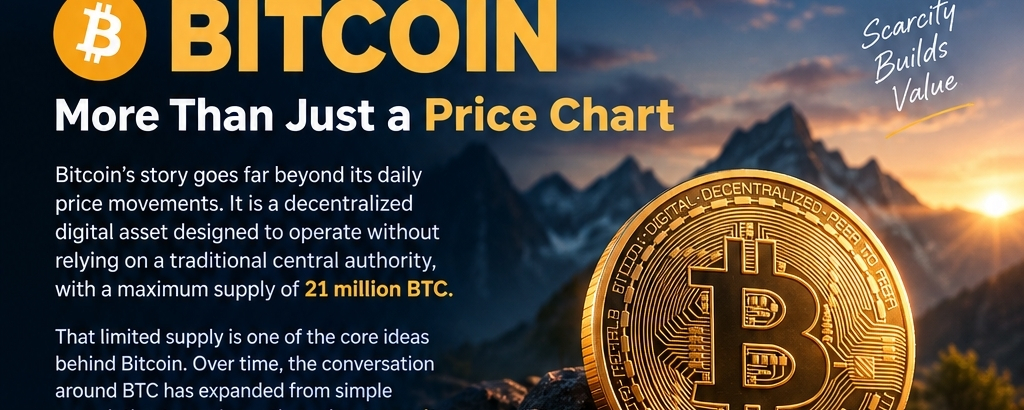

Bitcoin’s story goes far beyond its daily price movements. It is a decentralized digital asset designed to operate without relying on a traditional central authority, with a maximum supply of 21 million BTC.
That limited supply is one of the core ideas behind Bitcoin. Over time, the conversation around BTC has expanded from simple speculation toward questions about scarcity, adoption, liquidity, and its potential role within the broader financial system.
But Bitcoin’s market is never driven by one factor alone.
When looking at BTC, I think it’s important to consider several pieces of the puzzle:
→ Price structure: Is Bitcoin maintaining higher highs and higher lows?
→ Support & resistance: Which levels are attracting buyers or sellers?
→ Volume: Is a breakout supported by meaningful market participation?
→ ETF flows: Are institutional flows adding or reducing exposure?
→ Macro conditions: How are interest rates, liquidity, and risk sentiment affecting markets?
→ On-chain activity: What are large holders and network participants doing?
And perhaps the most important lesson: not every Bitcoin rally needs to be chased.
BTC can move quickly in both directions, and short-term volatility can be significant. Looking for confirmation, managing risk, and understanding your own time horizon can be more useful than reacting emotionally to every candle.
Bitcoin can be viewed through many different lenses — technology, scarcity, decentralization, monetary economics, investment, and adoption.
The short-term question is often:
“Where is BTC going next?”
But the bigger question is:
“What role will Bitcoin play in the global financial system over the next decade?” ₿
That is what makes Bitcoin such an interesting asset to keep studying.
DYOR. Crypto assets carry significant risk.#BTC走势分析