
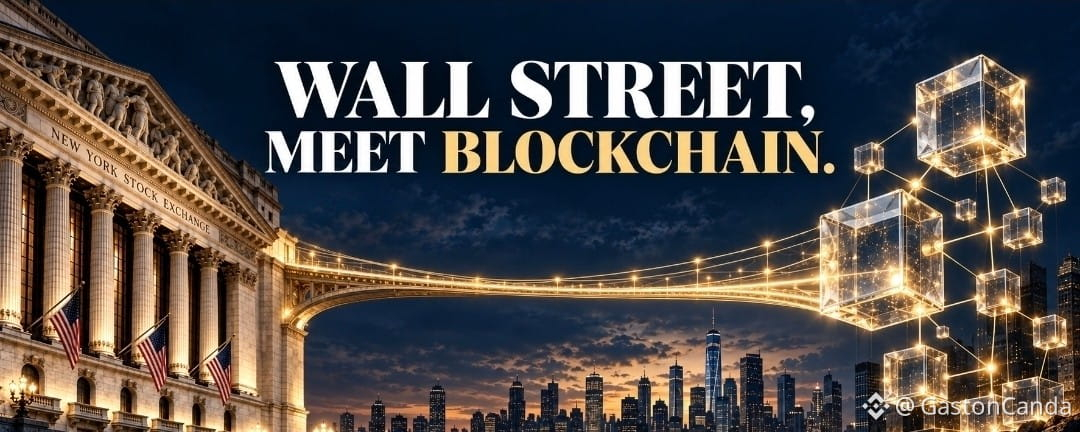

🏛️ Wall Street is preparing for longer trading hours. Tokenization could change what happens behind every trade.
Imagine finishing your shift and accessing investments through markets that better fit your schedule.
For someone building a portfolio from a regular paycheck, that future is easy to relate to.
Two developments are bringing it closer.
🔎 What’s happening?
The SEC scheduled a September 17 roundtable to examine preparations for 24-hour trading in U.S. equities, including market readiness, operational resilience and the implications of longer trading hours. "Source: SEC" (https://www.sec.gov/newsroom/meetings-events/sunshine-act-notice-roundtable-preparations-24-hour-trading-091726)
Meanwhile, DTCC has already moved beyond planning: it reported transactions using DTC-tokenized securities on July 15, ahead of a planned October 2026 service launch. Its model allows securities held at DTC to move between traditional and tokenized forms. "Source: DTCC" (https://www.dtcc.com/press-releases/2026/dtcc-turns-tokenization-into-reality)
These are distinct developments, but together they point toward a more connected financial system.
⚙️ Why tokenization matters
Trading hours determine WHEN you can trade.
Tokenization changes how an asset can be represented and transferred.
DTCC says its service is designed to preserve the ownership rights, entitlements and investor protections of the underlying assets. The initial framework covers eligible securities, including Russell 1000 stocks, major index ETFs and U.S. Treasuries. "Source: DTCC" (https://www.dtcc.com/news/2026/may/04/dtcc-advances-development-of-new-tokenization-service)
That distinction matters: a tokenized security’s legal structure determines what you actually own. A token that tracks a stock’s price should never automatically be treated as equivalent to owning the stock.
🌐 Why this matters for crypto
My view: one of blockchain’s most consequential use cases could be helping traditional assets move through financial markets more efficiently.
Potential benefits include more flexible collateral transfers, better connectivity between platforms and fewer constraints on when assets can move.
But adoption does not automatically translate into higher prices for every blockchain token. Investors still need to ask where activity happens, who earns fees and whether a token captures any of that value.
⚠️ More access brings new challenges
Longer trading hours do not create liquidity by themselves. Overnight markets can have thinner order books, wider spreads and greater slippage.
And 24-hour trading does not necessarily mean 24/7 trading. Buying any U.S. stock on a Sunday at 3 a.m. remains a possible future scenario, not a conclusion we can draw from this roundtable.
Tokenization also leaves practical questions: custody, cybersecurity, settlement arrangements and how investor rights are enforced.
📌 What I’m watching next
• Whether DTCC delivers its planned October launch.
• Which assets and networks attract sustained usage.
• Whether overnight liquidity supports reliable execution.
• How much access reaches ordinary investors.
As someone building wealth from a paycheck, I want more flexibility and a clear understanding of what I own.
A market that stays open longer should give us more choice—not make us feel we need to trade constantly.
Would you use tokenized stocks and ETFs alongside crypto, or do you prefer keeping those investments separate?
@GastonCanda
#Tokenization #TradFi #RWA