




Imagine trying to play competitive table tennis, but every time you hit the ball, you have to wait twelve seconds for a referee in another country to mail you a confirmation letter that it landed on the table. That is exactly what trading high-frequency derivatives on a standard blockchain feels like. Market makers and institutional funds cannot operate in an environment where they have to wait for global network consensus just to update a simple limit order. For years, the industry accepted this unbearable latency as the mandatory cost of doing business in decentralized finance.
Lighter protocol dismantles this limitation entirely. It is a high-performance, application-specific zero-knowledge rollup built directly on top of Ethereum. Instead of relying on automated formulas, Lighter operates a fully on-chain central limit order book dedicated exclusively to perpetual futures. It bridges the massive gap between the blistering speed of traditional finance and the cryptographic security of decentralized networks.
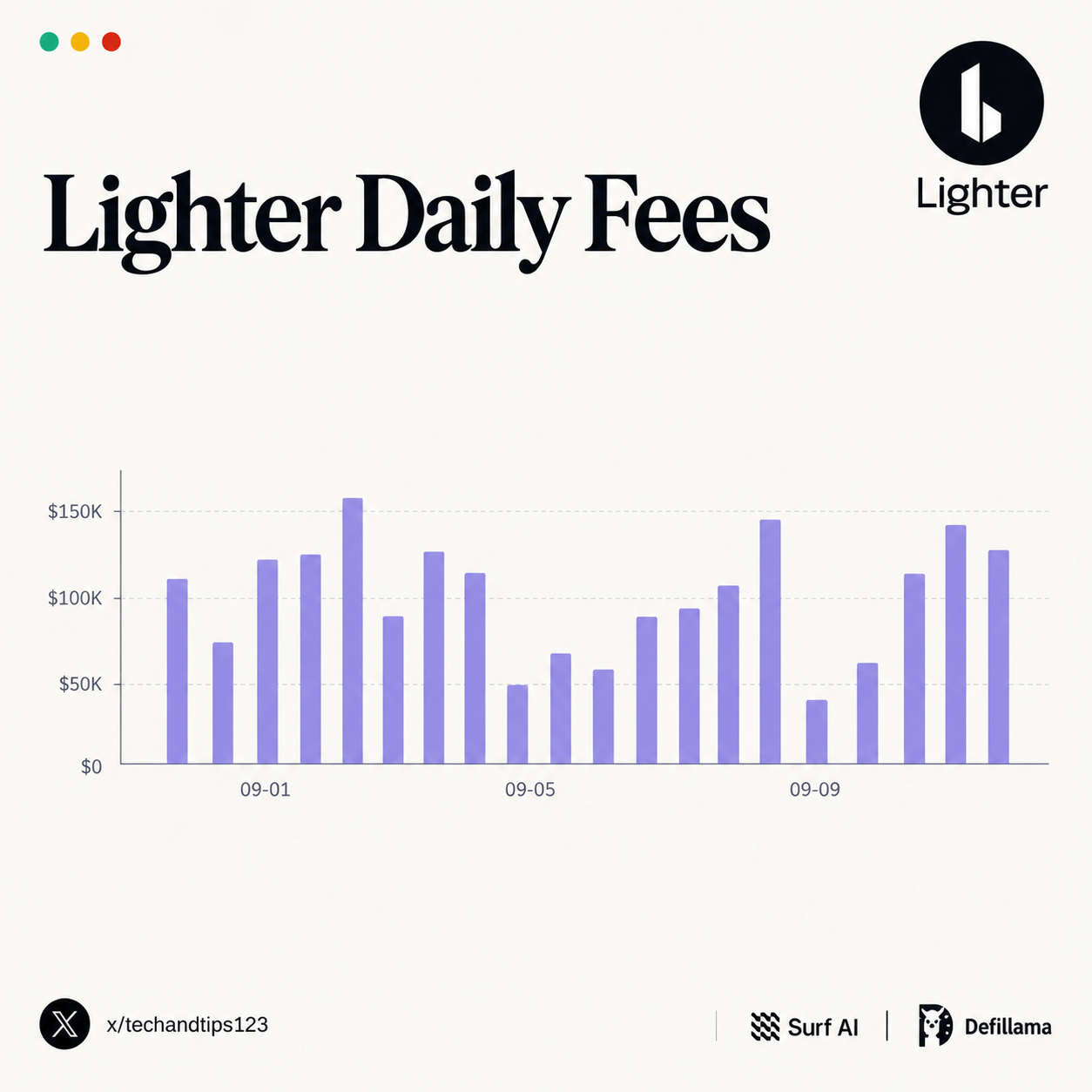
This infrastructure matters right now because institutional capital requires absolute verifiable security and zero slippage. Legacy automated market makers simply cannot provide this level of precision. By processing over 100,000 orders per second with less than five milliseconds of latency, Lighter matches the performance of Wall Street infrastructure while never taking custody of user funds. With $39 billion in recent 30-day trading volume and over $1.6 trillion cumulatively, Lighter proves that traders no longer have to compromise between raw speed and sovereign self-custody.
▨ The Problem: What’s Broken?
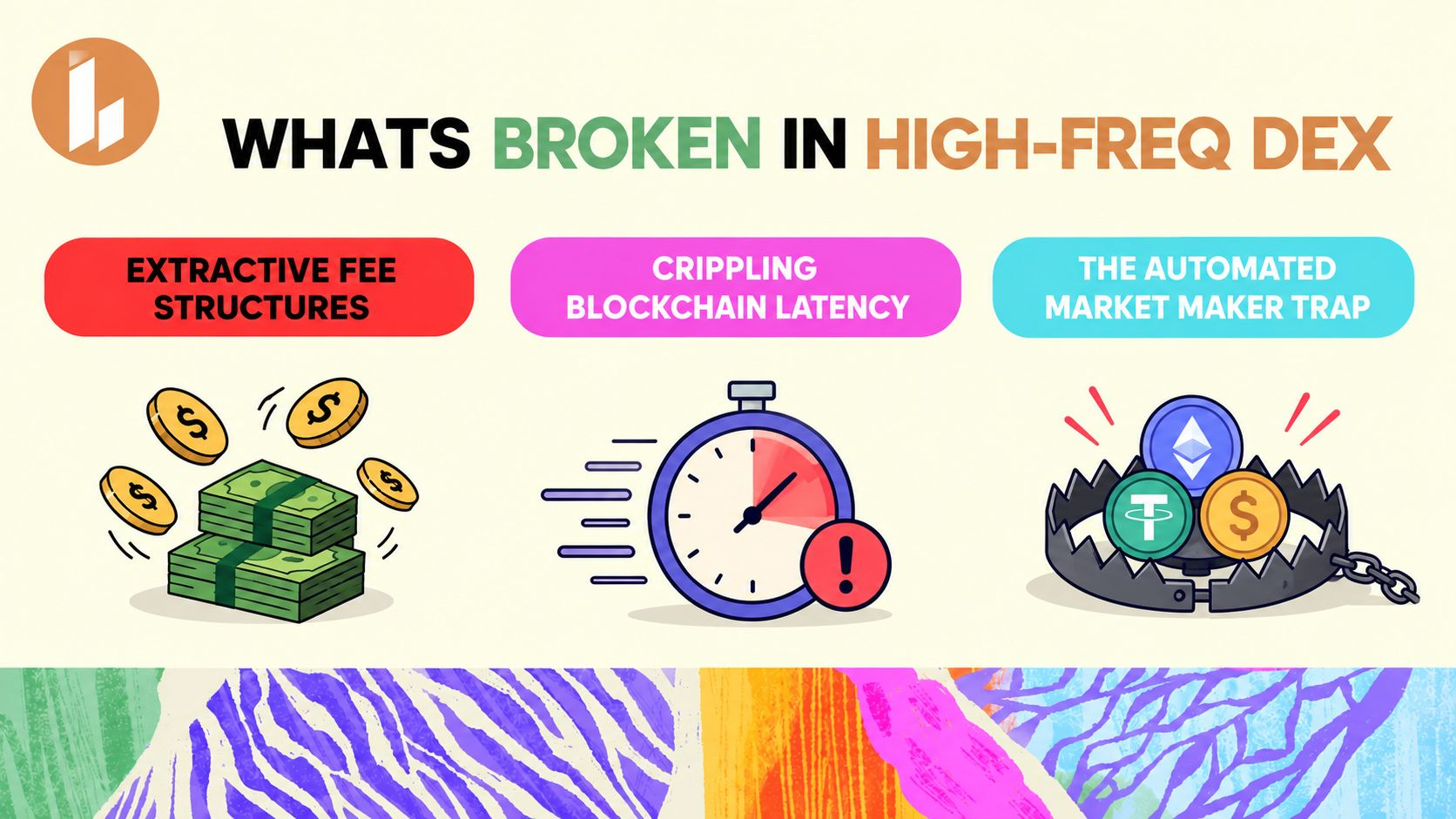
🔹 The Automated Market Maker Trap → Automated market makers were a brilliant bootstrap mechanism, but they force active traders to endure severe slippage and front-running. A mathematical curve simply cannot react to sudden market volatility as sharply as a dedicated order book. This mechanical lag leaves liquidity providers highly exposed to impermanent loss and leaves traders stuck with terrible execution prices during market panics.
🔹 Crippling Blockchain Latency → Generalized blockchains process every single action sequentially. Whether a user is buying a digital collectible or executing a complex algorithmic hedge, they wait in the exact same line. This concurrency bottleneck introduces massive latency and exorbitant per-order gas fees. This sluggish environment effectively prices high-frequency algorithmic traders entirely out of the decentralized ecosystem.
🔹 The Trust Deficit in App-Chains → To escape latency, several decentralized exchanges moved their matching engines to proprietary application chains secured by independent validator networks. This architectural choice trades mathematical security for economic security. Traders are forced to trust that a small, centralized group of node operators will not collude to reorder trades or manipulate liquidations to their own advantage.
🔹 Extractive Fee Structures → The current decentralized derivatives market relies heavily on a parasitic fee model. Retail users are heavily taxed on both sides of a trade to subsidize the liquidity providers and the protocol treasury. This constant financial extraction stifles organic volume and prevents decentralized venues from genuinely competing with massive centralized exchanges.
▨ What Lighter Is Doing Differently
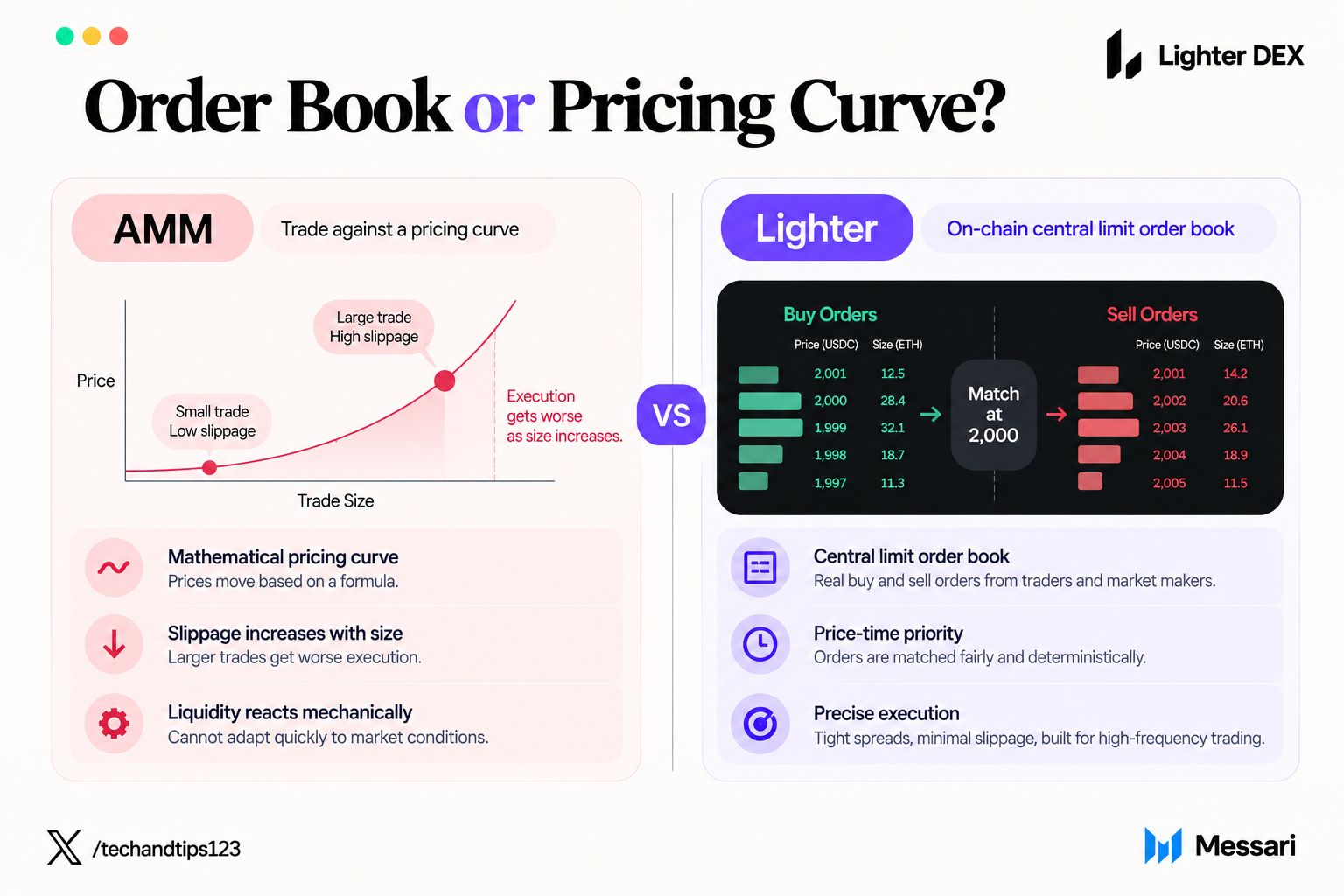
Lighter refuses to compromise between execution speed and cryptographic security. Instead of forcing a matching engine onto a generalized blockchain, the development team built a hybrid architecture. They deployed a high-performance matching engine written in Golang that runs entirely off the main chain. This sequencer processes orders in a deterministic, single-threaded loop. This is the exact same architectural design that powers the fastest centralized exchanges in the world. By keeping the heavy computational work isolated, the platform easily scales past 100,000 transactions per second.
The critical difference is how Lighter anchors this speed to the blockchain. In traditional off-chain setups, users must trust the operator blindly. Lighter eliminates this trust requirement entirely by utilizing custom Plonky2 zero-knowledge circuits. After the off-chain sequencer matches a batch of trades, a specialized prover network generates a cryptographic receipt. This zero-knowledge proof mathematically guarantees that every single match, margin check, and liquidation adhered strictly to the immutable rules of the exchange.
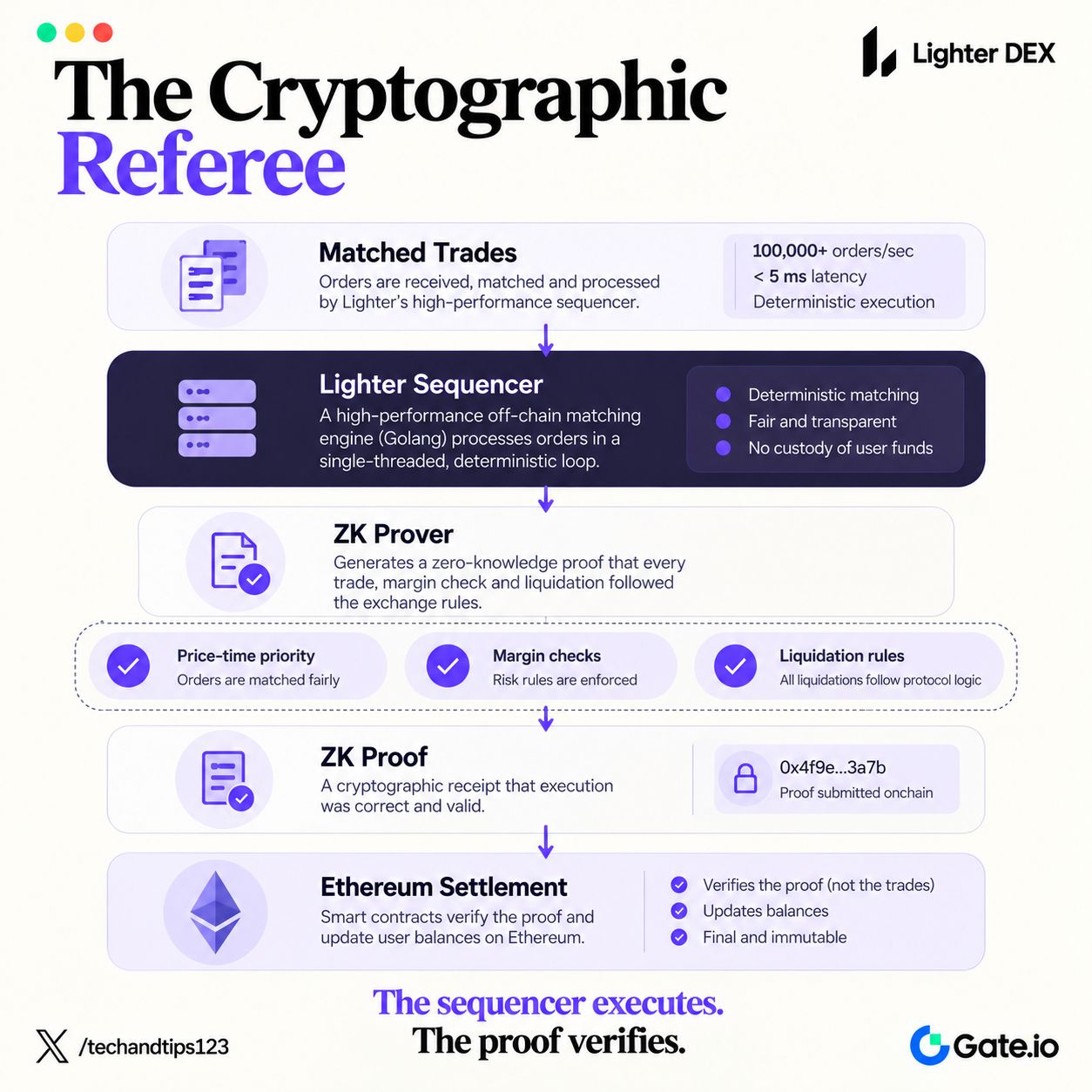
The protocol then submits this proof to the settlement smart contracts deployed on the Ethereum base layer. These contracts do not calculate the trades. They simply verify the cryptographic math and update the user balances. Because the protocol encodes its entire risk engine directly into these mathematical constraints, the sequencer cannot forge a signature, skip an order in the queue, or execute an unfair liquidation. If an account is healthy, the underlying math prevents it from being liquidated. Lighter delivers the lightning-fast execution of a centralized server while maintaining the absolute, trustless security of the Ethereum network.
▨ Key Components & Features
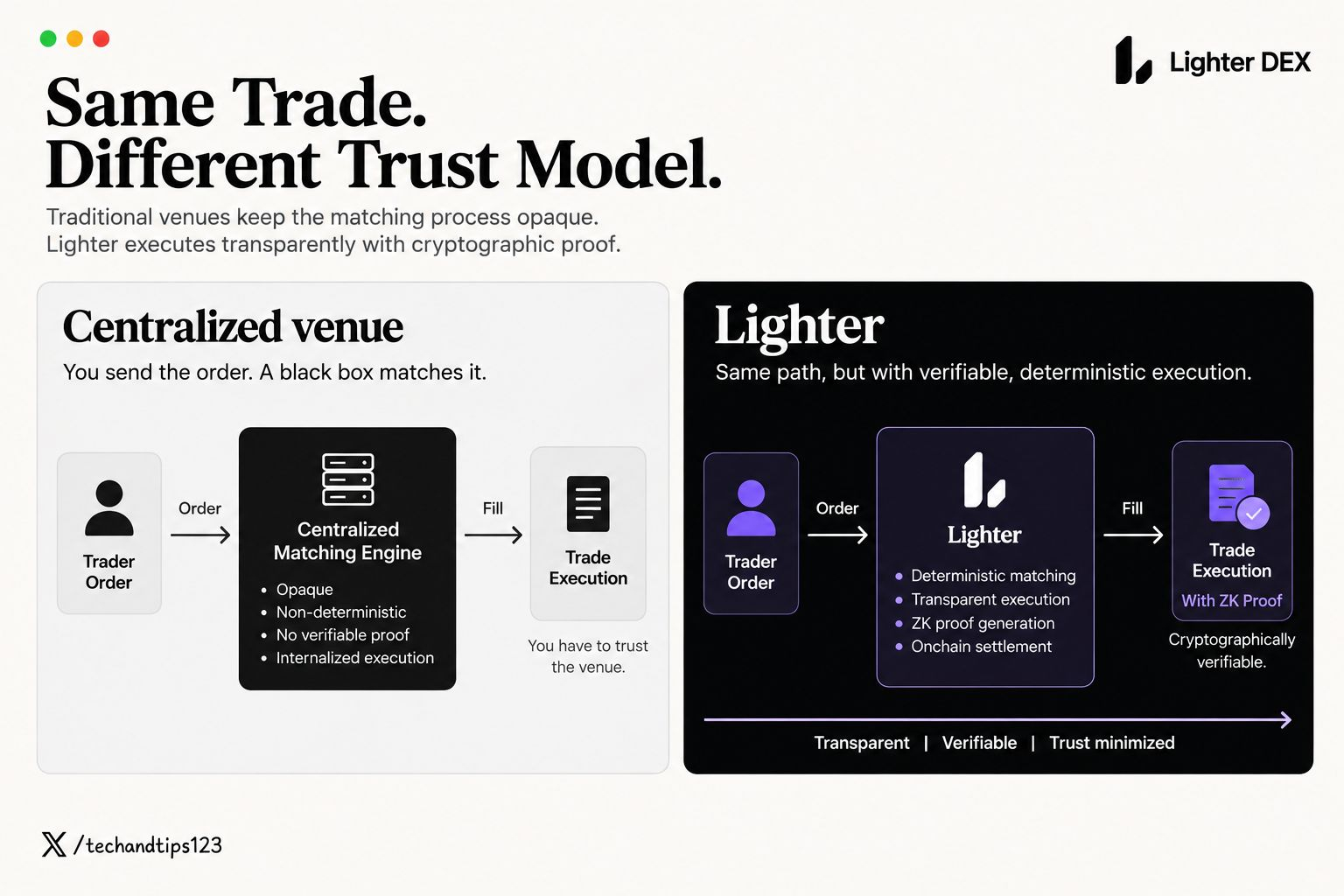
1️⃣ Off-Chain Sequencer : This is the execution heart of the protocol. It maintains the order book state in local memory and matches buy and sell intents in under five milliseconds. This speed guarantees that market orders fill in a single atomic transaction without the risk of partial execution between block confirmations.
2️⃣ Zero-Knowledge Prover Network : This component acts as the ultimate cryptographic referee. It takes the matched trades from the sequencer and generates a succinct execution proof demonstrating that price-time priority was perfectly respected. This mechanism completely neutralizes maximal extractable value and front-running risks.
3️⃣ Algorithmic Execution Suite : Lighter natively supports advanced trading tools like Time-Weighted Average Price, Random Slice, and Pegged orders. These allow institutional block traders to dissect massive positions over time to obfuscate their footprint and minimize market impact without requiring complex external software.
4️⃣ Escape Hatch Settlement Layer : User funds are strictly held in heavily audited Layer 1 smart contracts, never by the Lighter team. If the off-chain sequencer ever goes offline or attempts to censor activity, users can interact directly with the base layer contract to instantly withdraw their capital.
5️⃣ ZK-Enforced Risk Engine : The protocol embeds its margin requirements directly into the zero-knowledge circuits. The system automatically rejects limit orders that deviate too far from the oracle mark price through fat finger prevention and ensures that no trade can inadvertently push a healthy account into an underwater state.
▨ How Lighter Works
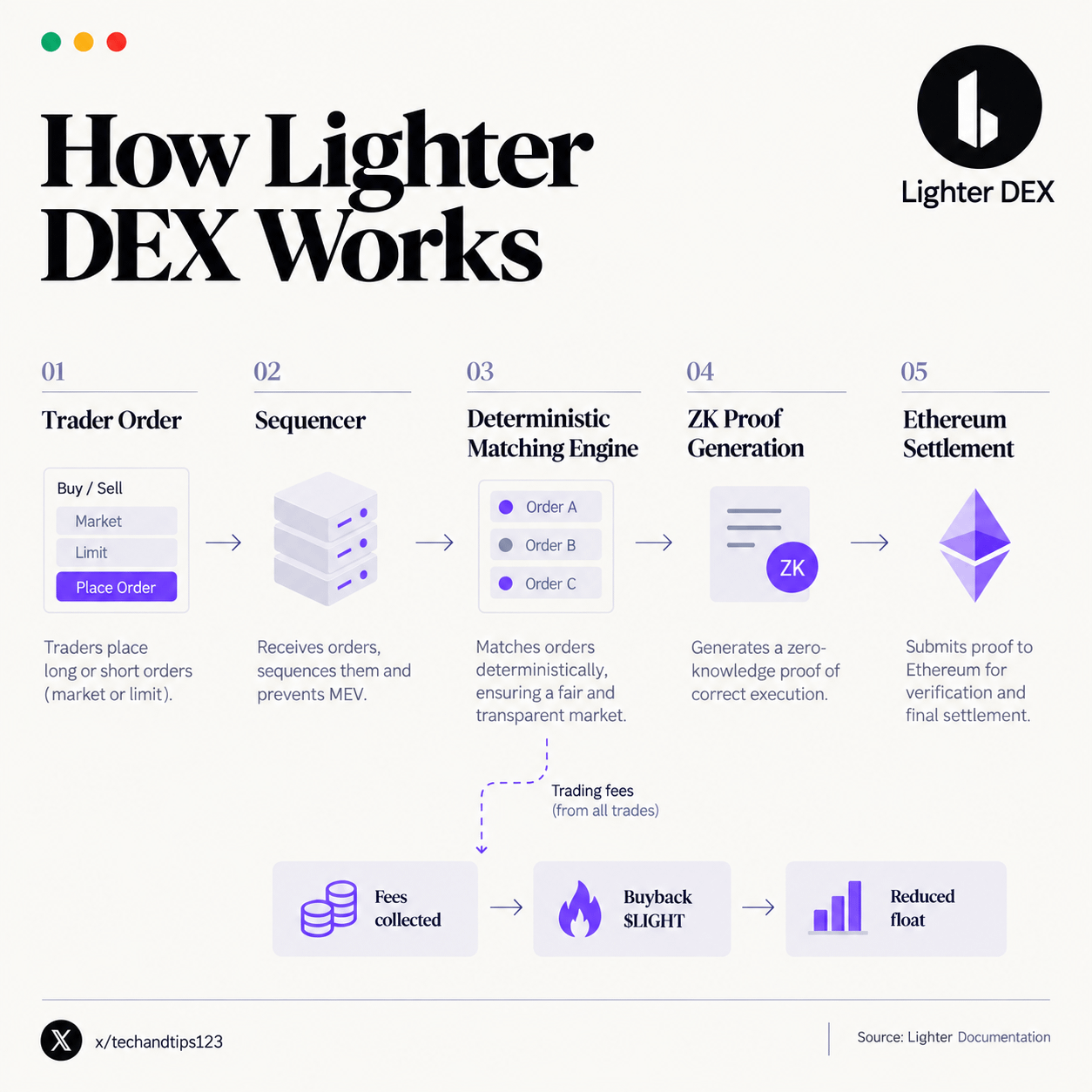
🔹 Step 1: A trader deposits their stablecoin collateral directly into the Lighter smart contract deployed on the Ethereum mainnet. This officially locks their funds in a secure, non-custodial vault.
🔹 Step 2: The trader submits a cryptographically signed order intent via the Lighter API or frontend interface, specifying their exact price and size requirements.
🔹 Step 3: The off-chain sequencer receives this intent, places it into a strict first-in-first-out queue, and instantly matches it against resting liquidity in the central limit order book. This provides the trader with millisecond-scale soft finality.
🔹 Step 4: The prover network aggregates a massive batch of these matched trades and computes a zero-knowledge proof. This proof mathematically validates that the sequencer executed the trades perfectly according to the protocol rules.
🔹 Step 5: The protocol submits this cryptographic proof to the Ethereum mainnet settlement contract. The contract verifies the math, permanently updates the official user balances, and finalizes the trading round without requiring expensive on-chain computation.
▨ Value Accrual & Growth Model
✅ Zero-Fee Retail Integration → Lighter solves the retail adoption bottleneck through its Robin Hood strategy. By offering zero maker and zero taker fees for all standard retail accounts, the protocol removes all financial friction from the trading experience. This drives massive organic volume and accelerates user onboarding.
✅ Premium Tier Incentives → Institutional entities, quantitative funds, and market makers pay customized fees to access prioritized API endpoints, higher rate limits, and guaranteed connection stability. This creates a sustainable revenue stream directly from the most heavily capitalized players in the entire market.
✅ Treasury Yield Reinforcement → Traders must park massive amounts of USDC inside the settlement contracts to use as margin. Lighter captures the risk-free treasury yield on these dormant stablecoin deposits through a direct revenue-share agreement with Circle. This allows the protocol to generate passive income simply by safely holding user collateral.
✅ Algorithmic Scalability Levers → By isolating the matching engine off-chain and only posting highly compressed zero-knowledge proofs to the base layer, Lighter scales infinitely. It can process billions of dollars in daily volume without bloating the underlying Ethereum network or suffering from unexpected gas fee spikes.
✅ Adoption Loop → The zero-fee structure attracts massive waves of retail traders. This deep pool of active traders naturally attracts institutional market makers who want to capture that volume. The market makers deposit massive collateral, which generates high treasury yield for the protocol. The protocol uses this revenue to improve infrastructure and deepen backstop liquidity, transforming the platform from a specialized trading tool into essential financial infrastructure.
▨ Token Utility & Flywheel
Description of the token The LIT token serves as the primary economic and governance anchor for the Lighter ecosystem. It features a strictly capped total supply of one billion units, ensuring that long-term participants do not suffer from continuous inflationary dilution.
Token Use Cases:
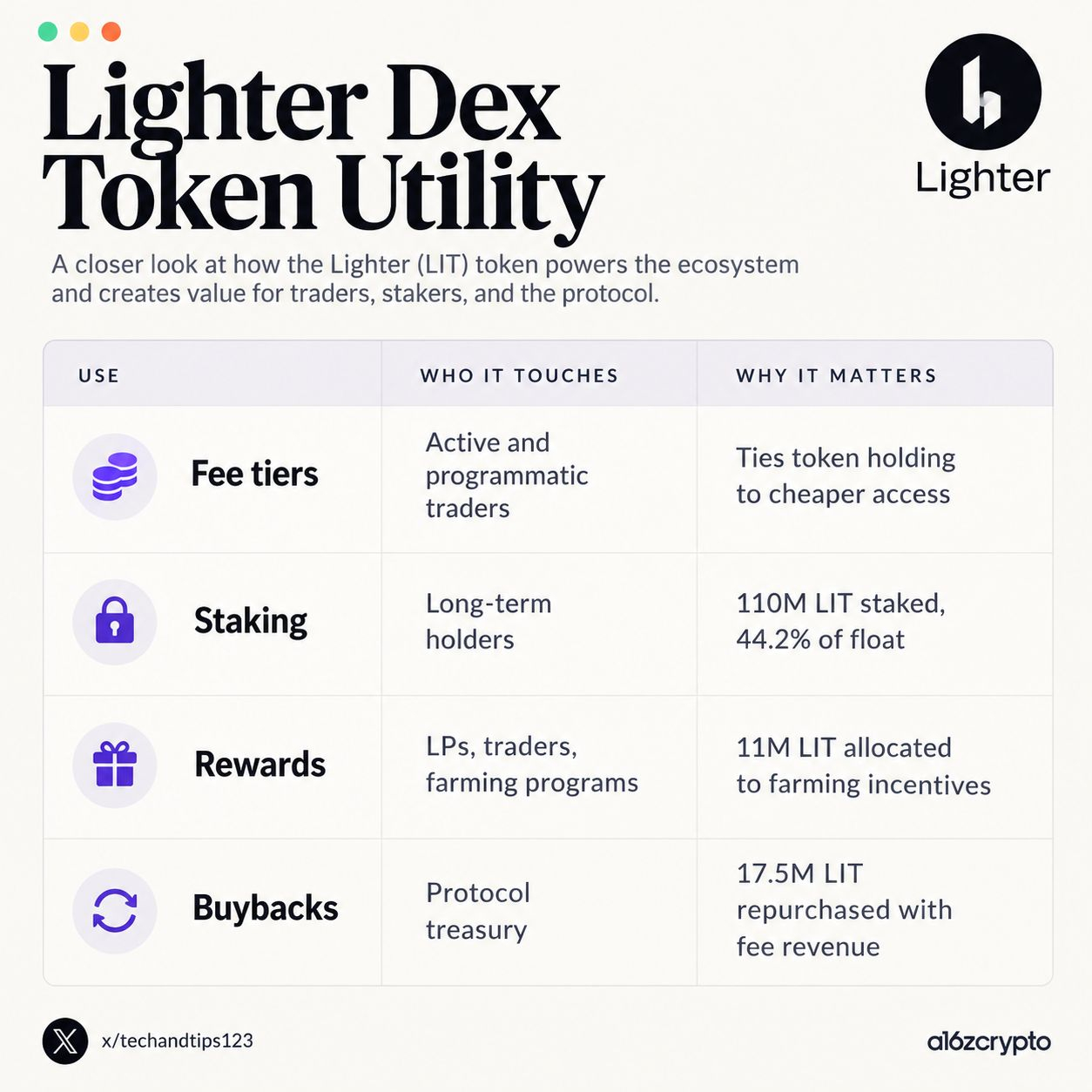
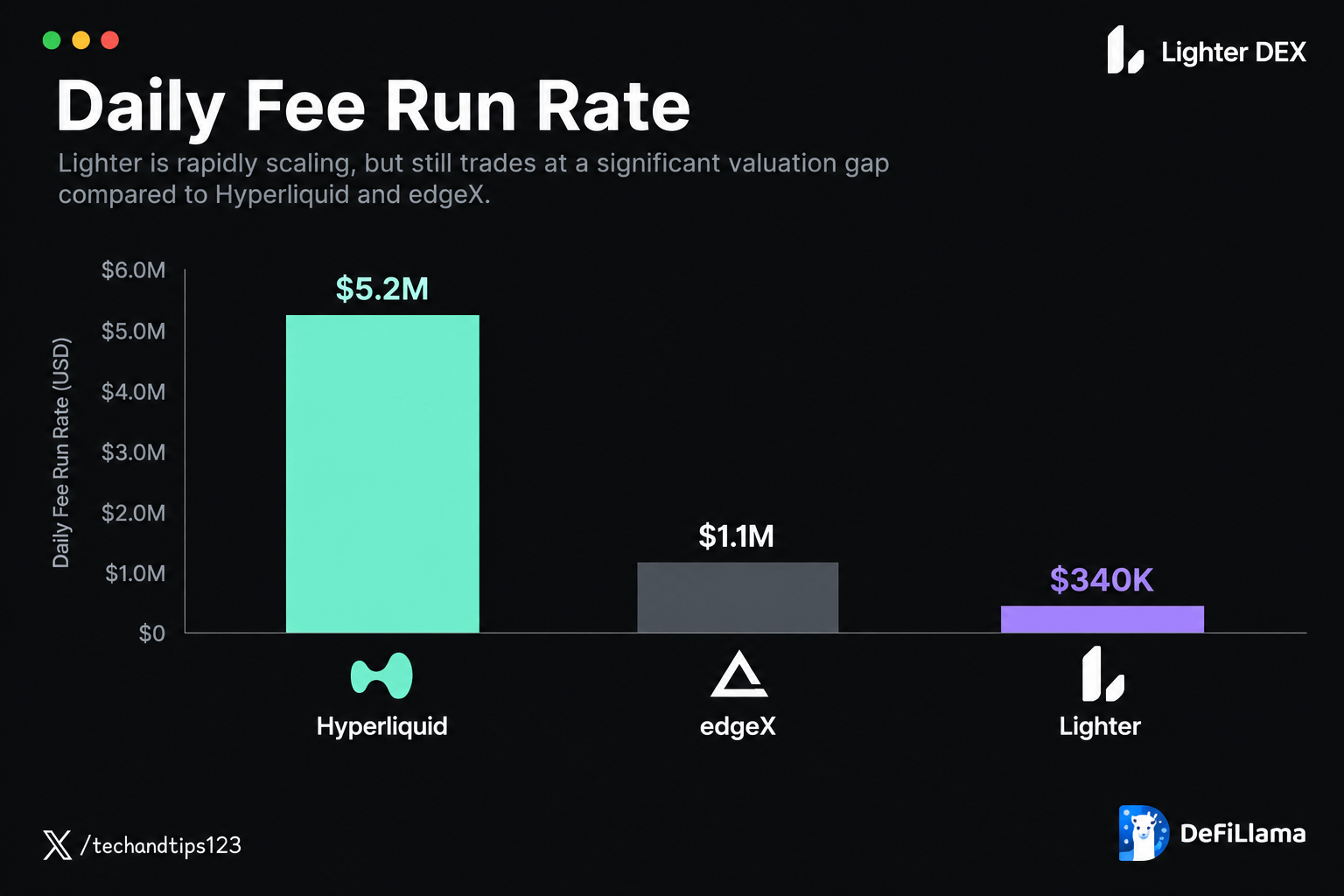
Payments: The protocol generates roughly $26 million in annualized revenue from premium institutional fees, liquidation penalties, and stablecoin yield. Every single dollar of this revenue is routed into systemic on-chain buybacks of the LIT token.
Rewards: Liquidity providers must hold LIT exposure to deposit capital into the Lighter Liquidity Pool. By participating in this backstop mechanism, they earn a share of the fees generated by the platform.
Staking: Institutional market makers are required to stake significant amounts of LIT to unlock the premium tier structures and gain access to prioritized execution bandwidth.
Access / Governance: Holding the token grants users voting power over the protocol parameters. This allows the community to shape future asset listings, adjust fee structures, and fine-tune the risk engine configurations.
The Flywheel:
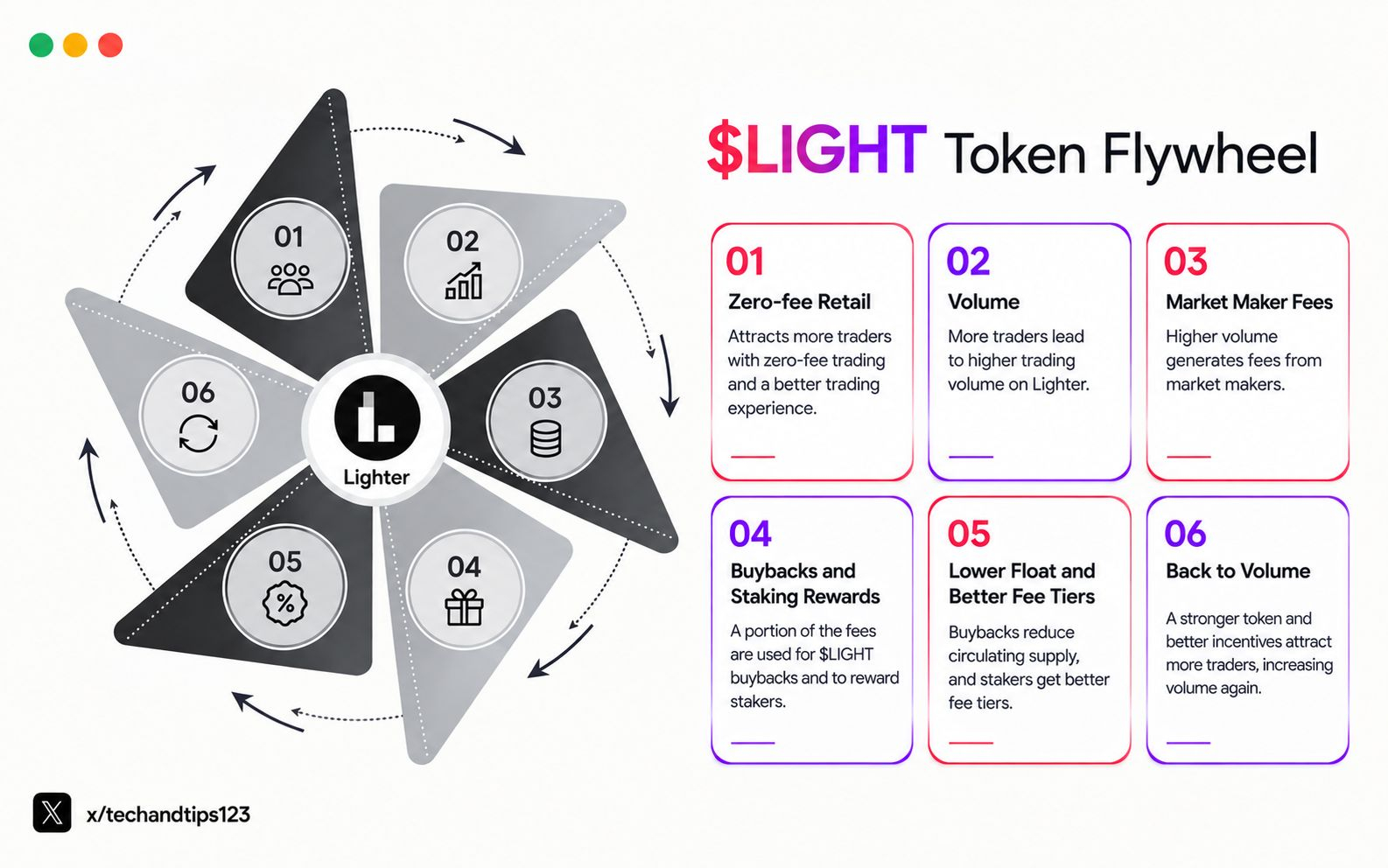
The Lighter flywheel operates on a highly engineered mechanism of structured supply absorption. The zero-fee retail model creates an absolute explosion of trading volume. This organic volume inevitably attracts professional high-frequency trading firms. These institutional players are forced to purchase and stake massive amounts of LIT to access the premium execution lanes they desperately need to compete effectively on the platform.


As the trading volume scales higher, the platform generates immense revenue from liquidation penalties and stablecoin treasury yields. Lighter takes 100 percent of this generated revenue and programmatically buys LIT off the open market. This constant, automated buy pressure, combined with the institutional staking requirements, rapidly drains the available circulating supply of the token.
A tighter token supply naturally increases the value of the rewards paid out to the liquidity providers. This encourages them to deposit even more capital into the system to capture the upside. This resulting deep liquidity creates the tightest spreads in the decentralized market, which brings in the next massive wave of retail traders to spin the entire economic wheel faster and cement the protocol as the dominant venue for digital asset derivatives.