

How market making works in crypto exchanges – TDMM
Every token you trade has a market maker behind it, or it should. Here is what they actually do, why the spread and slippage you pay depend on them, and how to tell a real one from a fake one.
Key takeaways
A market maker quotes a bid and an ask on the same pair, all day, every day. It earns the spread; you get to trade instantly.
The spread is the visible cost of trading. Slippage is the hidden one. Both shrink as market depth grows, and depth is what a market maker manufactures.
The algorithms do not “set” prices. They compute fair value, skew quotes to manage inventory and re-quote hundreds of times a second.
On 10 October 2025, visible BTC perpetual liquidity fell 99.8% in under an hour when makers pulled back. That is what a market without makers looks like.
Real market making is about tradability. Fake market making is wash trading, and people are going to prison for it.
What a market maker actually does
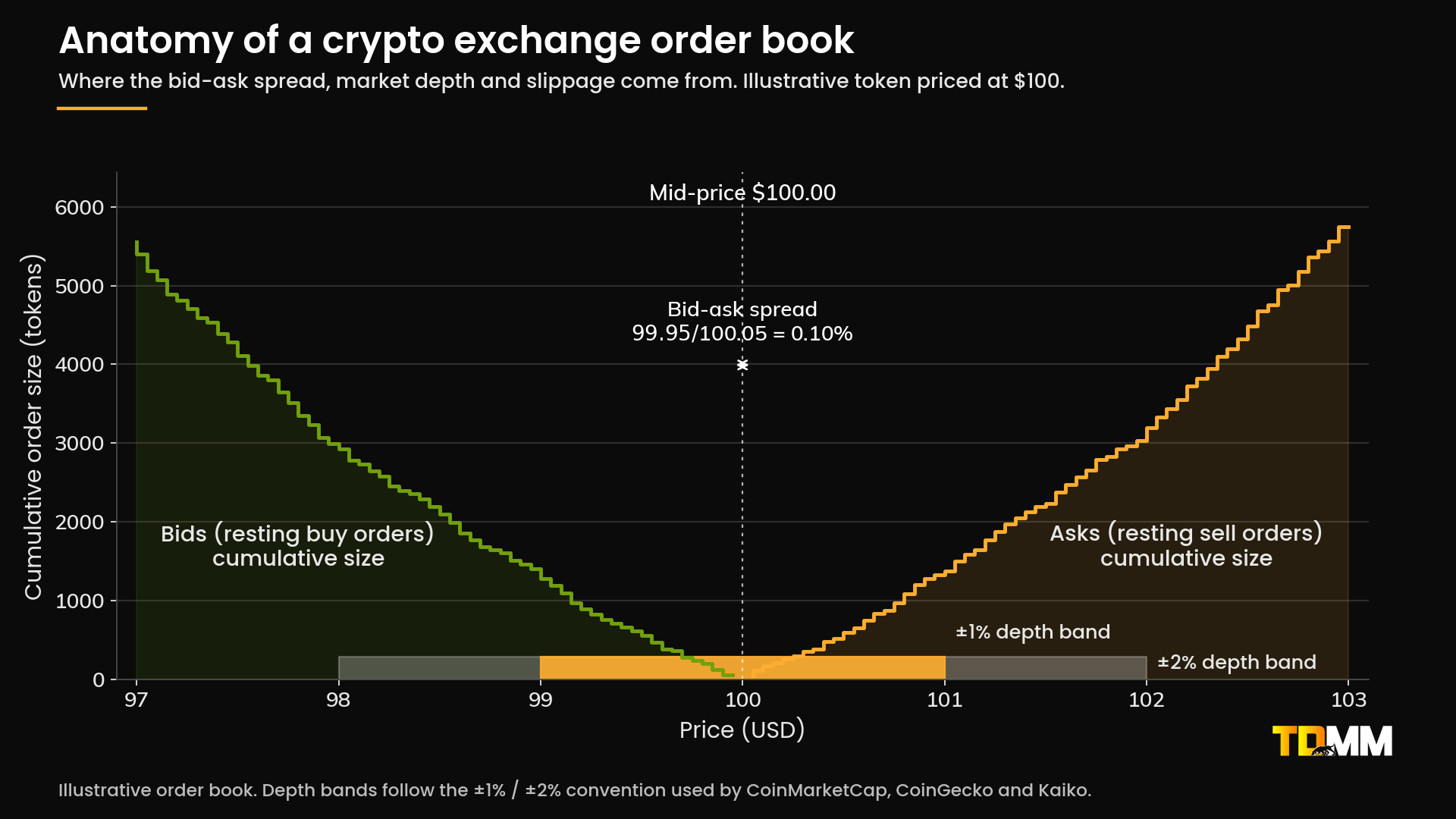
Buyers and sellers almost never show up at the same time, in the same size, at the same price. A market maker stands in the gap. It keeps resting buy orders (bids) and sell orders (asks) on the book continuously, takes your tokens when you sell and hands them to the next buyer, and gets paid the difference between the two prices.
Exchanges pay for this behaviour. Binance’s spot market maker program admits firms with 30-day volume above 1,000 BTC and scores them on maker volume, quoted spread, order size and order duration, in exchange for fee reductions and higher API limits.
Spread and slippage in one minute
Spread = (best ask − best bid) ÷ best ask. A $99.95 bid against a $100.05 ask is 0.10%, or 10 bps. On BTC/USDT at the top exchanges, TokenInsight measured spot spreads of roughly 0 to 0.02 bps in July 2026. On a newly listed token, expect 20 to 100 bps with a market maker and several percent without one.
Slippage is what happens when your order is bigger than the liquidity at the best price and fills across several levels. A $250,000 sell that slips 0.5% on a deep book can slip close to 7% on a thin one. Kaiko’s example: a $100,000 WLD sale on Uniswap v3 would have slipped 6.3%.
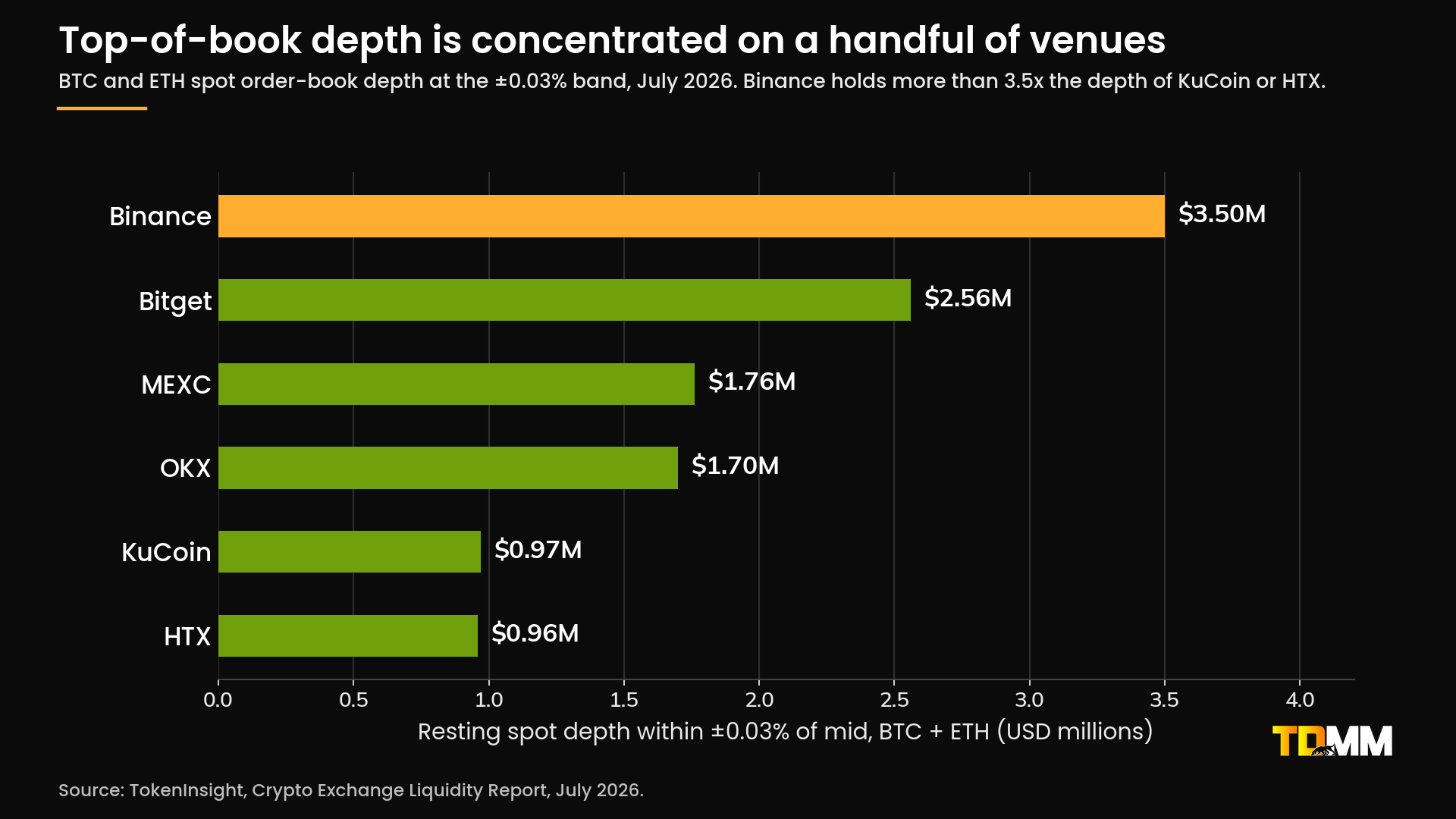
Depth is concentrated. In July 2026 Binance held about $3.5M of BTC and ETH spot depth within 0.03% of mid, more than 3.5x KuCoin or HTX. If your token is only liquid on one venue, it is one outage away from being illiquid.
Inside the algorithm
The engine runs a loop: market data → fair value → inventory check → quote engine → execution → hedge and risk → repeat, every 10 to 200 milliseconds, per pair, per venue.
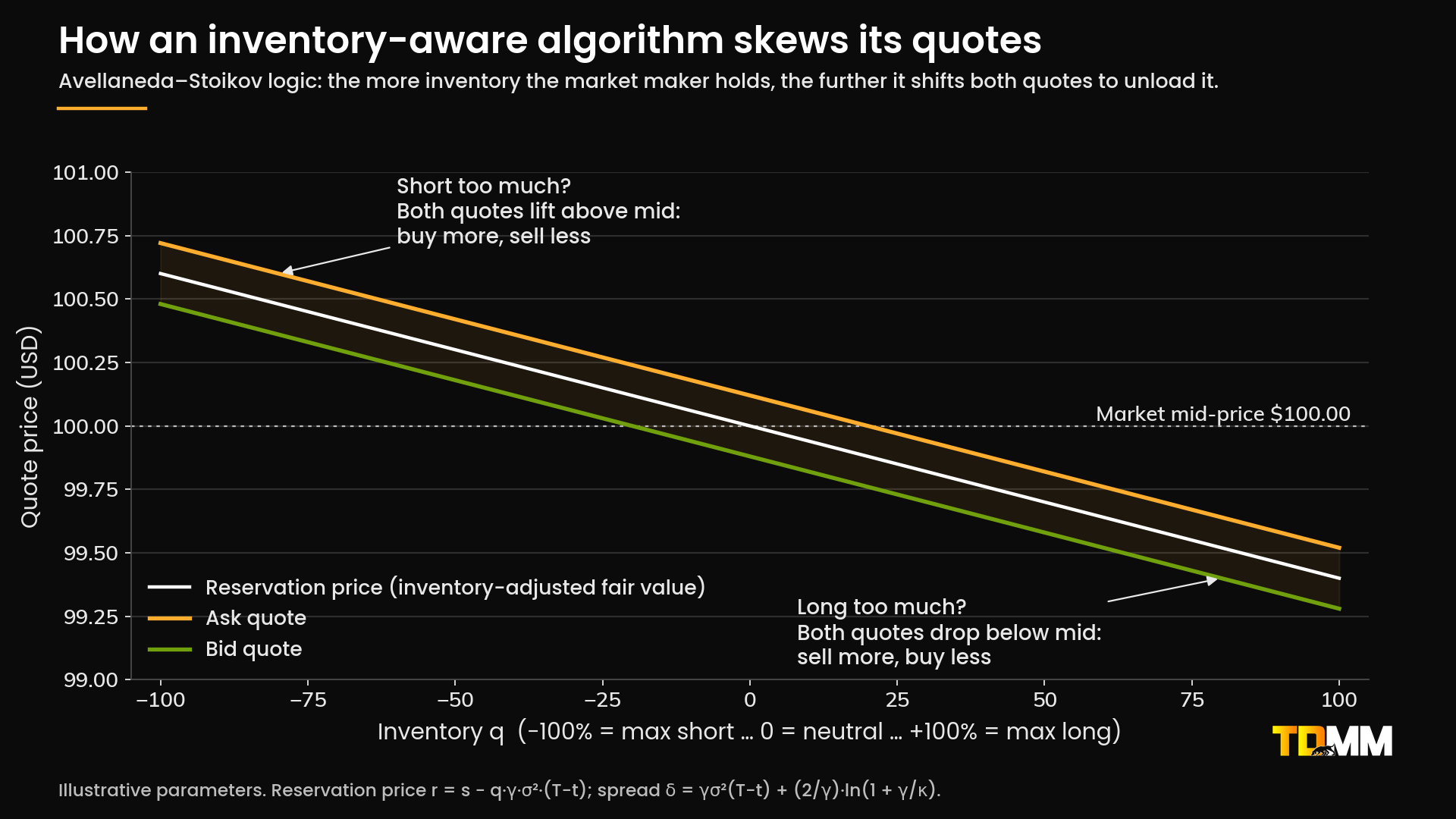
The core idea, from the Avellaneda-Stoikov model, is that the maker quotes around a reservation price rather than the market mid. Long too much inventory? Both quotes drop below mid so it sells more and buys less. Short too much? Both lift above mid. Spreads widen with volatility and narrow when the book is dense. Professional desks add cross-exchange hedging, perpetual hedging and AMM range management on top, and hard risk limits that pull quotes when fills turn toxic.
10 October 2025: the day the makers stepped back
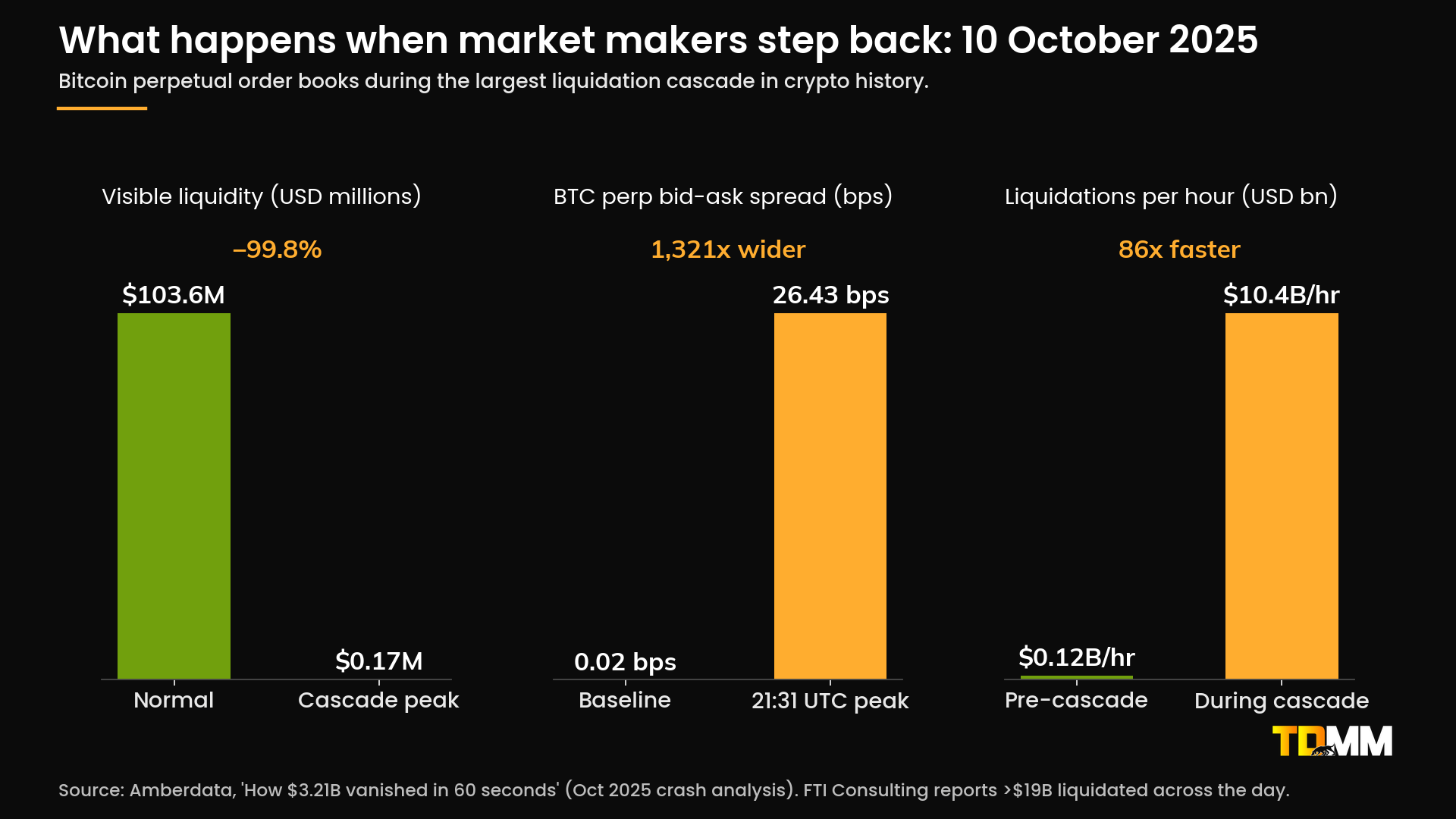
More than $19 billion of leverage was liquidated in about a day (FTI Consulting), $3.21 billion of it in a single minute (Amberdata). Visible BTC perpetual liquidity collapsed from $103.6M to $0.17M. The spread went from 0.02 bps to 26.43 bps. BTC fell 6.8%; AVAX and AAVE printed intraday drawdowns near 69%.
Two lessons. Market makers are not a guarantee against crashes; their risk rules pull quotes when fills become toxic, and any firm that promises otherwise is promising to lose its clients’ inventory. And the tokens that recovered fastest were the ones whose makers were back on the book within minutes.
Real market making vs. volume manufacturing
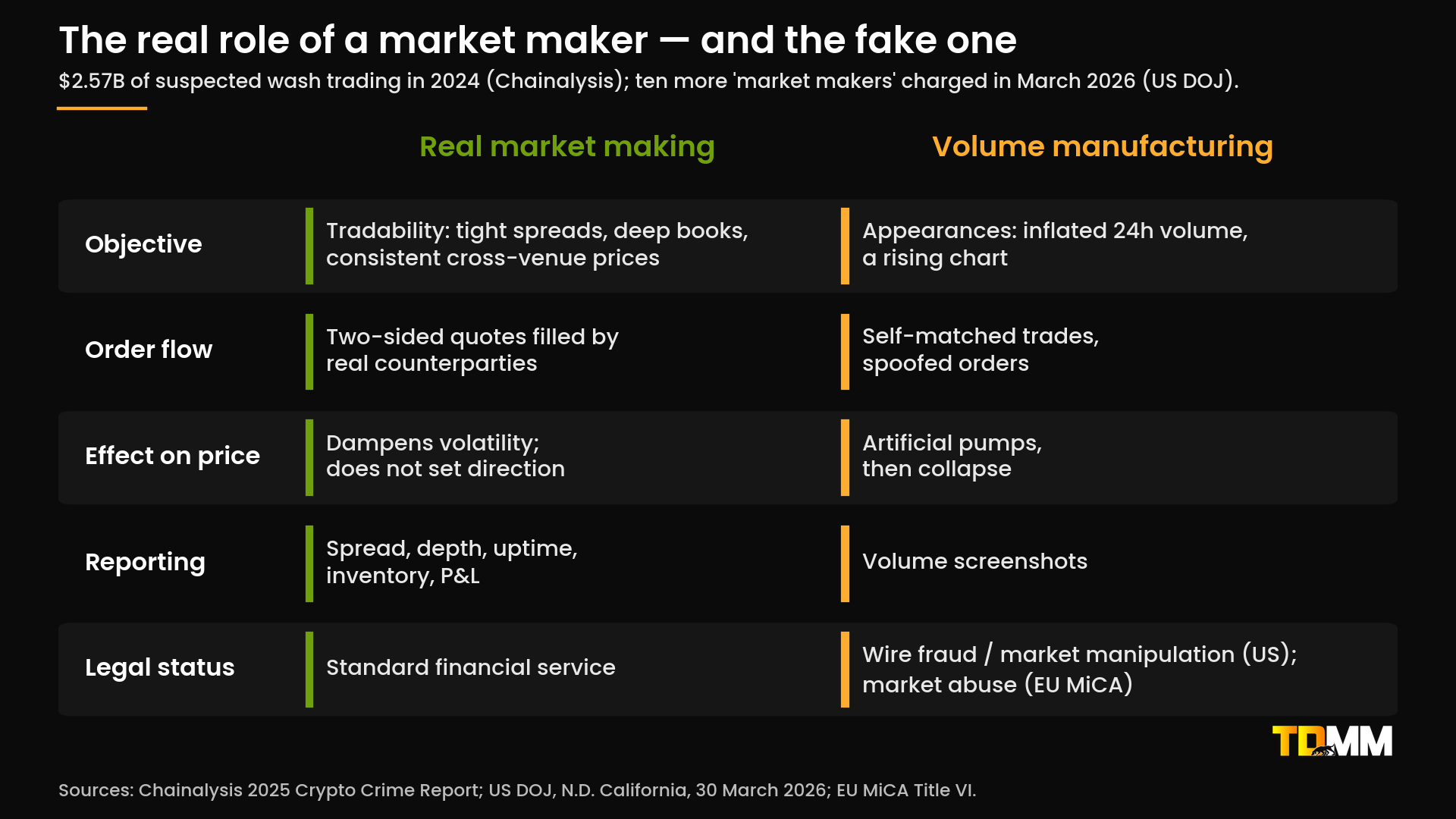
A real market maker makes your token tradable at size, on every venue, in every condition, and reports spread, depth, uptime, inventory and P&L so you can verify it. A fake one trades with itself to print volume. Chainalysis found $2.57B of suspected wash trading on three chains in 2024. The Gotbit founder was sentenced and forfeited $23M in June 2025; on 30 March 2026 US prosecutors charged ten more people from four “market making” firms. CoinMarketCap, CoinGecko and the exchanges have all tightened their screens.
It also does not work commercially: only about 32% of new listings trade above listing price immediately, and fewer than 10% a year later (CoinGecko). Fake volume changes none of that. Real depth does.
Where TDMM fits
TDMM has quoted crypto markets since 2015: $10B+ traded, 100+ CEX and DEX integrations, 200+ markets, 24/7. Proprietary engines, one risk book across venues, transparent reporting, and a flat no to wash trading and price promises. Market making, treasury, exit management and listing support under one roof.
Full guide with worked examples, deal structures and an evaluation checklist: tdmm.io/insights/blog/
#MarketMaking #CryptoLiquidity #BidAskSpread #Slippage #OrderBook #TDMM #Binance