
Zcash Isn’t Just Another Privacy Coin
Zcash is entering a very different phase.
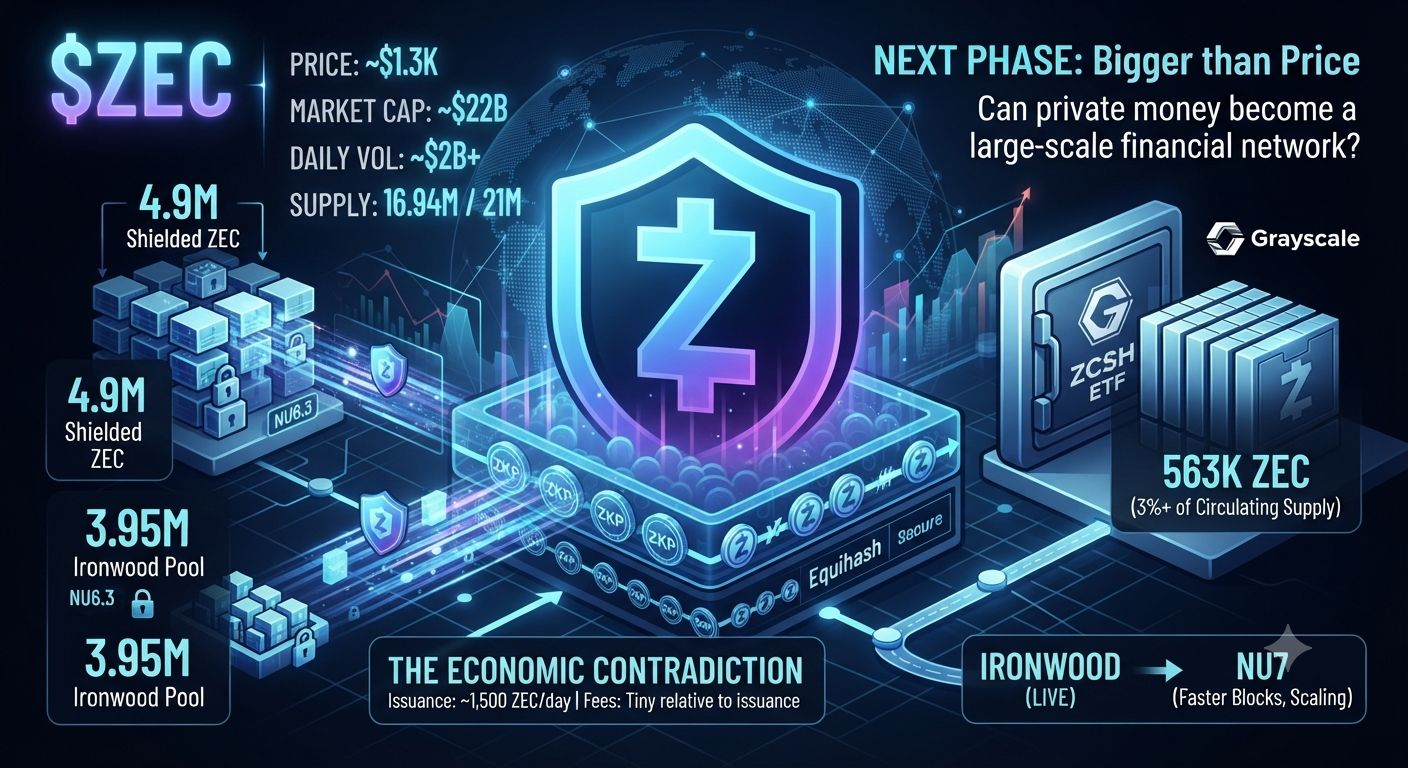
$ZEC is trading around $1.3K with roughly a $22B market cap and ~$2B+ in daily volume, while only ~16.94M of its 21M maximum supply has been issued.
The more interesting number is underneath the price: around 4.9M ZEC is now shielded, nearly 29% of issued supply, with roughly 3.95M ZEC already sitting in the new Ironwood pool after NU6.3.
That matters because Zcash is not relying on a narrative alone. Its core architecture uses zero-knowledge proofs to shield transaction details, while Equihash continues to secure the chain through Proof of Work.
But there is a real economic contradiction.
Network issuance is roughly 1,500 ZEC per day, while transaction fees remain tiny relative to the value of newly issued coins. So the key question isn't simply whether Zcash has demand.
It is whether privacy usage can eventually translate into sustainable network value capture.
Meanwhile, institutional access has changed the market structure. Grayscale’s ZCSH ETF now holds roughly 563K ZEC, equivalent to more than 3% of circulating supply.
And the protocol isn't standing still: Ironwood is live, while NU7 discussions include faster blocks and scaling improvements.
The next phase of Zcash is therefore bigger than price.
Can private money become a large-scale financial network — and can the economics catch up with the technology?
Zcash is entering a very different phase.
$ZEC is trading around $1.3K with roughly a $22B market cap and ~$2B+ in daily volume, while only ~16.94M of its 21M maximum supply has been issued.
The more interesting number is underneath the price: around 4.9M ZEC is now shielded, nearly 29% of issued supply, with roughly 3.95M ZEC already sitting in the new Ironwood pool after NU6.3.
That matters because Zcash is not relying on a narrative alone. Its core architecture uses zero-knowledge proofs to shield transaction details, while Equihash continues to secure the chain through Proof of Work.
But there is a real economic contradiction.
Network issuance is roughly 1,500 ZEC per day, while transaction fees remain tiny relative to the value of newly issued coins. So the key question isn't simply whether Zcash has demand.
It is whether privacy usage can eventually translate into sustainable network value capture.
Meanwhile, institutional access has changed the market structure. Grayscale’s ZCSH ETF now holds roughly 563K ZEC, equivalent to more than 3% of circulating supply.
And the protocol isn't standing still: Ironwood is live, while NU7 discussions include faster blocks and scaling improvements.
The next phase of Zcash is therefore bigger than price.
Can private money become a large-scale financial network — and can the economics catch up with the technology?