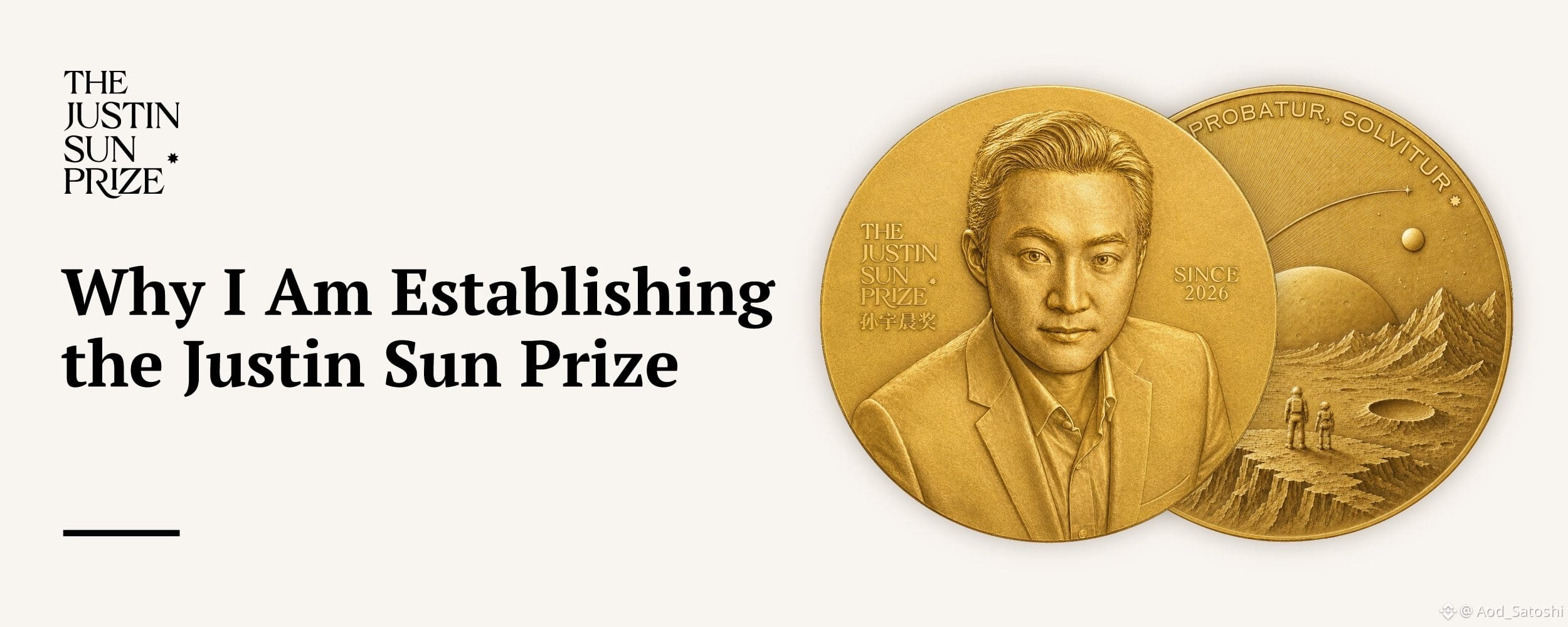
I think the Justin Sun Prize is more interesting than the headline “Justin Sun created a prize named after himself.”
The real story is the structure behind it.
The prize is framed as a global mathematical bounty, but what makes it different is formal verification. Under the published rules, submissions must pass Lean-based verification before moving forward.
That changes the question from:
“Who solved the problem?”
to:
“Can the proof be independently verified?”
That matters.
If AI becomes better at producing complex mathematical proofs, discovery may no longer be the only bottleneck. Verification could become just as important: is the answer actually correct, reproducible, and independent of reputation?
That’s where formal verification gets interesting. Instead of trusting authority alone, the logic itself can be checked systematically.
Another point worth watching is that the proof could come from a human, an AI system, or both. What matters is whether it survives verification.
Then there’s the blockchain angle.
If prize payments and records are handled on-chain, the process becomes easier to audit and trace.
Still, I wouldn’t call this a “new Nobel Prize” yet.
Prestige isn’t created by prize money alone. It comes from the quality of the problems, the credibility of the judging process, the people involved, and the body of work built over time.
That is what the Justin Sun Prize still has to prove.
But the combination of mathematics, AI, formal verification, and blockchain is genuinely worth watching.
If this model works, the bigger question may not be who wins.
It may be whether humans and AI can create new knowledge together and verify the result without simply trusting whoever produced it.
@TRON DAO @TronDao_THA @justinsuntron
#TRONGlobalFriends #TGF #TRON
The real story is the structure behind it.
The prize is framed as a global mathematical bounty, but what makes it different is formal verification. Under the published rules, submissions must pass Lean-based verification before moving forward.
That changes the question from:
“Who solved the problem?”
to:
“Can the proof be independently verified?”
That matters.
If AI becomes better at producing complex mathematical proofs, discovery may no longer be the only bottleneck. Verification could become just as important: is the answer actually correct, reproducible, and independent of reputation?
That’s where formal verification gets interesting. Instead of trusting authority alone, the logic itself can be checked systematically.
Another point worth watching is that the proof could come from a human, an AI system, or both. What matters is whether it survives verification.
Then there’s the blockchain angle.
If prize payments and records are handled on-chain, the process becomes easier to audit and trace.
Still, I wouldn’t call this a “new Nobel Prize” yet.
Prestige isn’t created by prize money alone. It comes from the quality of the problems, the credibility of the judging process, the people involved, and the body of work built over time.
That is what the Justin Sun Prize still has to prove.
But the combination of mathematics, AI, formal verification, and blockchain is genuinely worth watching.
If this model works, the bigger question may not be who wins.
It may be whether humans and AI can create new knowledge together and verify the result without simply trusting whoever produced it.
@TRON DAO @TronDao_THA @justinsuntron
#TRONGlobalFriends #TGF #TRON