
For a long time, managing different types of assets meant using different platforms.
Crypto on one exchange.
Stocks through another broker.
AI tools somewhere else.
Payments and other financial services in separate apps.
That fragmentation is gradually changing.
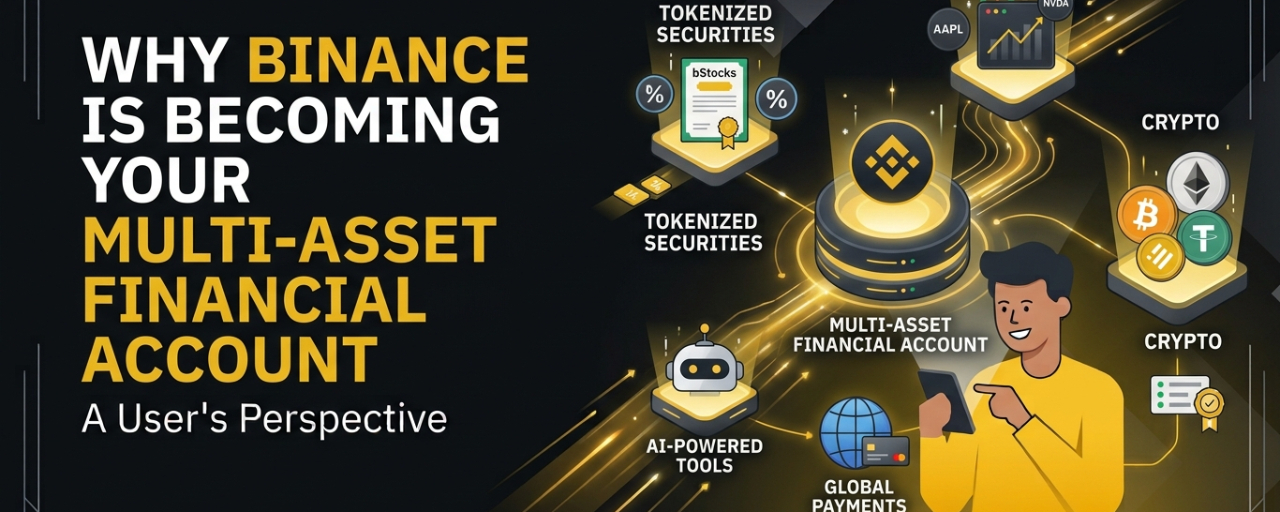
Binance started as a crypto exchange, but its ecosystem is expanding into areas that go beyond crypto trading, including U.S. stocks and ETFs, tokenized securities, AI-powered tools, and infrastructure designed for AI agents.
So, why Binance?
For me, the answer increasingly comes down to three things:
Access. Network. Agentic infrastructure.
1. Why Binance? Because access is expanding beyond crypto
One of the clearest changes is the addition of traditional financial assets alongside crypto.
Binance launched Stocks & ETFs trading in 2026, giving eligible users access to more than 7,000 U.S.-listed stocks and ETFs directly through the Binance ecosystem. Binance has also highlighted minimum investments starting from $5 for supported products. Availability, however, depends on the user's region and eligibility. (Binance)
That changes the experience of someone who wants exposure to different asset classes.
Instead of thinking:
“Which platform do I use for crypto, and which one do I use for stocks?”
the experience is increasingly becoming:
“What assets can I access through my Binance account?”
Then there is bStocks, Binance's tokenized securities offering.
According to Binance Academy, bStocks represent tokenized securities backed 1:1 by corresponding U.S. shares held by regulated custodians. They can be traded on Binance's spot market 24/7, and fractional exposure can start from $5. (Binance)
There is an important distinction here: bStocks are not the same as directly owning the underlying shares. They represent an interest in the underlying securities through the tokenized structure. (Binance)
That distinction matters.
But the bigger picture is clear: Binance is building an environment where crypto, traditional assets, and tokenized securities can exist within a broader financial ecosystem.
2. Why Binance? Because the network matters
Access to markets is only one part of the equation.
The other part is liquidity.
Liquidity affects how efficiently orders can be executed. Deeper markets can generally provide tighter spreads and reduce the potential impact of larger orders, while thinner markets can lead to greater slippage. (Binance)
This becomes particularly important when the platform is connecting different types of financial activity.
Crypto trading already depends heavily on liquidity and market depth.
But the same infrastructure becomes even more relevant when you start thinking about automated systems and AI agents that can retrieve market data and potentially execute actions.
Binance's own Agent OS documentation highlights liquidity, real-time market data, and access to multiple markets as part of the infrastructure available to connected agents. (Binance)
So the value isn't simply:
“Binance has many products.”
It's also:
“Those products are increasingly being connected through the same ecosystem.”
3. Why Binance? Because AI is moving from answering to acting
This is probably the most interesting part for me.
AI has traditionally been something we ask questions to.
You ask for an explanation.
You ask for market information.
You ask for an analysis.
But the next stage is AI that can interact with external tools and actually perform authorized actions.
That's where Binance Agent OS comes in.
Launched in August 2026, Binance Agent OS is a platform and toolkit designed to connect compatible AI applications and agents to Binance capabilities. It brings together Binance APIs, the Wallet Agentic Hub, Binance x402, Skill Hub, and support for the Model Context Protocol (MCP). (Binance)
MCP essentially provides a standardized connection layer that allows compatible AI applications to discover and use supported tools.
And this isn't limited to one AI environment.
Binance lists compatibility with tools including ChatGPT, Claude, Claude Code, Codex, and VS Code, among others. (Binance)
That means the conversation is moving from:
AI tells me what I could do → AI can help me do it.
4. Binance AI Pro takes the idea even further
Binance has also been developing Binance Ai Pro, an AI agent designed to help users with market analysis, trading workflows, and execution.
The beta version introduced integration with multiple AI models, including ChatGPT, Claude, Qwen, MiniMax, and Kimi, alongside Binance Skills. It also uses a separate AI account structure with restricted permissions rather than simply giving the AI unrestricted access to the user's main account. (Binance)
That architecture is important.
AI and finance involve real consequences, so permissions matter.
With Agent OS, users can determine what an agent is allowed to access, while Binance provides mechanisms for managing or revoking those permissions. The Agent OS documentation also notes that the system is not an autonomous trading system that removes the need for authorization or user judgment. (Binance)
In other words, the goal isn't simply:
“Let AI control everything.”
It's closer to:
“Give AI useful tools, but define the boundaries.”
5. From an exchange to an ecosystem
This is why the phrase “multi-asset financial account” is becoming interesting.
Consider the pieces coming together:
Crypto
Spot, futures, Convert, and other crypto products.
Traditional markets
Access to thousands of U.S. stocks and ETFs for eligible users. (Binance)
Tokenized securities
bStocks provide tokenized exposure to supported U.S. securities and can operate on-chain. (Binance)
AI
Binance Ai Pro brings AI-assisted workflows into the platform. (Binance)
Agent infrastructure
Agent OS and MCP provide a standardized way for compatible AI applications to interact with supported Binance tools. (Binance)
Liquidity and market infrastructure
The same ecosystem provides access to market data and execution infrastructure.
Individually, each feature is useful. But the bigger story is what happens when they start working together.
6. And that's my answer to “Why Binance?”
I don't choose Binance simply because it has a long list of products.
The more interesting reason is the direction of the ecosystem.
Finance is becoming increasingly digital.
Assets are becoming increasingly tokenized.
AI is becoming increasingly capable of interacting with external systems.
And users increasingly want fewer fragmented experiences.
Binance is building toward a model where crypto, traditional assets, tokenized securities, payments, market infrastructure, and AI-powered tools can exist within one connected environment. Binance itself describes this broader evolution as a financial “super app” experience, with Agent OS now adding an agentic layer to that ecosystem. (Binance)
That doesn't mean every feature is available everywhere, nor does it mean every product is suitable for every user. But it does explain why Binance is becoming more than just a crypto exchange.
The real question is no longer only:
“Where can I trade crypto?”
It's increasingly:
“How much of my financial workflow can I access, manage, and eventually automate from one place?”
And that's what makes Binance's evolution particularly interesting to me.
🔎 Sources
Binance Blog — Introducing Binance Agent OS (Binance)
Binance Announcement — Binance Agent OS launch (Binance)
Binance Academy — What Are bStocks? (Binance)
Binance Announcement — Binance Ai Pro Beta (Binance)
Binance Academy — Guide to Binance Ai Pro (Binance)
Binance Academy — What Is Liquidity and Why Does It Matter? (Binance)
Binance Blog — AI Agents and the Financial Super App (Binance)
Disclaimer: This article is for educational and informational purposes only and should not be considered financial advice. Availability of Binance products and services may vary by jurisdiction and eligibility. Always conduct your own research (DYOR) and consider the risks before using any financial product or AI-assisted trading tool.