
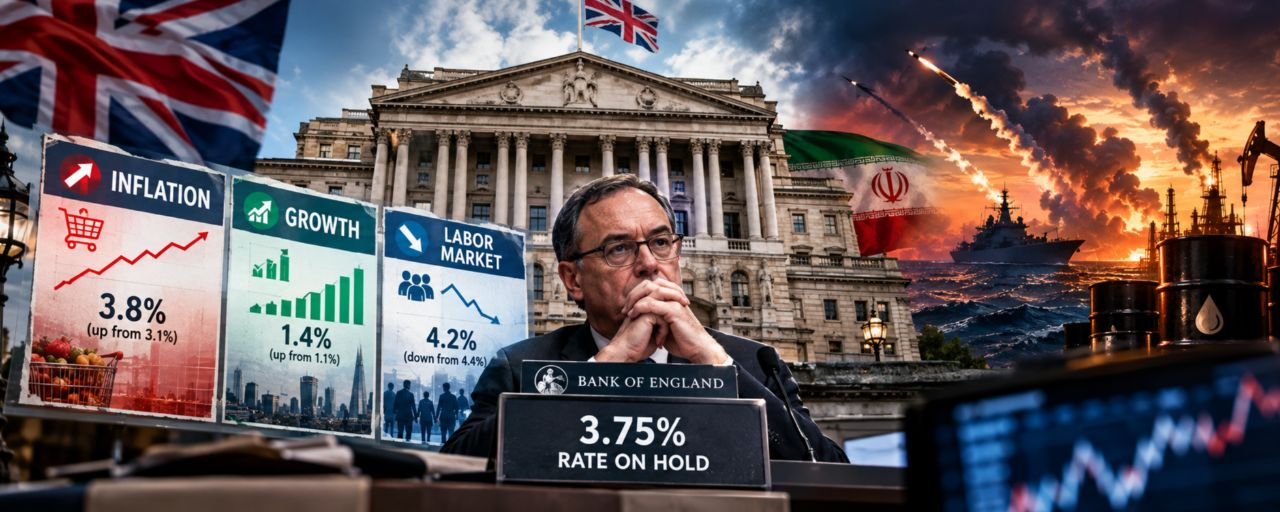

The Bank of England looks all but certain to leave interest rates unchanged at 3.75% when the Monetary Policy Committee meets on Thursday, September 17. That would be the sixth consecutive hold since December, and on paper it should be a fairly uneventful decision.
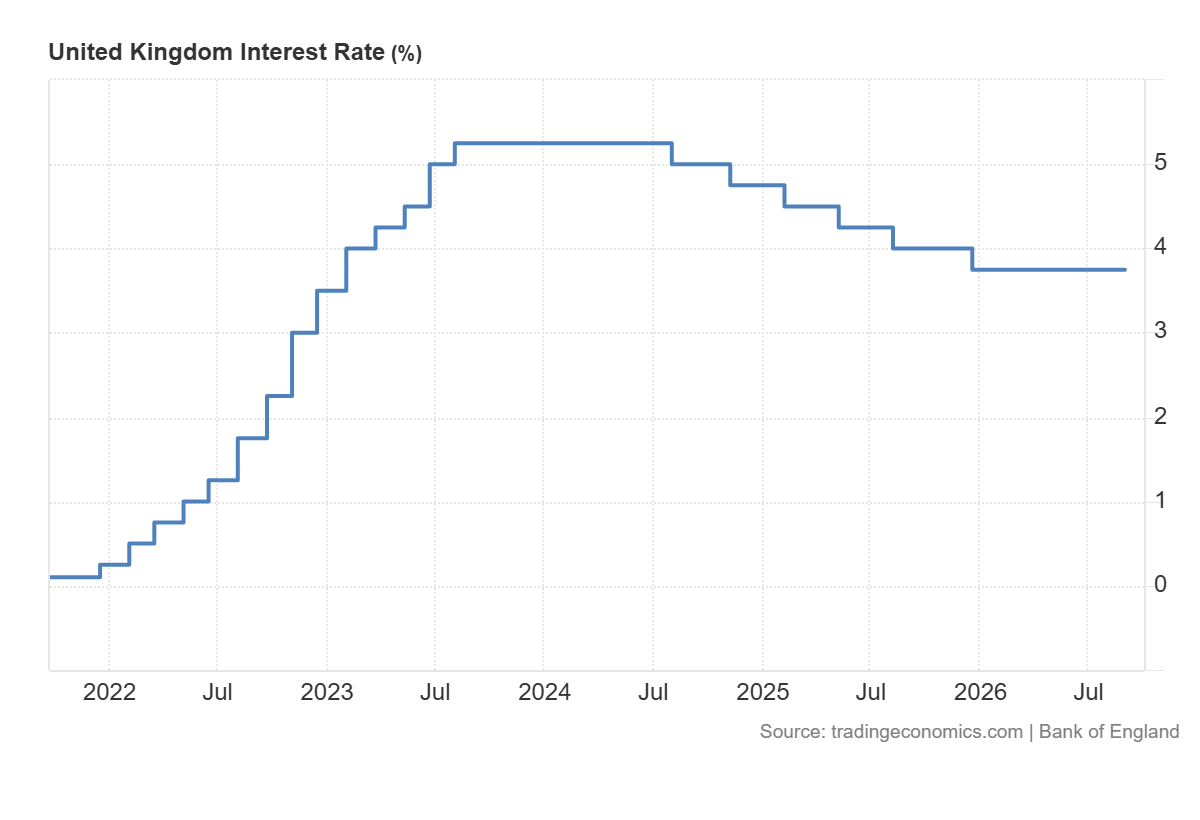
In practice, the backdrop has gotten messier. Inflation is now expected to peak higher than economists were forecasting just a few months ago, largely because the Iran war keeps pushing oil prices around, and policymakers are having to weigh that against a labour market that's clearly losing steam.
A shadow committee that's almost as divided as the real one
City AM runs its own Shadow Monetary Policy Committee, a panel of independent economists who vote on rate decisions alongside the real thing, and its latest read is a hold, but not a comfortable one.
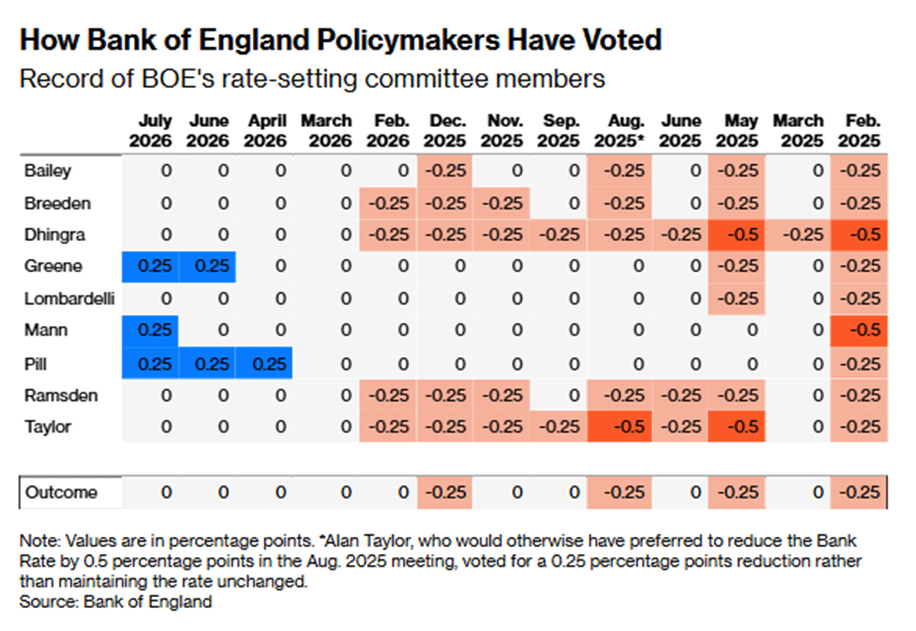
The panel split 6-3 in favour of no change. Three members voted instead for a 25 basis point increase. Most of the economists involved, who took part independently of whatever institutions they work for, agreed the call was finely balanced, and some of those who ultimately backed a hold admitted the case for waiting was "thin."
That's roughly where the real MPC found itself in July too. At that meeting, policymakers voted 6-3 to hold Bank Rate at 3.75%, with Huw Pill, Megan Greene and Catherine Mann all voting to push it up to 4%. Economists expect the same three to dissent again this time around.
Curiously, markets didn't read that vote as especially hawkish once the dust settled. If anything, the reaction went the other way: the probability traders assigned to no change in September rose from 53.6% before the July decision to 73% afterward.
Governor Bailey leaned into that dovish reading himself, saying the Committee wasn't moving any closer to a hike despite the 6-3 split. Even so, the number of MPC members pushing for tighter policy has been creeping up meeting to meeting, and that's not lost on anyone watching the vote count.
Inflation ticks up, but not everywhere at once
UK CPI inflation rose to 2.9% in July, up from 2.6% in June and the highest reading since March. Core CPI inflation held at 2.6%, with goods inflation rising to 2.7% from 2.2% and services inflation unchanged at 3.4%. That matters because services make up the largest share of the UK economy, and a decline there suggests the kind of second-round effects policymakers worry about- wage demands feeding into prices, broader retail markups- aren't really showing up yet.
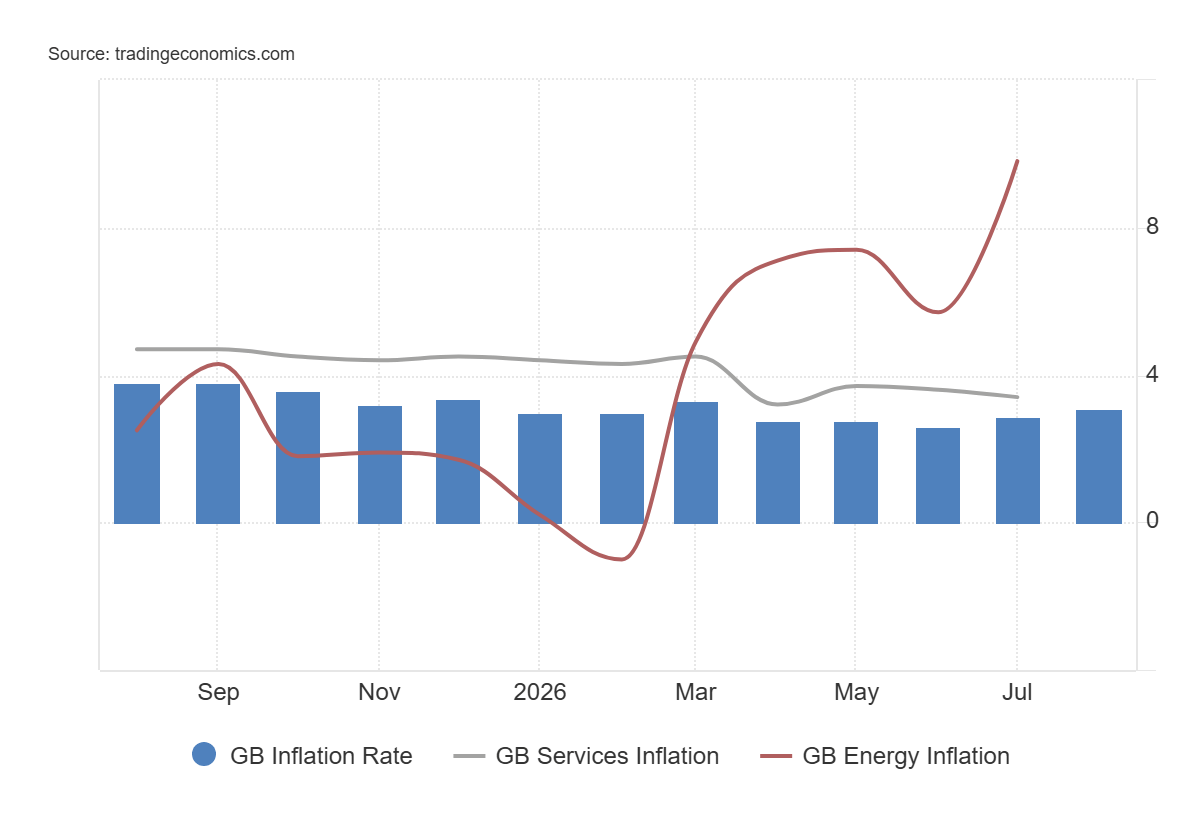
Energy prices are doing most of the heavy lifting; if there's one thing tilting sentiment toward eventual tightening, it's energy. In the August CPI print, transport costs, particularly motor fuels, made the largest upward contribution to the annual rate, with transport inflation rising to 4.6% from 3.6% in July.
Escalating tensions in the Middle East have pushed oil prices higher, reviving inflation worries right as central banks were starting to feel confident that price pressures were fading.
Ofgem's next price cap takes effect in October and will lift bills by 4% for a typical dual-fuel household, which gives the Bank a fairly concrete reason to expect inflation to tick up further in the near term. That said, higher energy costs don't automatically justify higher rates on their own, and that's feeding into hawkish chatter in markets about a hike landing before the year is out.
UBS has described the upcoming rate decision as a broader shift in tone, one that leaves a future rate rise looking a lot less far-fetched than it did over the summer. The playbook, as UBS frames it, is straightforward enough: hold rates now, but keep the rhetoric hawkish.
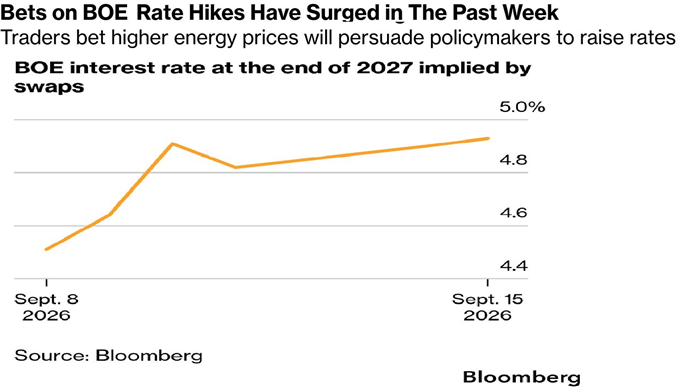
Money markets have turned notably more hawkish as the energy price surge revives inflation concerns, and swaps are now pricing in five separate 25 basis point increases from the Bank of England. Some analysts go further still, arguing that the odds of a near-term rate cut are fading fast and that the chance of the Bank's next move being up rather than down is getting harder to dismiss.
Growth, meanwhile, came in stronger than expected. New figures show the economy grew 0.4% in July, up from 0.3% in June, with the gains spread fairly evenly across the board:
Services: +0.4%
Production: +0.2%
Construction: +0.1%
Economic activity strengthened across services, production and construction alike, which is the kind of broad-based number that makes it harder for the MPC to justify sitting on its hands indefinitely.
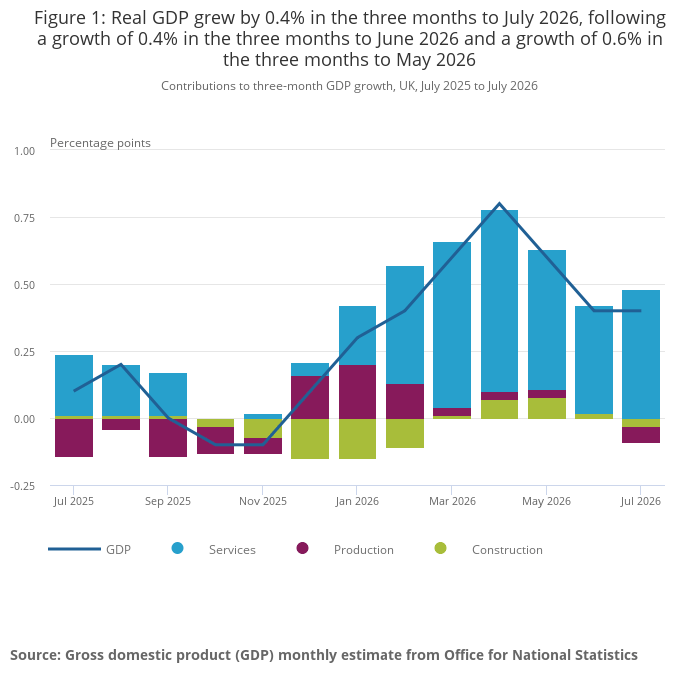
Rising inflation combined with a stronger economy could be enough to push policymakers toward a hike in the months ahead, several market participants suggested.
Wealth Club: a hike before Christmas is "a touch more likely"
Susannah Streeter, chief investment strategist at Wealth Club, expects the Bank to hold but thinks the stronger growth numbers shift the odds. "Stronger-than-expected growth makes an interest rate hike before Christmas 'a touch more likely'" and could mean three more hikes are on the horizon, she said.
"The big worry is that higher energy costs will be passed on as higher prices by businesses and consumers, but the committee will likely want to see more evidence of that before triggering rate hikes," Streeter said.
Given the turmoil in energy and bond markets, however, Streeter added, there is an expectation that we could see three to even four rate hikes over the next year. However, if the economy slows and consumers turn more cautious, that reticence may do some of the inflation-busting work for the bank.
But the labour market is pulling in the opposite direction
Just as the inflation and growth numbers build a case for tightening, the jobs data cuts the other way, and could end up tempering some of that hawkish rhetoric. The latest labour market report shows the number of employees on UK company payrolls fell by 26,000 in August and is down 145,000 compared with August 2025.
The unemployment rate for people aged 16 and over held at 4.9% for the May to July quarter, but pay growth is clearly cooling. Total pay growth, including bonuses, slowed to 3.9% in the three months to July, down from 4.2% in the prior three-month period. Regular pay growth, which strips out bonuses, held steady at 3.5%.
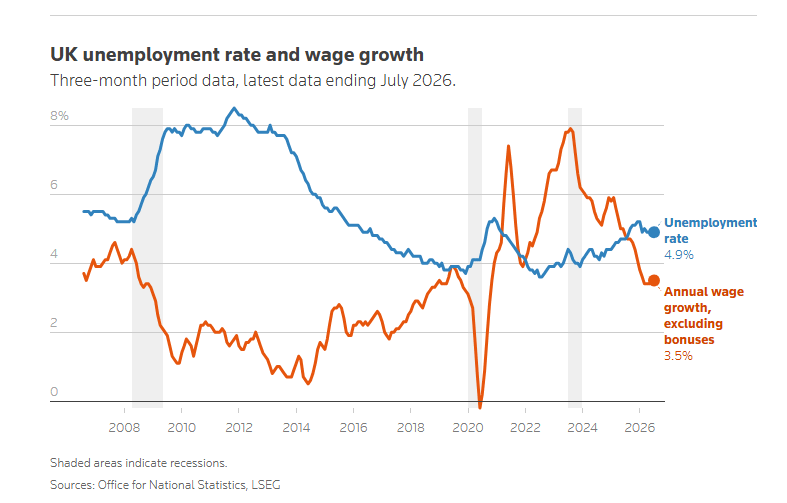
Felix Feather, an economist at Aberdeen, sees that softness as the main thing keeping a lid on rate hike expectations so far, even with the energy shock in play.
"The softness of the labour market had been the key variable holding back expectations for rate hikes in response to the ongoing energy cost shock," he said. "But markets have now moved to price aggressive hiking. We see the Bank of England hiking only twice, in November and February 2027."
Where that leaves Thursday's decision
Futures markets are currently pricing in a hiking cycle starting in November that would take the policy rate to roughly 4.50% by March, up from 3.75% today. For now, most economists still expect the Bank to favour a wait-and-see approach, particularly given how much of the current inflation pressure is tied to a conflict in the Middle East whose economic fallout is still playing out.
A hold on Thursday looks like the safe call. What happens after that will likely come down to whether the labour market keeps softening quickly enough to offset an energy shock that, so far, shows no real sign of easing.