


Bitcoin Caught Between CLARITY, Inflation & 5% Yields
Hey everyone, and welcome to the Weekly Market.
Bitcoin went nowhere last week, and it took the hard road to get there. As of Sunday afternoon it sat near $77,000 with Ethereum near $2,490, both within touching distance of where they stood seven days earlier. In between, Bitcoin dropped a thousand dollars in sixty seconds on Friday’s CPI print, recovered almost all of it, ran to $79,890 on Saturday, then slid back towards $77,200. By Tuesday morning, with the US 10-year yield above 5% for the first time since 2007, it was trading around $76,800, down 1.8% on the session. Bitcoin remains roughly 39% below its October 2025 peak of $126,198.
Ether ran harder in both directions. It jumped from roughly $2,433 to $2,667 on Friday, with about $250 million of shorts liquidated and transactions above $1 million rising nearly 14%, then gave the entire move back and was under $2,500 by Sunday. It is currently trading around $2,470.
What matters is what Bitcoin absorbed to end the week flat: Brent above $100, a 10-year yield pushing 5%, four consecutive days of spot ETF outflows, and an inflation print that beat every forecast on the street. That is either impressive resilience or a market that has not yet repriced. Wednesday’s Fed decision settles which.
Nasdaq wrote a $100 million cheque for infrastructure that does not go live until 2027, Visa disclosed a $20 billion stablecoin settlement run rate, and an 86-year-old remittance company replaced its bank card with a blockchain one. None of it moved the price this week. All of it is proceeding regardless of what the price does.
Bitcoin barely reacted to any of it.
In this issue, I’ll break down what actually drove the movement, how macro catalysts are compressing into a high-impact window, what on-chain flows are revealing about holder behaviour, and where structural momentum may emerge next.
Let’s get into it.
1. Sector Performance & Key Developments
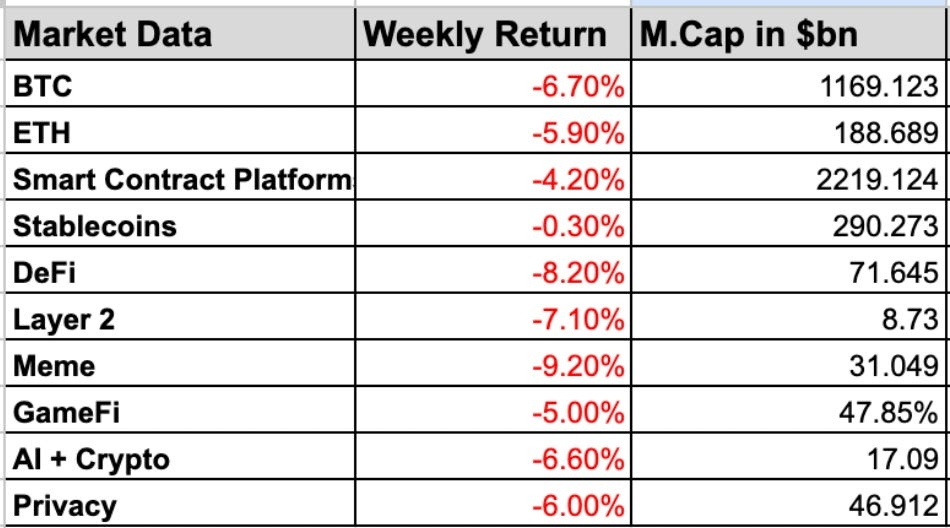
Nasdaq’s venture arm agreed to invest $100 million in Payward, Kraken’s parent, at a reported $21 billion valuation. Payward will adopt Nasdaq’s market surveillance technology across all its venues, and the two are building Nasdaq Equity Tokens, expected in the second quarter of 2027.
Visa disclosed that stablecoin settlement volume across its network has passed a $20 billion annualised run rate, more than fifteen times a year ago, with more than 160 stablecoin-linked card programmes live. Rain has financed about $2 billion through Visa’s stablecoin credit facility since August 2023 with zero defaults.
MoneyGram launched its first stablecoin-backed Visa card, starting in Colombia, holding a dollar balance in USDC on Stellar. The company discontinued its conventional fiat card in December 2025 and replaced it with this one.
Coinbase and Moov agreed to bring stablecoin payments to more than 1,000 US community banks and credit unions. US Bank began a stablecoin pilot on Stellar. Citi launched instant blockchain-based cross-border payments for Japanese corporates and joined DBS to enable 24/7 dollar payments using tokenised deposits on Swift’s blockchain ledger.
Tether and Fasanara Capital committed $400 million to StableFund, a private credit vehicle lending through fintech platforms in more than 60 countries with USDT as the settlement layer, with plans to raise up to $3 billion more.
Block applied to the OCC to establish Builders Bank & Trust, an uninsured national trust bank for Bitcoin and stablecoin custody. Since 2025 the OCC has received 40 charter applications, approving 21 and denying 2, with Coinbase, Paxos, BitGo, Ripple, Circle and Revolut in the queue.
Consensys split into two companies: MetaMask under Joe Lubin, and a new Consensys under Mike Kriak focused on institutional infrastructure including Linea and the Besu client, already used by Citi, DTCC and BNY Mellon.
Kalshi filed with the CFTC for 60 perpetual futures contracts on individual US stocks, including Tesla, Apple and Nvidia.
Hanwha Investment & Securities completed a tokenised securities platform on Avalanche, ahead of Korean amendments taking legal effect on 4 February 2027.
Roughly 4,000 BTC, about $320 million and approximately 95% of reserves, left the federation wallet of Liquid, Blockstream’s Bitcoin sidechain, on 6 September via a range-proof cache bug. 3,400 BTC came back on 7 September after Blockstream confirmed on-chain that bridge nodes were patched. About 598.5 BTC, roughly $47 million, did not. Bitcoin itself was never touched.
More than a hundred researchers published a paper cutting the estimated resource cost of a key step in a quantum attack on Bitcoin and Ethereum signatures by 86% in roughly two months. Nobody broke anything. The Ethereum Foundation set a target of full base-layer quantum resistance by December 2029. Bitcoin has no equivalent dated plan for the roughly 7 million BTC sitting in addresses with exposed public keys.
Metaplanet fell 9.9% on Tuesday to ¥244, down about 17% over two sessions while Bitcoin barely moved, after a 2022 share-option plan that scaled the executive pool with every share issuance expanded it from roughly 46 million to about 319 million shares. The board has since cancelled 41% of it.
BitMine bought another 28,086 ETH, taking holdings to 5,929,198 ETH, about 4.9% of supply and worth roughly $14.8 billion, with 85% staked.
Strategy bought no Bitcoin at all last week, repurchasing $176.3 million of its STRC preferreds instead. It holds 845,050 BTC, about 4.02% of the 21 million that will ever exist.
Germany’s finance ministry drafted a 25% flat tax on crypto gains from 1 January 2027 (26.375% including the solidarity surcharge), ending the twelve-month tax-free holding exemption for future purchases.
Hunter Biden’s $LAPTOP memecoin on Base fell 86.5% within half an hour of launch after sniper bots bought heavily at listing, and was trading roughly 99.9% below its reported peak by Sunday.
Norway’s $2.3 trillion oil fund has proposed cutting its holdings of US government bonds by about $80 billion.
2. CLARITY hits a wall
Crypto just lost one of its biggest regulatory catalysts of the year.
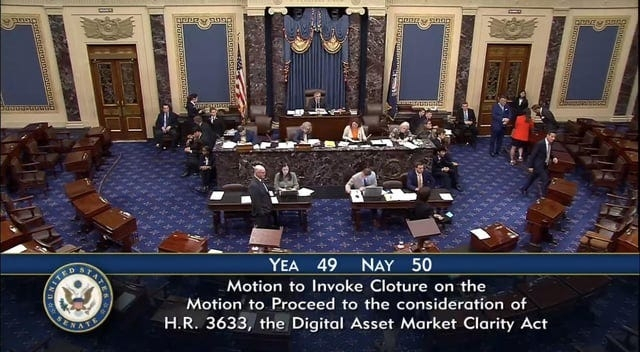
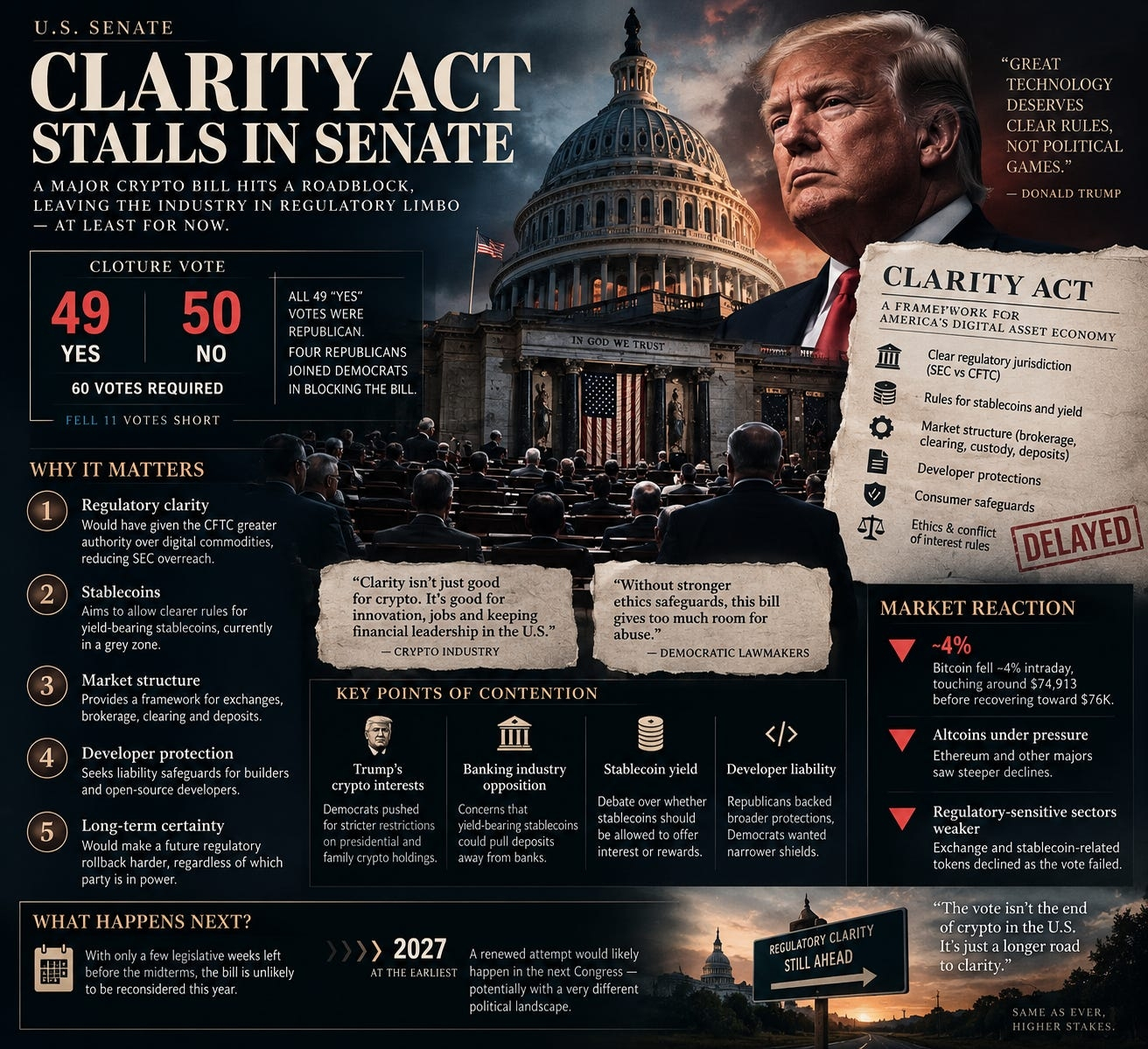
On Tuesday, the Senate voted 49–50 on whether to advance the CLARITY Act, falling 11 votes short of the 60 needed to invoke cloture. Every Democrat voted against advancing it, joined by four Republicans.
Importantly, this wasn’t a final vote killing the bill. It was the procedural vote needed to bring CLARITY to the floor for debate and amendments.
But with the midterms approaching and the legislative calendar getting increasingly compressed, the setback is significant.
And the market noticed immediately. Bitcoin fell roughly 4% intraday, touching around $74,913 before recovering toward $76K. Coinbase and Circle, arguably two of the biggest listed beneficiaries of a clearer US crypto regime, each dropped around 9%.
But the interesting part isn’t the 49–50 headline. It’s what CLARITY was actually trying to fix.
For years, one of the biggest problems in US crypto has been a basic question: is this a security or a commodity, and therefore who regulates it?
CLARITY was designed to draw a much clearer line between the SEC and CFTC, giving the CFTC a much larger role over digital commodities instead of leaving the industry to navigate a regulatory framework largely shaped by agency actions and enforcement.
That matters because the difference isn’t cosmetic. The SEC and CFTC operate with very different regulatory frameworks, and a statutory framework would give exchanges, issuers, brokers and developers something they have lacked for years: rules they can actually build around.
The Trump administration has already pushed the SEC in a more crypto-friendly direction, but that’s exactly why legislation matters. An administration can change its regulatory approach overnight; Congress passing a market-structure law is considerably harder to unwind. CLARITY was essentially an attempt to turn today’s friendlier regulatory environment into something more durable.
And that’s where the bill became much bigger than an SEC-versus-CFTC fight.
Stablecoins are sitting right in the middle of it. The latest negotiations included restrictions around rewards, interest and yield on stablecoins, an issue that has put crypto firms and banks on opposite sides of the table. The latest version even gave the Treasury Department additional powers around stablecoin rewards.
The banking industry’s concern is straightforward: if consumers can hold dollars in a stablecoin and earn something closer to money-market yields, some of that money could migrate away from traditional bank deposits.
For Circle and crypto platforms, that is an enormous opportunity. For banks, deposits are funding for loans. If enough deposits leave, banks potentially have less capital available to lend.
Then there’s DeFi and developer liability. The Republican position has generally pushed for broader protections for developers so that writing or maintaining open-source protocols doesn’t automatically expose developers to liability for what users subsequently do with them. Democrats have pushed for narrower protections, arguing that developers shouldn’t receive blanket immunity when a protocol is deliberately designed in a way that facilitates abuse or losses.
So CLARITY was quietly trying to answer several questions at once: who regulates crypto, how exchanges operate, how stablecoins compete with bank deposits, where DeFi developers become legally responsible, and how crypto fits into the existing financial system.
Then politics made everything harder.
One of the biggest Democratic objections has been the lack of stronger restrictions around Trump’s crypto interests. Trump and his family have become deeply financially exposed to the sector, while his administration is simultaneously shaping crypto regulation.
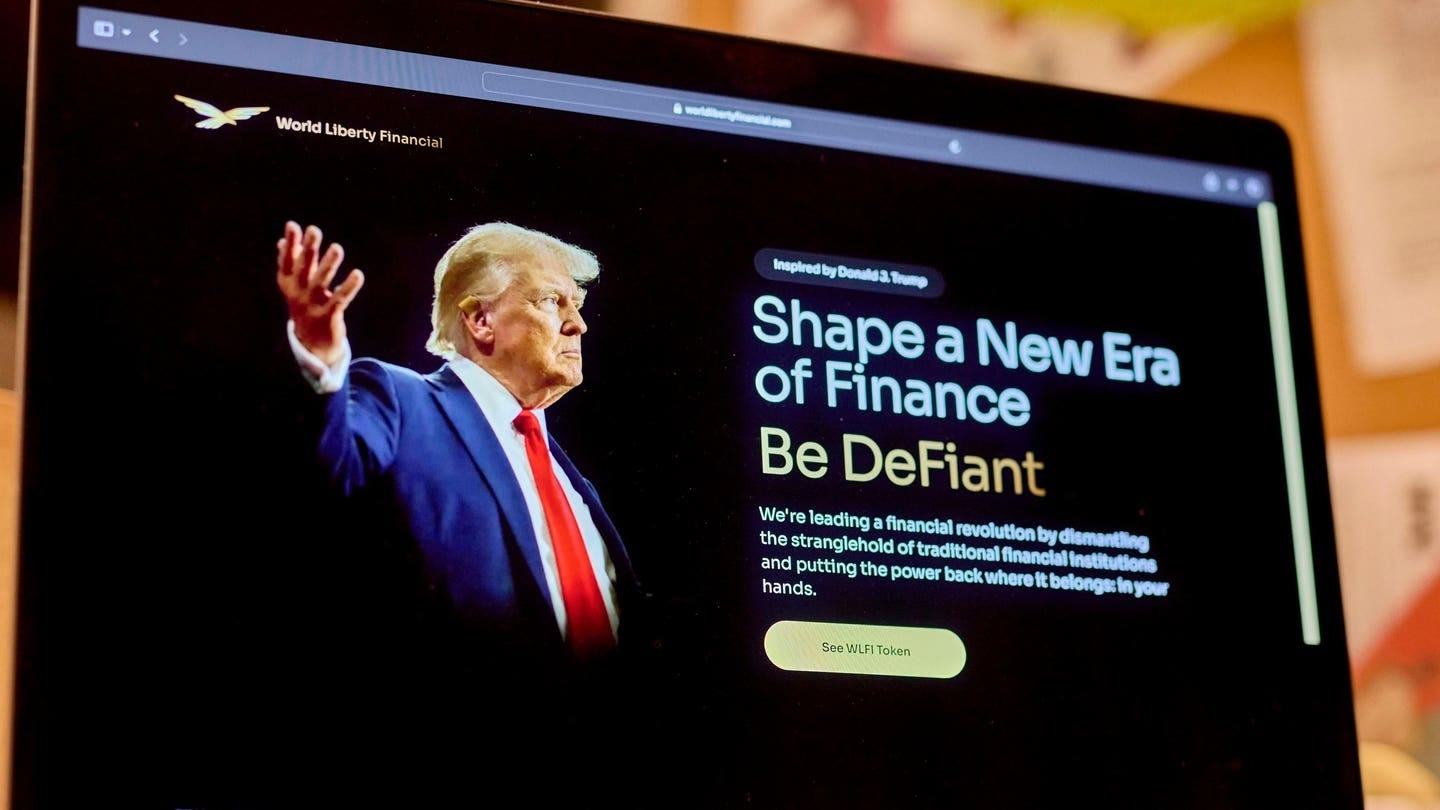
AP reports that Trump and his family have generated more than $500 million in revenue through World Liberty Financial, while the administration has also pushed for the broader crypto framework.
That has made the ethics question impossible to separate from the legislation itself. Democrats wanted stronger safeguards around presidential and family crypto holdings and activities. Republicans argued the bill would establish the regulatory framework and consumer protections the industry needs. Those disagreements ultimately became one of the central reasons Democrats refused to provide the votes needed to reach 60.
And there is a bigger market implication here.
Bitcoin doesn’t actually need CLARITY
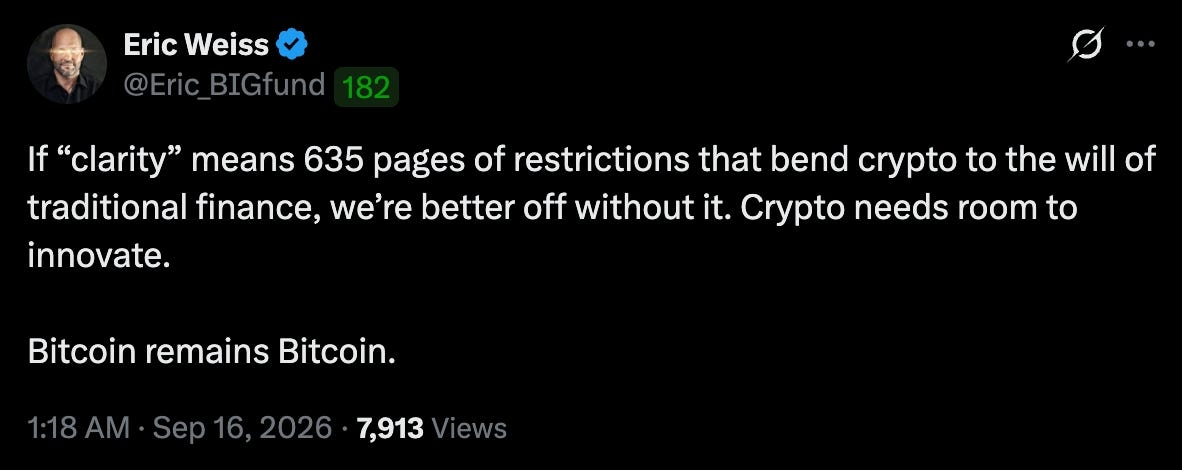
Bitcoin already has a relatively mature institutional market and its investment thesis doesn’t depend on whether a stablecoin can pay yield or whether a DeFi developer gets a statutory liability shield

The bigger beneficiaries of regulatory clarity were always going to be the infrastructure around Bitcoin: stablecoins, exchanges, Ethereum, DeFi and tokenized financial products.
The frustrating part for crypto is that the bill didn’t fail because the US suddenly decided it doesn’t want a crypto framework. It failed because everyone wants clarity on different terms
Crypto wants fewer regulatory barriers.
Banks don’t want stablecoins eating their deposits.
Democrats want stronger ethics restrictions.
Republicans want a durable market-structure framework.
Regulators want clearly defined jurisdiction.
And the industry wants developers to be able to build without living under permanent legal uncertainty.
CLARITY was the attempt to put all of those interests into one piece of legislation. 49 senators were willing to move it forward. It needed 60. It got 11 fewer.
The final takeaway is that the US isn’t necessarily moving away from regulation. It’s just becoming much harder to agree on what that regulation should look like.
3. Macro Backdrop
1. The 10-Year Touched 5%. Then It Went Higher
The US 10-year yield touched 5.012% on Monday. It then pulled back and settled around 4.960%
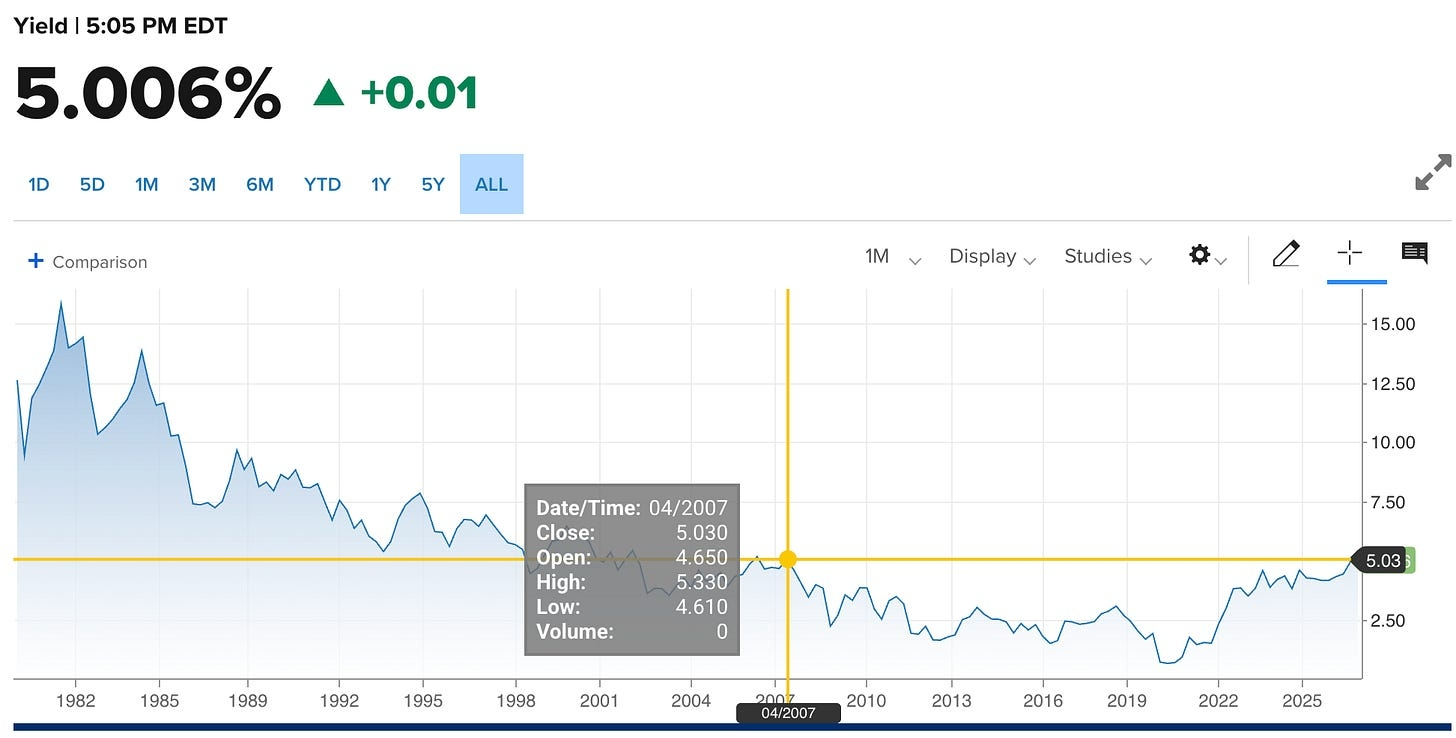
There has been a similar event in history.
On October 23, 2023, the 10-year briefly crossed 5%, hitting roughly 5.02%, before buyers stepped in and pushed yields back down to just above 4.8%.
For a moment on Monday, it looked like we were watching the same trade play out again.
Except this time, the buyers didn’t show up in the same way.
The 10-year is above 5.04%, taking it to its highest level since 2007 and, importantly, above the 2023 peak that had previously stopped the move. The next thing to watch is whether the market can actually close above 5%, rather than simply touch it intraday.
Going into Tuesday, the curve stood at:
2-year: 4.688% , 10-year: 5.035% , 30-year: 5.396%
The interesting part is where the pressure is coming from. The 10- and 30-year yields are rising more than 3x faster than the 2-year. That’s not really a market obsessed with the Fed’s next meeting anymore. It’s the longer end demanding more compensation for inflation, government borrowing and the risk of holding US debt for 10–30 years.
In other words, this increasingly looks like a term-premium problem rather than a Fed problem. And it’s already feeding through to the real economy. The 30-year mortgage rate jumped 23bp in a week to 7.17%.
So what’s pushing yields higher?
War-driven inflation. Oil is back above $100, making it harder for markets to price a quick return to low inflation.
Government borrowing. US government debt has reached roughly $40 trillion, around twice the level of a decade ago. Washington is already spending more on interest than on defence. Then, last week, Trump floated a $5,000 “dividend” for every adult citizen if Republicans retain control of Congress, a proposal that could cost more than $1 trillion.
AI borrowing. The biggest technology companies are increasingly tapping the bond market to finance the enormous cost of building data centres. They’re effectively competing with the Treasury for the same pool of investors and capital.
And then there’s the problem with the government’s attempted solution.
Treasury Secretary Scott Bessent’s $6 billion buyback announcement last week disappointed investors. The message from the market was fairly simple: buying back a relatively small amount of debt doesn’t solve a problem created by issuing enormous amounts of it.
Ceiling or floor?
There are now two very different arguments.
Experts say it’s still too early to call a top.
The other side points back to what happened in 2023. Crossing 5% brought a wave of buyers into Treasuries, while Japan’s latest 20-year auction attracted stronger demand than its 12-month average as higher yields pulled investors back in. Bank of America’s Meghan Swiber also argues that a firm Fed rate rise can actually help pull longer-term yields lower.
And this is where it becomes particularly important for crypto:
Bitcoin and gold don’t pay you to hold them. A government bond yielding roughly 5% for a decade changes the opportunity cost of owning an asset that produces no interest or cash flow.
Both Bitcoin and gold slipped Tuesday morning, with gold falling even as the war backdrop continued to deteriorate.
More importantly, the bond market is starting to question something that crypto has been arguing for years.
2. CPI: The Small Number Was the Frightening On
On Friday the BLS published August CPI:

The actual numbers:
Headline: 3.4% over twelve months, exactly matching July. Monthly plus 0.4%.
Core: 2.4% annually, down from 2.5%, the lowest since 2021. Monthly plus 0.3%, up from 0.2% in July.
Energy: plus 2.1% on the month, plus 16.3% on the year. Petrol: plus 3.9% on the month, plus 27.4% on the year.
The annual core figure fell. The monthly core figure rose. At 0.3% a month, inflation runs at roughly 3.5% a year if it continues, against a 2% target. The reassuring number described the past. The alarming number described the present.
Seventeen published forecasts preceded the release, ranging from 0.16% to 0.24%. The actual figure beat every single one. Shelter did most of the damage.
PPI told the same story. Producer prices for final demand rose 0.4% in August after 0.1% in July, with final demand goods up 1.1% on the month. Producer prices lead consumer prices.
Market-implied odds of a rate rise at this week’s meeting went from around 70% to roughly 87% by the weekend, and to 94% by Tuesday.
And the pipeline says September will be worse than August:
US diesel hit a record $6.23 a gallon on Monday, up from $5.85 a week earlier. Petrol is $4.32, up 16 cents in a week, in a month when it usually falls.
Factory input costs, year on year to August: raw materials plus 12.8%, intermediate goods plus 11.5%, finished goods plus 6.6%. The average freight shipment costs 16% more than a year ago. Purchasing managers have reported rising prices for 23 consecutive months, and in August not one industry reported falling raw-material costs.
Costs at the start of the chain are rising nearly twice as fast as prices at the end. More of that increase is still to reach shoppers.
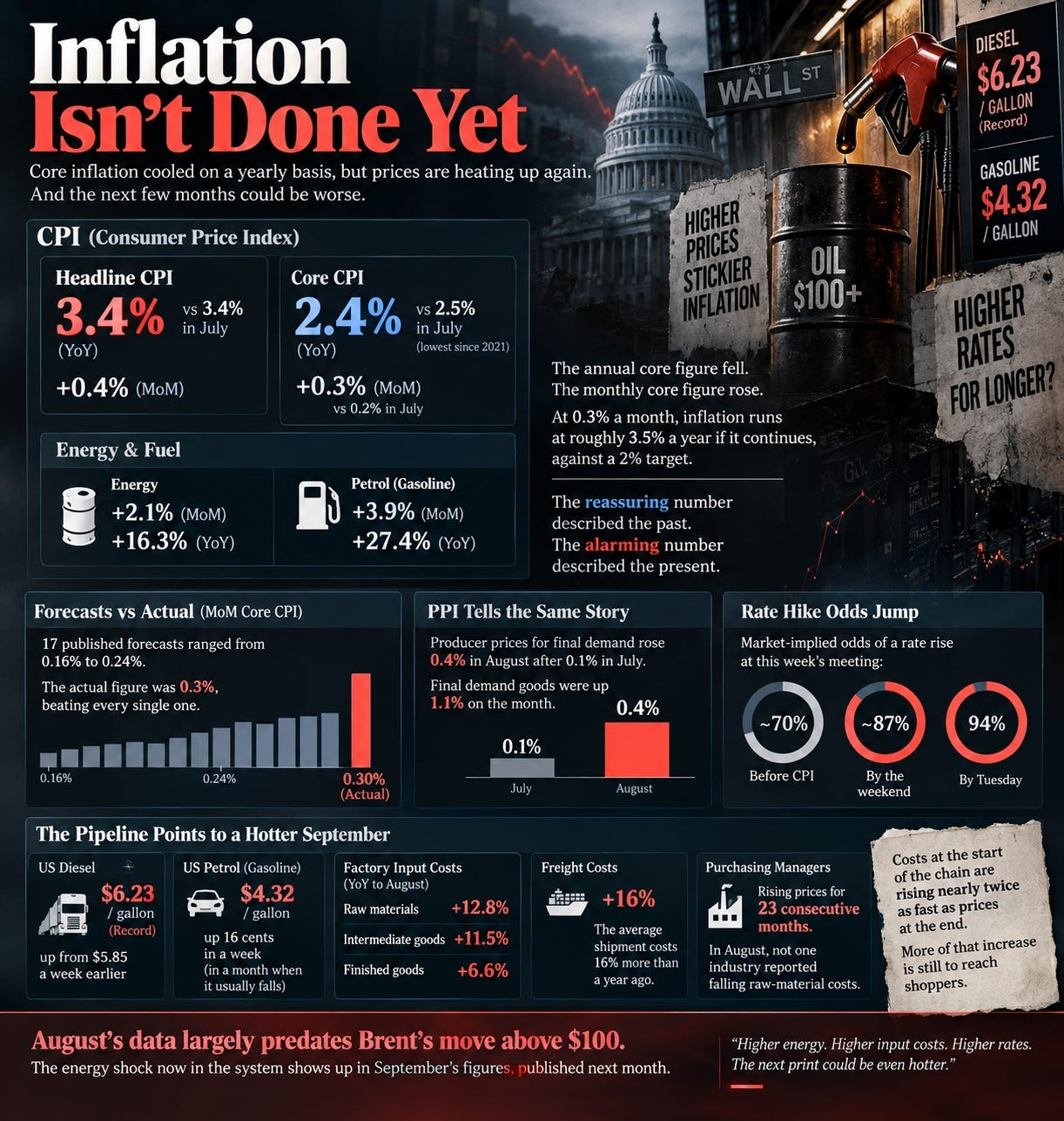
August’s data largely predates Brent’s move above $100. The energy shock now in the system shows up in September’s figures, published next month.
3. Saudi Arabia Is Running Out of Ways to Ship Oil
For seven months, this was an oil story. Last week, it became a story about the cost of money.
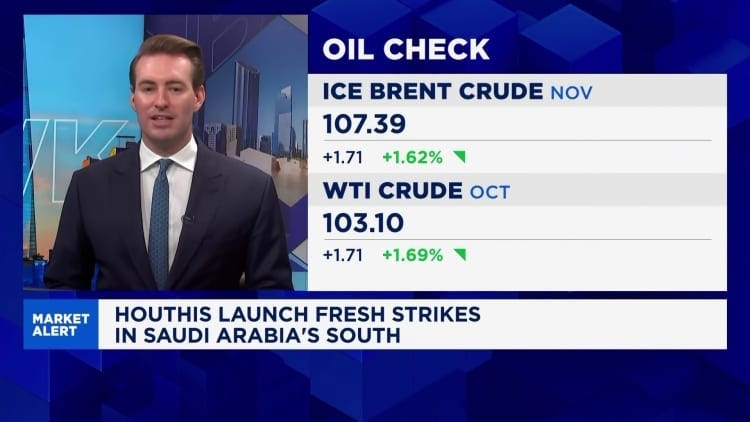
Brent closed above $101 on Wednesday, hit $109.80 on Monday and was around $107.86 Tuesday morning, up roughly 25% since early August. WTI is at $103.62. Goldman sees $120 if attacks broaden, or a move back towards $80 if exports normalise.
The bigger problem is that all three of Saudi Arabia’s export routes are now under pressure.
Hormuz: Just 4 commodity ships crossed Monday, down from 10 Sunday and roughly 125 a day before the war. Iran’s Revolutionary Guards say the strait remains “closed and still under our smart control,” while Iranian officials are reportedly planning another restricted zone.
East-West pipeline: Built to bypass Hormuz and move oil to Yanbu on the Red Sea, it was hit by drones late last week, with damage across two regions. After the April attack it took seven days to restart. Yanbu has only 5–7 days of export inventory.
Bab al-Mandeb: Crossings fell from 28 to 21 between Sunday and Monday. The Houthis control almost the entire Yemeni Red Sea coast, including Perim Island, and fired dozens of missiles and drones at a Saudi airbase Monday.
Saudi production had already fallen to 6.24M barrels/day in August, down 23% from July and far below the 9.6M barrels/day produced in 2025.
China had been covering almost half its daily oil needs from stockpiles for months, helping keep prices contained. It has now started buying heavily from abroad again. That cushion is fading just as physical supply is being disrupted.
The oil curve is showing the same thing. Front-month Brent is roughly $5 more expensive than delivery a month later, the widest gap since July 23. Buyers are paying up for barrels they can get now because they’re increasingly worried about getting them later.
And the shock is already moving through the economy. China’s August producer prices rose 3.8% YoY, with imported crude among the biggest contributors.
That’s what makes an oil shock particularly ugly for central banks: higher energy prices push inflation up while simultaneously making consumers poorer. A central bank can’t create more oil. It can only suppress demand that is already weakening.
The diplomatic picture isn’t helping. Gulf-Iran talks in Oman have been postponed with no new date, while Washington has reportedly declined Saudi requests for direct military assistance beyond intelligence. Trump’s proposed Ukraine-Russia energy truce, even if it holds, addresses the smaller supply shock: Gulf diesel exports fell 152M barrels between March and August, 2.2x the decline from Russia.
So there are now three countdowns: how quickly can the pipeline be repaired, how long can Yanbu keep loading from storage, and can shipping recover before that storage runs out?
The second one ends in days.
4. ETF Insights
The ETF bid disappeared. Bitcoin ETFs saw $463M of outflows over the holiday-shortened week, the first negative week since June. ARK and Grayscale accounted for $371M of the outflows, while BlackRock was roughly flat
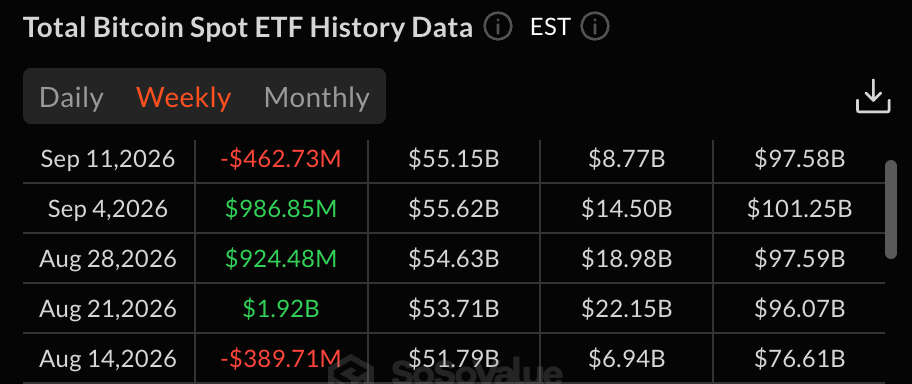
The ETF inflows had helped carry BTC from around $63K to $82K over the previous three weeks. With that marginal buyer gone, BTC fell 4.4% on the week, losing roughly $3.5K
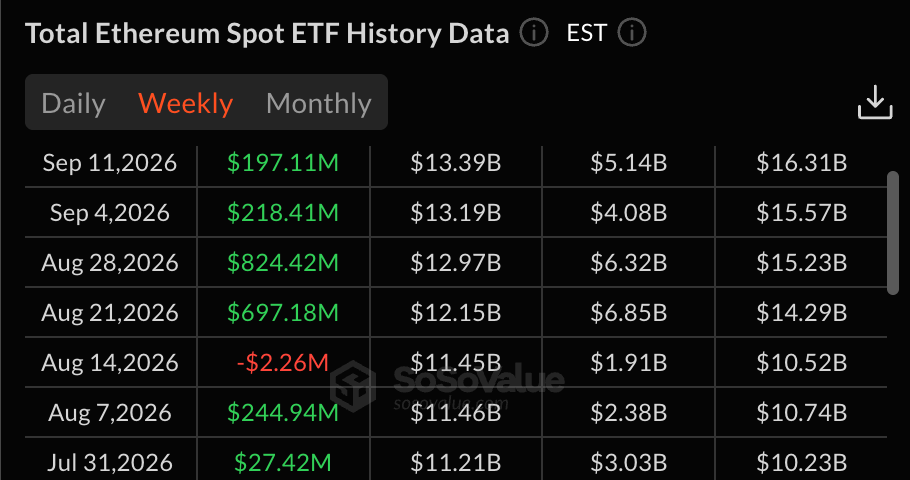
ETH ETFs went the other way, but the headline is misleading. ETH ETFs recorded $197M of inflows for the week, but almost all of it came from a $216M inflow on Friday after CPI. Tuesday through Thursday were net negative.
With ETF flows turning negative again, one of the market’s largest structural sources of BTC demand is no longer adding liquidity at the same pace. BTC has now spent four weeks between $76K and $82K, with three rejections at $82K since August. Without a renewed ETF bid, the market is still looking for its next marginal buyer.
5. The Week Ahead
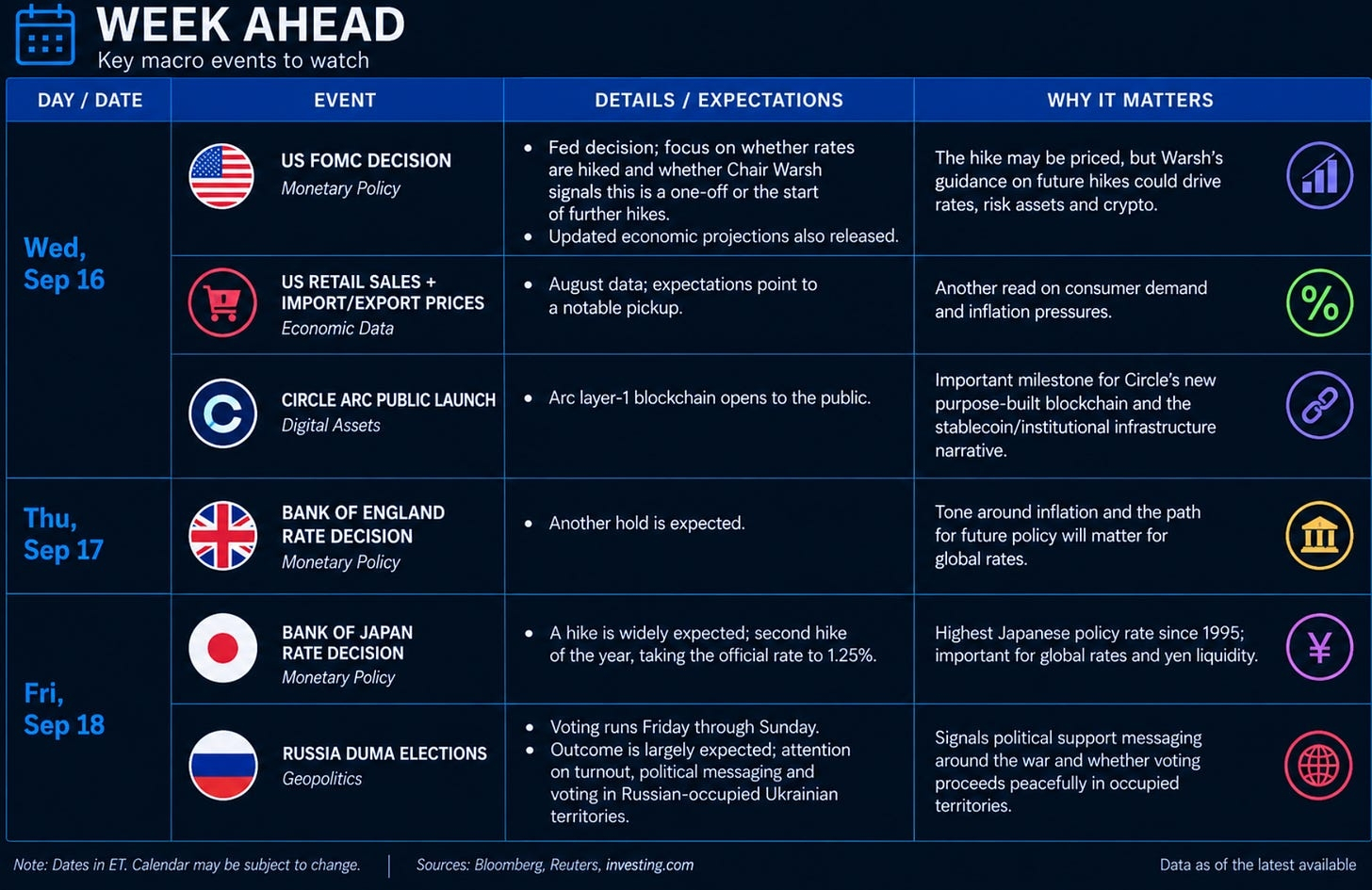
The main event is FOMC: The 25bp hike is largely priced in; the real market-moving question is whether Warsh signals one-and-done or more hikes into 1Q27.
6. Conclusion
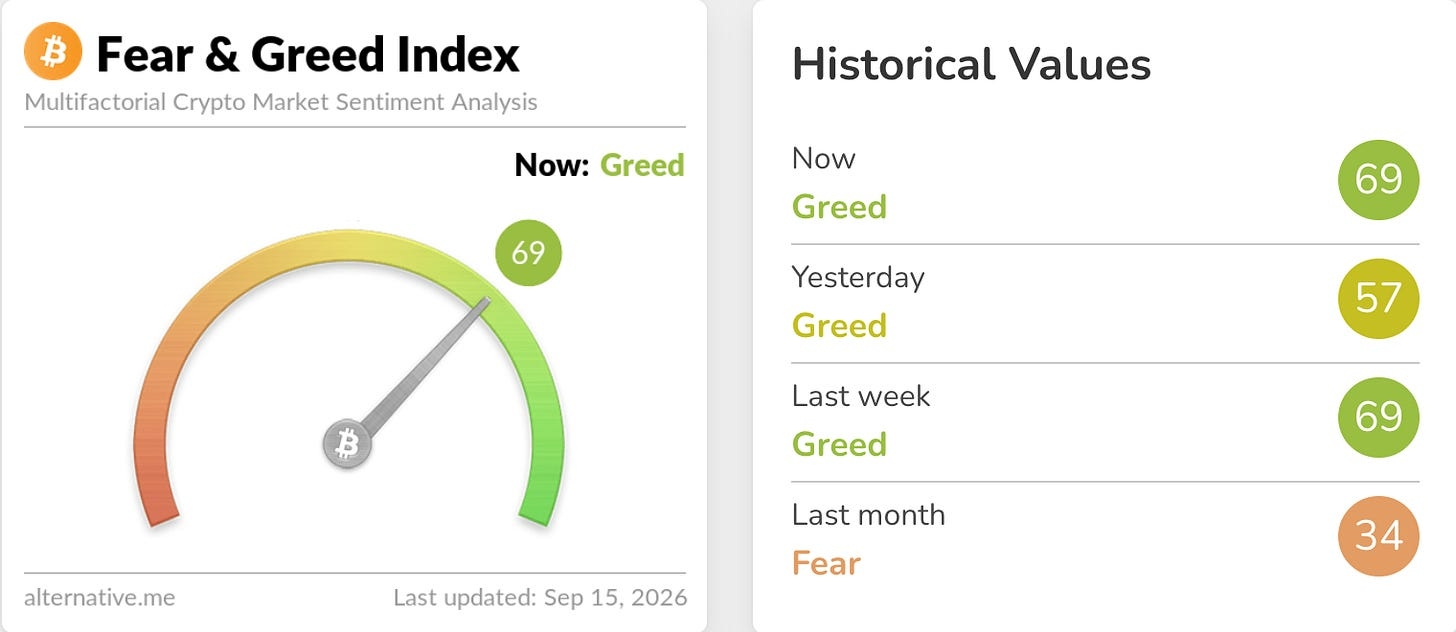
Bitcoin spent the week caught between a single inflation print and a Fed decision it has no control over. It absorbed a lot and gave up relatively little, which is probably the best thing you can say about the tape. But it is still sitting below the $83,000–86,000 supply wall, with the 10-year at 5%, oil above $107, four straight days of ETF outflows, and a Fed Chair who has made it clear he wants to react to the data in front of him rather than give markets much advance warning.
The bull case is narrower than it was in August and is now largely a fiscal story. The Treasury’s expanded buybacks failed to support the long end, and the market increasingly sees the problem as too much issuance rather than too little liquidity. That’s the strongest version yet of the debasement argument we’ve been making over the past two weeks. Bitcoin is still being driven by real yields, liquidity and the dollar, and all three moved against it this week. If a rate hike sends the 10-year back below 4.96%, like the rejection in 2023, the setup improves quickly. If yields keep climbing through the hike, anything that doesn’t pay you to hold it has a much tougher quarter ahead, regardless of what happens in Washington.
The takeaway is simple: respect the event risk, size positions around a 36-hour window that could reprice the entire market, and let the 10-year tell you whether the Fed still has control of the long end before adding into the supply wall.