

Tokenized equities are moving from a niche blockchain experiment to a serious financial market — and Binance already has a $21.6 billion head start.
Robinhood’s latest push into tokenized equities is a strong signal that on-chain stocks are becoming a competitive frontier. Traditional equities are increasingly finding a new home on blockchain rails, offering the potential for faster settlement, broader accessibility and integration with digital finance.
But while new players are entering the space, Binance has already been building.
Binance’s Tokenized Equities Head Start
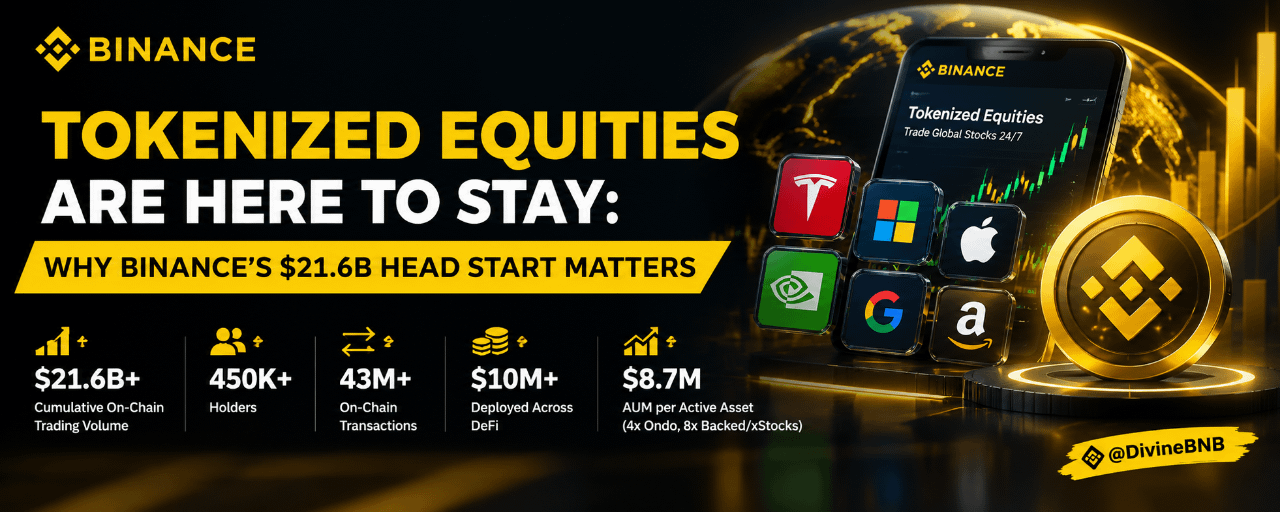
Binance’s tokenized equities ecosystem has generated more than US$21.6 billion in cumulative on-chain trading volume, with nearly 450,000 holders and approximately 43 million on-chain transactions.
Those numbers matter because they show that tokenized stocks are not simply a concept being tested. There is already significant activity, users and capital behind the market.
For Binance, this provides an important advantage as competition in tokenized assets increases.

More Than Just Tokenized Stocks
The bigger story is how tokenized equities can connect traditional markets with DeFi and on-chain finance.
More than US$10 million has already been deployed across DeFi within Binance’s tokenized equities ecosystem. This highlights the potential for tokenized real-world assets to become useful building blocks inside a wider digital financial system.
Instead of simply representing an asset on-chain, tokenization can create new ways for assets to interact with blockchain-based financial infrastructure.
Capital Depth Is the Real Advantage
Market share isn't only about the number of assets available. Capital depth and actual usage matter.
Binance’s tokenized equities ecosystem averages approximately US$8.7 million in AUM per active asset — around 4x the level of Ondo and 8x Backed/xStocks, based on the figures highlighted in the comparison.
That depth can be important for building liquidity and creating a stronger user experience as the market develops.
Why Robinhood’s Move Matters
Robinhood entering the tokenized equities space isn't necessarily a threat to Binance’s position. In many ways, it validates the direction Binance has already taken.
When major financial platforms begin competing around tokenized stocks, it signals that on-chain equities are becoming part of the broader evolution of financial markets.
The question is no longer whether tokenized equities will exist.
The question is who will lead the market as adoption accelerates?

The Bigger Picture
Tokenized equities sit at the intersection of crypto, traditional finance and blockchain infrastructure.
Binance has already accumulated significant trading volume, holders, transactions and DeFi activity in this category. That gives it a meaningful first-mover advantage as more platforms enter the market.
The competition is getting stronger — but Binance isn't starting from zero.
It already has the infrastructure, capital and users.
Final Takeaway
Tokenized equities are here to stay, and the arrival of major competitors only reinforces that trend.
With $21.6B+ in cumulative on-chain trading volume, nearly 450,000 holders, 43M transactions and $10M+ deployed across DeFi, Binance has built a substantial lead in the tokenized equities market.
The category is expanding. Binance is already in front.

FAQs
What are tokenized equities?
Tokenized equities are blockchain-based representations of traditional equity exposure, bringing aspects of stock markets onto on-chain infrastructure.
Why are tokenized stocks important?
They can connect traditional financial assets with blockchain infrastructure, potentially creating new opportunities for accessibility, settlement and integration with digital finance.
How much trading volume has Binance’s tokenized equities ecosystem processed?
According to the figures highlighted in this market comparison, Binance has generated more than US$21.6 billion in cumulative on-chain trading volume.
Are tokenized equities the future of finance?
Tokenization is becoming an increasingly important part of the evolution of financial markets, although adoption, regulation and market structure will continue to shape how the sector develops.
Content is for informational purposes only and not financial advice.