
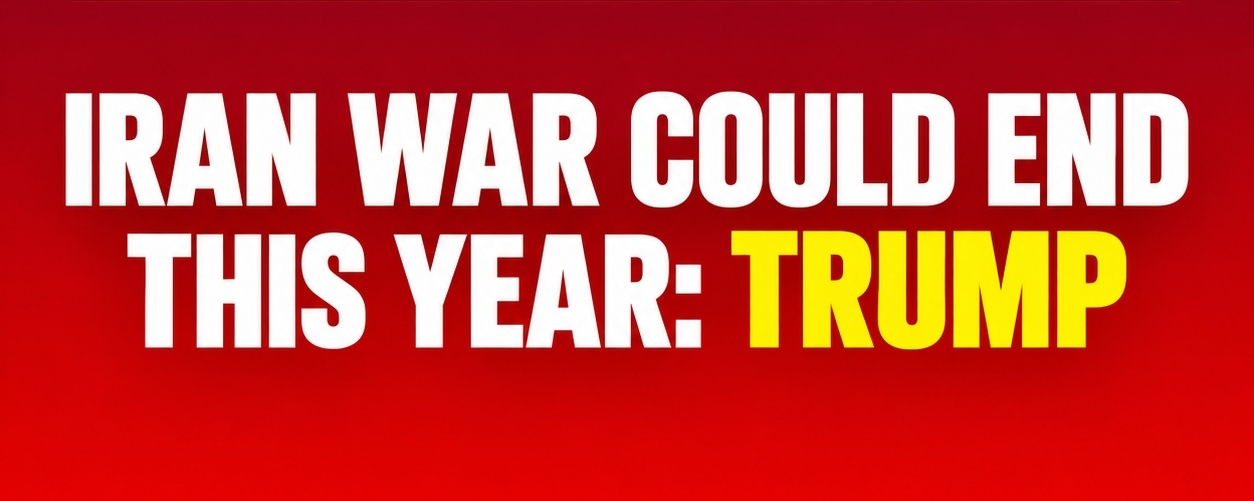

👉 The headline circulating in the image is based on a real and important development: U.S. President Donald Trump has again said he expects the war with Iran to end later in 2026.
But there is an important distinction between a presidential prediction and an actual ceasefire or peace agreement.
As of September 14, 2026, there is still no confirmed end to the conflict, while fighting, attacks on energy infrastructure and disruption around major shipping routes continue.
🟡 What Exactly Did Trump Say?
Trump has recently given several versions of his expected timeline.
On September 9, he said he expected the war to end “immediately after” the U.S. midterm elections, scheduled for November 3. He argued that Iran would eventually be unable to withstand U.S. economic pressure.
However, on September 13, Trump again said he expected the conflict to end later this year, while suggesting it could happen after the November elections. He also said gasoline prices could fall sharply once the war ends.
That makes the image's message directionally accurate, but the wording should be understood as Trump's expectation, not an announced peace deal.
🟡 Why November Matters So Much?
The U.S. midterm elections are scheduled for November 3, 2026, and the war has increasingly become connected to America's domestic political environment.
Trump has argued that Iran is attempting to influence the election by prolonging the conflict. At the same time, the war has contributed to higher energy prices and increased the economic pressure facing American consumers.
Reuters reported that Trump's approval ratings have fallen amid dissatisfaction surrounding the war and the cost of living.
This creates a complicated political equation:
War → energy disruption → higher oil prices → higher fuel costs → inflation pressure → greater political pressure.
Therefore, a post-election change in the conflict could potentially serve both a geopolitical and domestic political purpose.
But this should not be interpreted as proof that the war will automatically end after the election.
🟡 The Biggest Problem: Iran Has Not Simply Surrendered.
The battlefield situation does not currently support the idea of an immediate resolution.
The conflict has continued for months, and recent developments have actually increased pressure on regional energy infrastructure.
Iranian attacks around the Strait of Hormuz, Houthi activity in Yemen and attacks affecting Saudi energy infrastructure have all contributed to renewed market instability. Reuters reported that oil prices climbed more than 3% as new attacks threatened important supply routes.
🟡 Meanwhile, diplomatic efforts have struggled.
A planned meeting involving Iran and Persian Gulf states concerning the Strait of Hormuz was postponed, demonstrating that a broader regional agreement remains difficult to achieve.
So the key question is not simply:
“Does Trump want the war to end?”
The bigger question is:
“Can Washington and Tehran reach an agreement that both sides are willing and able to enforce?”
That remains unresolved.
🟡 The Strait of Hormuz Is the Real Economic Battlefield.
For global markets, the most important issue may not be the military headlines themselves.
It is oil transportation.
The Strait of Hormuz is one of the world's most strategically important energy chokepoints. The conflict has significantly reduced the volume of oil moving through the waterway.
According to the U.S. Energy Information Administration's September outlook, oil flows through the Strait of Hormuz have been severely constrained, while Middle Eastern oil production has been disrupted. EIA estimates that 5.7 million barrels per day of crude production could remain shut in during the fourth quarter of 2026 under its current assumptions.
The disruption is therefore much bigger than a temporary spike in headlines.
It is affecting:
Crude oil
Gasoline
Diesel
Shipping costs
Insurance costs
Inflation
Airline fuel expenses
Industrial production
Global supply chains
Monetary policy
🟡 Oil Has Become the Market's Warning Signal.
The latest price action demonstrates how sensitive energy markets remain.
On September 14, Brent crude was trading above $107 per barrel, while U.S. crude was above $102, after fresh attacks and supply concerns.
Reuters also reported that Brent had reached almost $110 per barrel on September 11 and had risen roughly 57% from its July low.
This creates an important market paradox.
If the war ends:
Oil supply could gradually recover.
Shipping risk could decline.
Insurance premiums could fall.
Energy inventories could begin rebuilding.
Inflation pressure could ease.
Risk assets could receive a significant boost.
If the war continues:
Oil could remain elevated.
Transportation costs could stay high.
Inflation could become more persistent.
Central banks could face greater pressure.
Global economic growth could weaken.
Financial markets could remain highly volatile.
🟡 Saudi Arabia Has Become Another Critical Risk
One of the most important recent developments is the disruption of Saudi Arabia's East-West pipeline.
The pipeline provides an alternative route that allows Saudi oil to bypass the Strait of Hormuz and reach the Red Sea.
Reuters reported that a drone attack forced the pipeline to shut down, threatening a potential loss of up to 4% of global oil supply if the disruption persists. Sources indicated that Saudi export inventories at Yanbu could cover only around five to seven days if the pipeline remains offline.
This is why the market reaction has been so aggressive.
The risk is no longer limited to Iran's direct oil exports.
The conflict is increasingly affecting the entire regional energy transportation network.
🟡 And There Is Another Chokepoint: Bab el-Mandeb.
The Strait of Hormuz is not the only concern.
Iran-aligned Houthi forces have expanded their presence along Yemen's Red Sea coast and moved toward strategically important territory around the Bab el-Mandeb Strait.
That matters because Bab el-Mandeb connects the Red Sea with the Gulf of Aden and is another major route for global energy and commercial shipping.
Reuters reported that the Houthis' advances are creating additional pressure on Saudi oil exports and regional shipping.
This means the conflict is developing into a multi-route energy security crisis rather than a problem confined to one geographic location.
🟡 What Happens If Trump Is Right?
If the conflict genuinely moves toward a settlement after the U.S. midterm elections, the initial market reaction could be significant.
A credible ceasefire could produce:
Lower geopolitical risk → lower oil risk premium → improved shipping conditions → falling energy costs → reduced inflation pressure.
Oil would likely be one of the first markets to react.
But the recovery would not necessarily happen overnight.
Even if missiles stop flying, damaged infrastructure still needs to be repaired, shipping companies need to reassess routes, insurance premiums need to normalize, and disrupted production needs to return.
EIA's latest outlook already assumes that Middle Eastern oil flows will gradually improve, but it expects some export constraints to persist through the end of 2026 and production to remain below pre-conflict averages into 2027.
So:
Ending the war ≠ instantly restoring the global energy system.
🟡 What If the War Continues Beyond 2026?
This is where the situation becomes considerably more serious.
Reuters reported that some senior Trump advisers have privately warned that the conflict could potentially last much longer, even extending beyond Trump's current term, despite Trump's public expectation that it will end after the midterms.
That does not mean a prolonged war is inevitable.
It does, however, highlight the enormous gap between:
Political expectations and military realities.
If negotiations fail and attacks continue, markets could face a much longer period of elevated energy prices and supply uncertainty.
🟡 What Does This Mean for Global Financial Markets?
The Iran conflict has implications far beyond oil.
1. Oil
Oil remains the clearest immediate beneficiary of supply disruption.
Any improvement in negotiations could trigger a sharp reversal.
Any escalation around Hormuz or Saudi infrastructure could push prices higher.
2. Inflation
Higher oil prices increase transportation and production costs across the economy.
That can make inflation harder for central banks to control.
3. Interest Rates
If energy-driven inflation becomes persistent, central banks may have less room to cut rates.
That could create pressure on equities and other risk assets.
4. Gold
Gold can benefit from geopolitical uncertainty and demand for defensive assets.
5. U.S. Dollar
The dollar can receive safe-haven demand during periods of severe geopolitical stress, although the direction also depends on interest-rate expectations and broader economic conditions.
6. Stock Markets
Markets could react violently to any major development.
A credible ceasefire could produce a risk-on rally.
A major escalation could produce another risk-off wave.
🟡 What About Bitcoin and Crypto?
This is particularly important for crypto traders.
Bitcoin is increasingly influenced by global liquidity, interest-rate expectations, dollar strength and overall risk appetite.
A genuine de-escalation in the Middle East could therefore create a potentially favorable environment for risk assets if it results in:
Lower oil prices
Lower inflation expectations
Reduced geopolitical risk
Lower bond yields
Greater expectations for monetary easing
Increased investor risk appetite
That could support Bitcoin and broader crypto markets.
But the opposite scenario is also possible.
If oil remains above $100 for an extended period and inflation expectations rise, markets could become more defensive. Higher yields and tighter financial conditions can create headwinds for speculative assets.
Therefore, crypto traders should not treat Trump's statement as an automatic “BTC bullish” signal.
The market needs confirmation through oil, Treasury yields, the U.S. dollar and liquidity conditions.
🟡 The Most Important Dates to Watch
The next major catalyst is the November 3, 2026 U.S. midterm election.
But traders should watch several developments before then:
1. U.S.–Iran negotiations
Any confirmed diplomatic channel would be significant.
2. Strait of Hormuz shipping
A sustained increase in traffic would signal improving energy conditions.
3. Saudi East-West pipeline
A rapid restoration would reduce immediate supply fears.
4. Brent crude
A sustained decline would suggest that geopolitical risk is being priced out.
5. Inflation expectations
A decline would give central banks greater flexibility.
6. U.S. Treasury yields
Lower yields could improve conditions for risk assets.
7. Bitcoin reaction
If BTC starts outperforming while oil falls and yields decline, that would provide a much stronger risk-on confirmation than a political headline alone.
🟡 The Bottom Line.
Trump's latest statement is important, but it should not be interpreted as confirmation that the Iran war is ending.
The most accurate reading is:
Trump expects the conflict to end later this year, potentially after the U.S. midterm elections.
However, the conflict remains active, diplomatic efforts have encountered setbacks, oil infrastructure is under pressure, and energy prices remain elevated.
The next few weeks could therefore be extremely important for global markets.
If diplomacy produces a credible settlement, the biggest market story could shift from energy shortage to energy normalization.
If the conflict expands further, the opposite could happen: higher oil prices, stronger inflation pressure and increased volatility across global financial markets.
For traders, the key lesson is simple: don't trade the headline alone. Watch the confirmation.
The real confirmation of de-escalation will come from oil prices, shipping activity, energy infrastructure, bond yields and risk appetite — not merely from political statements.