


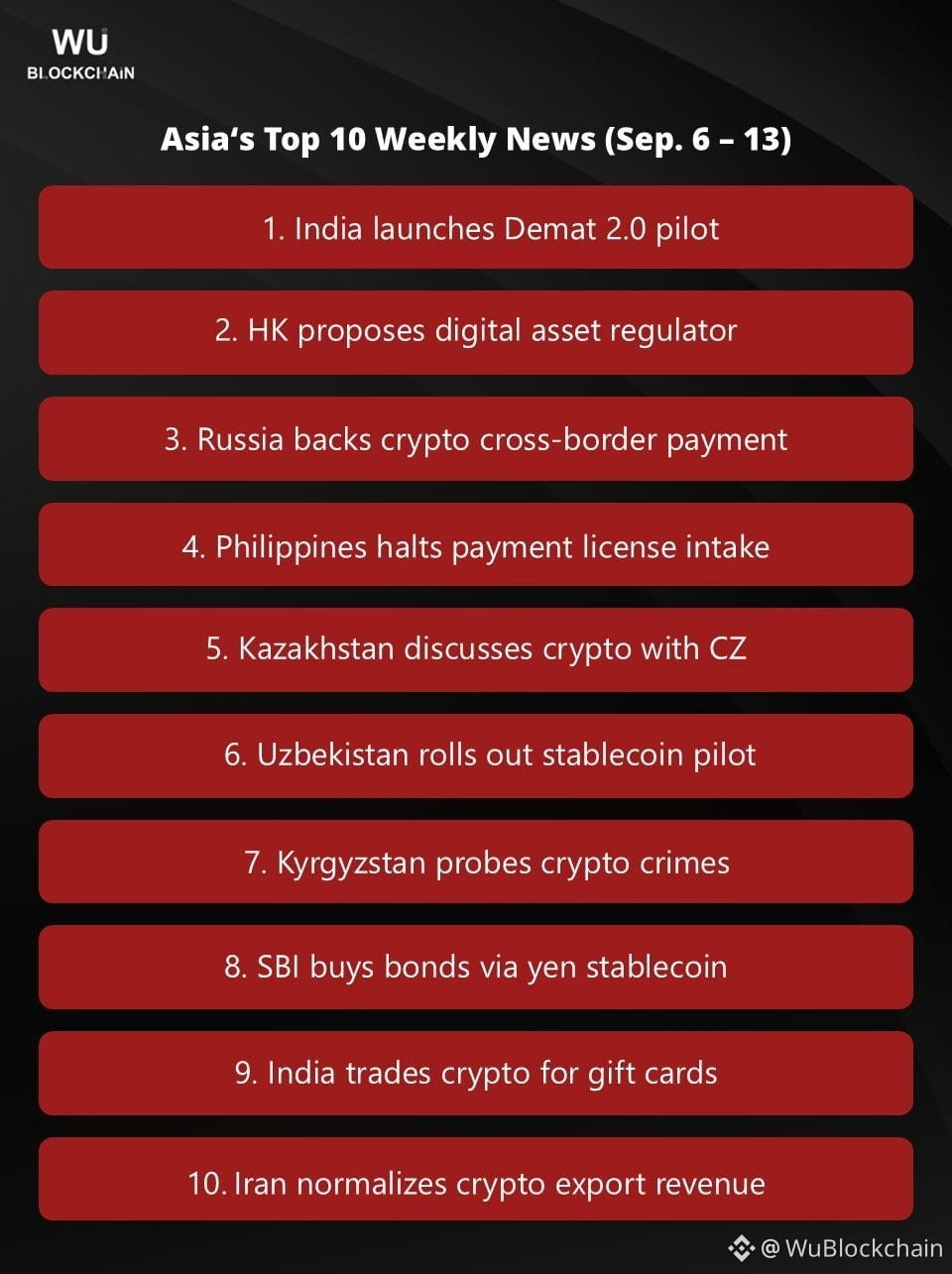
1. India Launches Demat 2.0 Pilot to Tokenize $620B Corporate Bond Market link
India’s Securities and Exchange Board (SEBI) has launched the Demat 2.0 pilot, leveraging blockchain and the Reserve Bank of India’s (RBI) wholesale digital rupee to issue and settle tokenized corporate bonds. State-owned power financier REC issued bonds worth 5 billion Indian rupees (approximately $56 million) via the system this month. Larsen & Toubro followed with an issue of the same size, while non-bank financial institution IIFL Finance issued 250 million Indian rupees (around $2.8 million) in bonds. The bonds retain fixed coupon rates, maturity dates and investor rights. Through RBI’s Unified Market Interface, Demat 2.0 links the tokenized bond ledger with the wholesale digital rupee, enabling simultaneous transfer of bonds and payment funds to mitigate settlement risk. Later phases plan to introduce secondary-market trading and gradual access for retail investors.
2. HK Legislator proposes Independent Digital Asset Regulator, Targeting 2032 Global Hub link
Duncan Chiu, Legislative Council member for the technology and innovation functional constituency in Hong Kong, has released a policy proposal. He suggests the SFC establish a dedicated independent digital asset division to unify regulatory standards, speed up approvals, and foster businesses including RWA, tokenised stocks, virtual asset ETFs and Hong Kong dollar stablecoins. The proposal sets a target for Hong Kong to develop into an international digital asset hub by 2032, and explores Web3 early-stage investment channels and private fundraising frameworks. SFC data shows 11 virtual asset spot ETFs have been approved in Hong Kong to date. Whether these proposals will turn into formal policies remains to be seen.
3. Putin Advisor: Crypto Cross-Border Payments Vital for Russian Imports in 2–3 Years link
Boris Titov, Russian Presidential Special Representative for Relations with International Organisations and Presidential Advisor, stated in an interview that the crypto-anchored cross-border payment system operates efficiently and with high reliability. Titov noted that amid Western nations’ ongoing blockades of traditional financial settlement channels, digital assets have become nearly the only viable settlement route for Russia’s trade partners in Asia and other regions. He added that demand for using cryptocurrencies to pay for import goods will remain highly relevant and urgent over the next two to three years as the current geopolitical situation persists. Russia’s new federal bill governing state oversight of cryptocurrencies formally took effect on September 1.
4. BSP to Suspend New OPS Registrations for 12 Months link
Under the Bangko Sentral ng Pilipinas (BSP) consultation draft, the central bank proposes to suspend the acceptance of new registration applications for Operators of Payment Systems (OPS) for 12 months to conduct a comprehensive review of existing classification and licensing frameworks. The draft mandates direct merchant arrangements for merchant acquiring activities involving Virtual Asset Service Providers (VASPs), together with risk controls including enhanced due diligence, ongoing monitoring and appropriate transaction and settlement limits. It also requires regulated entities to strengthen identification and surveillance of merchants, payment channels and fund flows. The proposal is still under public consultation.
5. Kazakhstan Deputy PM Meets CZ to Discuss Stablecoins & Crypto Infrastructure link
Zhaslan Madiyev, Deputy Prime Minister and Minister of Artificial Intelligence and Digital Development of Kazakhstan, met with Changpeng Zhao, founder of Binance, on September 4 to discuss cooperation covering digital assets, computing infrastructure and innovative payments. During the meeting, the Kazakh side presented projects including Alatau CryptoCity, Data Center Valley, and Binance Pay’s partnerships with local banks. Two memorandums were signed with relevant authorities, covering stablecoin issuance in Kazakhstan, development of digital asset payment infrastructure, and refinement of related taxation and judicial frameworks.
6. Uzbekistan Rolls Out Govt-Backed Stablecoin Payment Pilot link
Uzbekistan’s National Agency for Perspective Projects (NAPP) and central bank announced the launch of the HUMO stablecoin payment pilot. HUMO Digital has been admitted to the special regulatory regime for stablecoins. The pilot will test the issuance, circulation, redemption and payment functions of HUMO, with 1 HUMO pegged to 1 Uzbekistani sum and backed by Uzbek government securities. More than 20 merchants are scheduled to participate, with integration of banking, payment processing and blockchain infrastructure. The central bank stated the initial pilot lasts 12 months and may be extended subject to rules, while the total project duration cannot exceed three years.
7. Kyrgyzstan Opens 90 Crypto-Related Criminal Probes This Year link
According to Kyrgyz media Akchabar, Ulan Niyazbekov, Minister of Internal Affairs of Kyrgyzstan, stated that domestic law enforcement authorities have opened 90 criminal investigations related to cryptocurrencies since 2026. The cases involve cyber fraud, fund theft, money laundering and illicit fund transfers. Niyazbekov also disclosed that while probing an alleged transnational cyber fraud ring in 2025, police discovered a TRON wallet holding over $3 million in digital assets on suspects’ devices and tracked the related funds using blockchain analytics tools.
8. SBI Uses JPYSC to Buy JGBs; Outstanding Supply Hits ¥20.1B link
SBI Shinsei Trust & Banking has begun investing part of the reserve assets for its yen stablecoin JPYSC in short-term Japanese government bonds, with an initial tranche of 1 billion yen. As of September 7, JPYSC’s outstanding issuance stood at approximately 20.1 billion yen, and around 6.9 billion yen was engaged in JPYSC Lending on SBI VC Trade, bringing the combined size to roughly 27 billion yen.
9. India Sees Crypto-to-Gift-Card Route for Food, Fuel & Gold Purchases link
According to the Economic Times of India, some offshore platforms enable Indian users to purchase India-redeemable gift cards and vouchers using stablecoins such as USDT or other crypto assets for spending on groceries, fuel, mobile top-ups, food delivery and gold. Under this model, users transfer crypto assets from private wallets to overseas platforms, which then supply redemption codes via local Indian gift card partners. One platform that has issued over 16 million cards to Indian users once offered 1 USDT for roughly 88 rupees at a time when USDT traded above 95 rupees in India. This channel has drawn the attention of Indian authorities, raising potential regulatory concerns covering cross-border payments, foreign exchange rules, taxation and anti-money laundering compliance.
10. Iran Fully Normalizes Crypto for Export Receivables link
Amid US sanctions and blockades, Iran’s central bank has quietly eased foreign exchange controls in recent months, encouraging exporters to repatriate overseas funds through multiple channels including cryptocurrencies. Sources familiar with the matter said businesses can now conduct cross-border settlements via Iranian crypto exchanges using USDT, BTC and other digital assets, with USDT widely adopted. A corporate executive close to the government stated, “Receiving export proceeds in crypto has become fully normalized now.” Data from TRM Labs shows crypto transaction volume within Iran reached nearly $10 billion in 2025. Iran’s central bank has declined to comment.
Follow us
Twitter: https://twitter.com/WuBlockchain
Telegram: https://t.me/wublockchainenglish