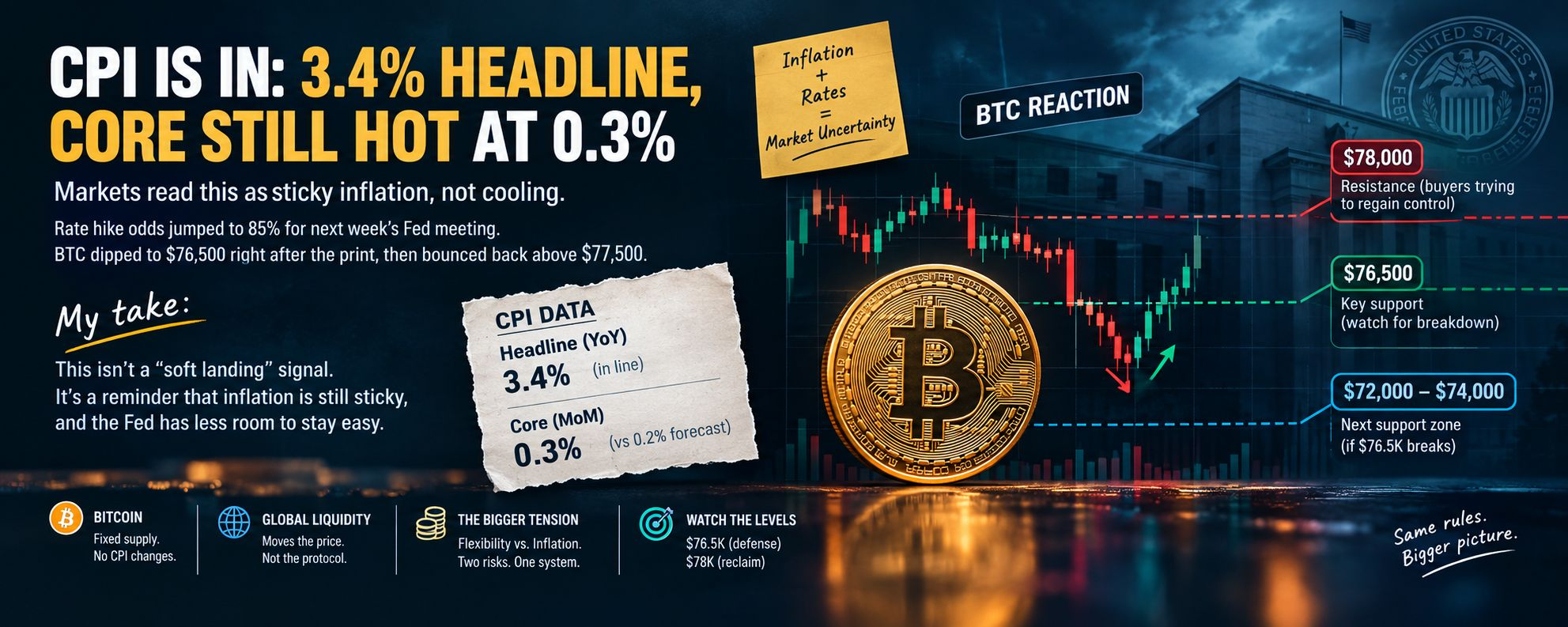

#CPIWatch I don’t know… maybe I’ve become a little more cautious about CPI days than I used to be. At first, I thought the market reaction was mostly about whether the headline number would beat or miss expectations. Over time, I’ve realized that the headline is often only the first layer. What matters to me is what the number says about the room the Federal Reserve has left to respond to a slowing economy, and what that means for an asset like Bitcoin that has become deeply connected to global liquidity and risk appetite.
The larger problem I keep coming back to is the tension between an economy that needs flexibility and an inflation problem that keeps taking that flexibility away. I see the same structural issue every time inflation refuses to cool cleanly. If policymakers loosen financial conditions too quickly, inflation can become harder to contain. If they stay restrictive for too long, financial markets eventually have to absorb the pressure. I don’t see an easy answer in that equation. I see a system constantly trying to balance two risks that can move in opposite directions.
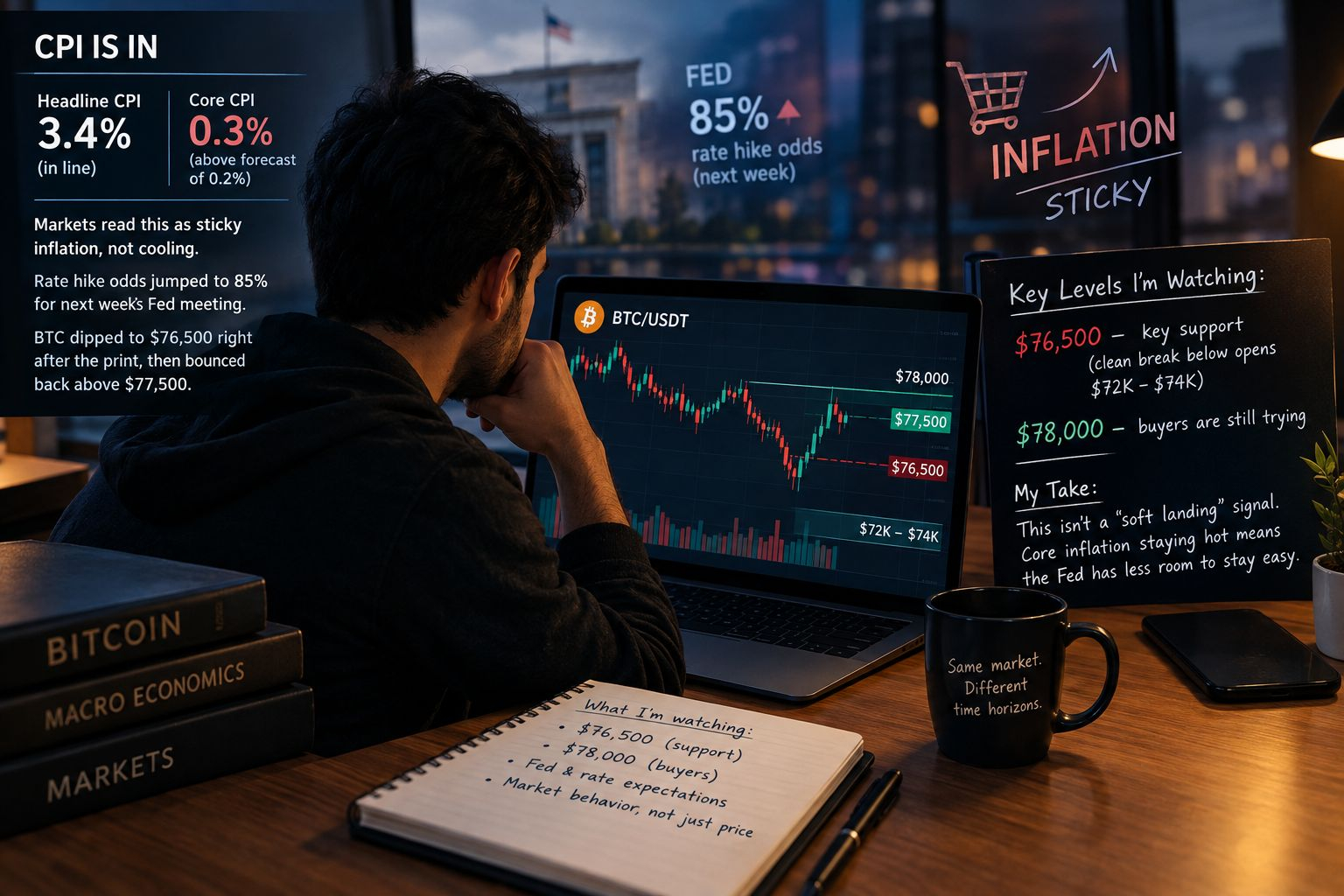
That is why I don’t think the latest CPI print can be understood simply as good or bad news. The headline CPI came in at 3.4% year over year, broadly in line with expectations, but core inflation came in at 0.3% month over month against a 0.2% forecast. To me, that difference matters. The headline can look relatively manageable while the underlying pressure remains stubborn. I read that as a sign that inflation is not disappearing as quickly as markets might want.
Maybe I was wrong to initially think the market could look through it. The first reaction in Bitcoin suggested otherwise. BTC dropped toward $76,500 almost immediately after the print before recovering above $77,500. I found that reaction more interesting than the actual size of the move. It showed me that liquidity is still sensitive to changes in interest-rate expectations, even when Bitcoin itself appears to be holding a relatively tight range.
I think this is where Bitcoin’s architecture creates an unavoidable tension. Bitcoin operates according to rules that do not change because inflation is higher or because the Federal Reserve wants more flexibility. Its supply schedule does not respond to CPI. Its monetary rules are not adjusted around economic forecasts. I see that as one of the core reasons people find the asset structurally interesting, but I also see the other side of it clearly: Bitcoin may have fixed monetary rules, but the market trading Bitcoin does not operate in isolation from the financial system around it.
That creates a strange combination of independence and dependence. I can look at Bitcoin and say that its underlying issuance rules are predictable. At the same time, I cannot ignore the fact that the price is determined by buyers and sellers operating inside a world of interest rates, leverage, liquidity, Treasury yields, institutional positioning and changing expectations. I don’t see that as a contradiction that needs to be solved. I see it as part of the reality of Bitcoin today.
The latest CPI reaction makes that especially visible to me. When markets suddenly pushed rate-hike odds toward 85% for the next Fed meeting, I saw the immediate problem for risk assets. Higher rates generally mean tighter financial conditions, and tighter conditions can reduce the willingness to chase volatile assets. Bitcoin is particularly sensitive to that shift because so much of its short-term price discovery happens through global liquidity rather than through changes in the protocol itself.
This is where I think incentive alignment and short-term speculation start pulling in different directions. Bitcoin’s protocol gives me a very long-term monetary framework, but the market surrounding it is filled with participants who may only care about the next few hours or the next few percentage points. A trader sees $76,500 as a level. A long-term holder may see the same price very differently. An institution managing risk may not care about either interpretation and may simply reduce exposure when volatility rises.#OpticalCommsStocksRallyOver3%
I don’t think any of those behaviors are necessarily wrong. They simply operate on different time horizons. The difficulty is that all of them eventually meet in the same order book.
That is why I’m watching $76,500 so closely. I don’t see it as some magical number. I see it as a point where market behavior could become more revealing. If Bitcoin loses that area cleanly, I would start watching the $72,000–$74,000 region because a breakdown could encourage more selling, especially if rate expectations remain restrictive. The important part for me would not be the number itself, but the behavior around it. I would want to see whether buyers actually defend the structure or simply wait for lower prices.
On the other side, $78,000 matters because it represents the area where buyers still appear to be trying to regain control. If Bitcoin can move above it with convincing participation, I would take that as evidence that the market is capable of absorbing the inflation shock rather than simply reacting emotionally to it. I would still be careful, though. A move above resistance without meaningful follow-through can easily become another failed breakout.
This is also where I see another unavoidable trade-off: Bitcoin’s growing accessibility makes it easier for more capital to participate, but it also makes short-term price behavior more closely connected to broader financial markets. More participation can bring deeper liquidity and greater market maturity. At the same time, it can increase the speed at which macroeconomic shocks are transmitted into Bitcoin.
I don’t think that means Bitcoin is becoming weaker. I think it means the market is becoming more complicated.#CircleProposes$400MTazapayAcquisition
I also don’t want to turn the CPI number into a simple prediction that Bitcoin must fall. Markets rarely behave that cleanly. A hotter core reading can push rate expectations higher, but price already reflects expectations before the data arrives. If enough traders were positioned for a hotter print, the actual reaction can sometimes fade quickly. That may explain part of Bitcoin’s bounce from $76,500 back above $77,500.
For me, that bounce is worth respecting, but not overinterpreting. I don’t see it as proof that the inflation problem has disappeared. I see it as evidence that buyers are still willing to step in when Bitcoin reaches an area they consider attractive.
That distinction matters.
I’ve learned that the hardest part of markets is separating what I want the chart to say from what it is actually saying. Right now, I see a market caught between two forces. Inflation remains sticky enough to restrict the Fed’s freedom, while Bitcoin remains strong enough to attract buyers on meaningful dips. Neither side has completely won.
And that leaves me with a fairly simple framework. Below $76,500, I become more defensive and start considering the possibility of a deeper move toward $72K–$74K. Above $78K, I become more interested in whether buyers can turn resistance into support. Between those areas, I think there is more noise than clarity.#BitcoinReboundsAbove$79KAfterCPI
Maybe that is the most honest conclusion I can reach right now. I don’t see this CPI print as a soft-landing signal, but I also don’t see it as an automatic disaster for Bitcoin. I see it as another reminder that the market is trying to price an uncomfortable reality: inflation is still sticky, the Fed has less room to stay easy, and Bitcoin still has to trade inside that financial environment even while its own monetary rules remain unchanged.#BinanceHerYerde
I’m watching the levels, but I’m watching behavior even more closely. If $76,500 breaks, I want to know whether sellers are actually gaining conviction. If $78,000 breaks higher, I want to know whether buyers can sustain it. Until one of those answers becomes clearer, I’m not sure the market has finished telling me what this CPI print really means.