#etherralliesasbearishbetsliquidate
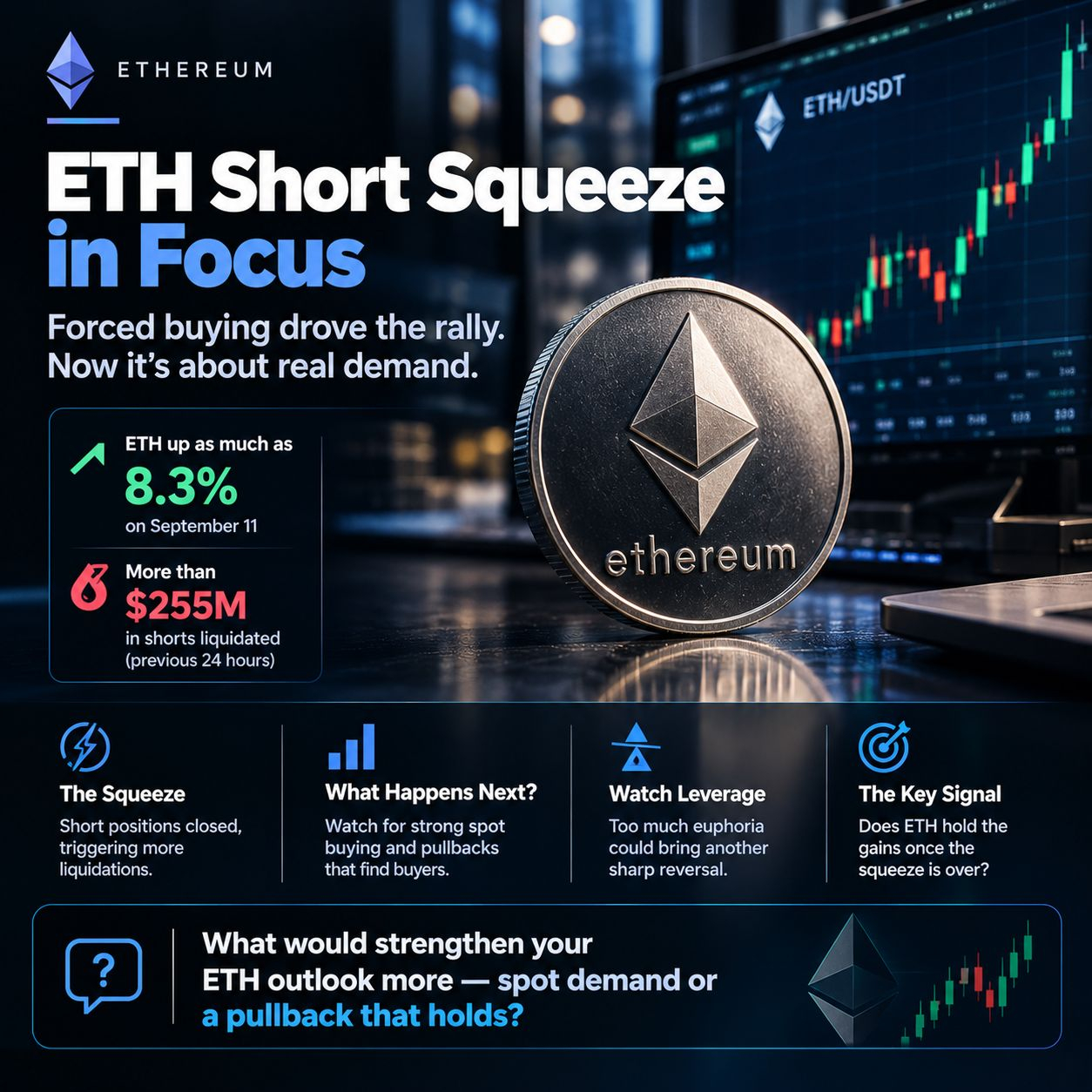
Ethereum ($ETH) caught traders’ attention on September 11 after rising as much as 8.3%, while more than $255 million in short positions were liquidated over the preceding 24 hours.
The move shows how quickly a leveraged crypto market can accelerate when short sellers are forced to close their positions.
Why the ETH Rally Accelerated
When ETH rises against heavily leveraged short positions, exchanges can forcibly close those trades.
That forced buying adds additional demand to the market. As more shorts are liquidated, the buying pressure can trigger even more liquidations, creating a feedback loop that pushes prices higher.
This helps explain why Ethereum can move sharply in a relatively short period.
But the liquidation data only explains part of the rally.
What Happens After the Short Squeeze?
The more important question now is whether ETH can hold its gains after forced buying slows down.
If spot buyers remain active and pullbacks continue finding support, the move would look healthier. It would suggest that demand is coming from traders buying ETH rather than simply short sellers being forced out.
On the other hand, if ETH quickly gives back its gains while spot demand weakens, confidence in the rally could fall.
Leverage Is Another Risk
A sharp recovery can also encourage traders to rebuild leveraged positions.
If leverage returns too quickly, ETH could become vulnerable to another wave of forced selling if momentum reverses.
That makes the period after the squeeze especially important.
For traders, the key signals are spot demand, price stability and how much leverage returns to the market.
The Bigger Picture for ETH
The $255 million liquidation figure shows the power of leverage in crypto markets, but it doesn't necessarily prove that a lasting trend has started.
For me, the strongest signal would be ETH holding its gains while spot buying remains active.
If that happens, the rally could have more substance beyond the initial short squeeze.
The real test for Ethereum isn't how high it moves during the squeeze — it's whether buyers remain after the forced buying disappears.
Disclaimer: This article is for educational and informational purposes only, not financial advice. Do your own research before making investment decisions.