


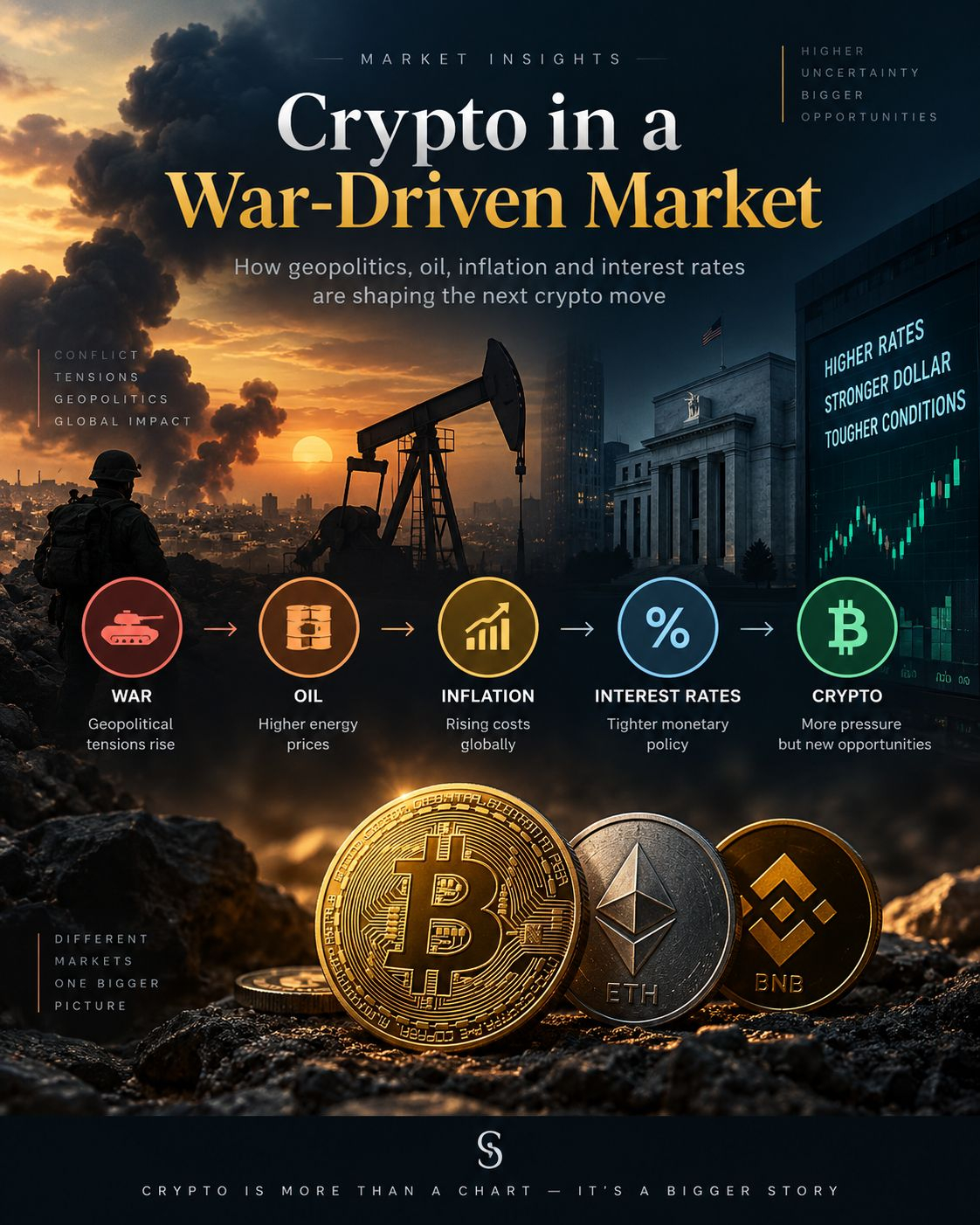
War, oil, inflation and interest rates are becoming one connected trade.
The crypto market is facing something bigger than a normal technical setup right now.
Bitcoin is trading around the $78K area, Ethereum is near $2.46K–$2.48K, while several major altcoins are showing more weakness. But the real story is happening outside the crypto charts.
🌍 Geopolitics is back at the center of the market
Escalating conflict between the U.S. and Iran has increased concerns over energy supply and shipping routes in the Middle East.
Brent crude has climbed above $105 per barrel, while WTI has also traded above $100 as markets price in the risk of further supply disruptions. At the same time, attacks affecting energy infrastructure elsewhere, including the Russia–Ukraine conflict, are adding another layer of uncertainty.
Why should crypto investors care about oil?
Because expensive oil doesn’t stay an “energy market problem.”
It spreads.
Higher oil → higher transportation and production costs → more inflation pressure → higher interest-rate expectations.
And that can become uncomfortable for risk assets.
📈 The interest-rate problem is returning
U.S. Treasury yields have moved sharply higher, with the 10-year yield around 4.9%, while hotter inflation data has increased expectations that monetary policy could remain restrictive—or even become tighter.
This matters enormously for crypto.
When investors can earn attractive returns from relatively safer government bonds, speculative assets have to compete harder for capital.
Higher rates can mean:
• Less liquidity flowing into risky assets
• A stronger U.S. dollar
• More pressure on growth stocks
• More pressure on leveraged crypto positions
That helps explain why Bitcoin has struggled to establish itself firmly above $80K, even when buyers continue appearing around the current range.
₿ But Bitcoin is doing something interesting
Here is the part I find most important.
Bitcoin hasn’t reacted to every geopolitical headline in exactly the same way.
On September 9, as oil moved above $100 following renewed Middle East escalation, Bitcoin actually climbed toward $79.7K while European equities fell. For that period, BTC behaved more like gold than a traditional risk asset.
Then the picture changed again.
As Treasury yields and the dollar strengthened, Bitcoin came back under pressure around the $78K area.
And this creates one of the most interesting questions in the market:
Is Bitcoin becoming a geopolitical hedge—or is it still primarily a liquidity-driven risk asset?
The answer may actually be:
Both, depending on the type of shock.
Immediate fear can create demand for alternative stores of value.
But prolonged war can push oil and inflation higher, forcing interest rates upward—and that can eventually hurt crypto liquidity.
♦️ Ethereum is waiting for direction
Ethereum is currently around the $2,470 area, after repeatedly struggling to build sustained momentum above roughly $2,500.
ETH’s problem right now may not be Ethereum itself.
It is the broader environment.
When uncertainty rises, capital often becomes more selective.
Bitcoin usually receives attention first. Higher-risk altcoins then need stronger market confidence before they can outperform consistently.
That means ETH traders should probably be watching Bitcoin, Treasury yields and oil just as closely as the ETH chart itself.
⚠️ Altcoins could feel the pressure first
This is where risk management becomes especially important.
If geopolitical uncertainty continues and liquidity becomes tighter, smaller altcoins can experience much larger percentage moves than Bitcoin.
A coin falling 5%, 10% or even more does not automatically mean:
“Great buying opportunity.”
Sometimes the market is simply repricing risk.
The better question is:
Is liquidity returning, or am I just trying to catch a falling asset?
🔍 What I’m watching now
For the next major crypto move, I’m paying attention to five things:
1. Bitcoin and $80K
Can BTC reclaim and hold it, rather than simply touching it?
2. Brent crude oil
A continued move above $100–$105 keeps inflation risk elevated.
3. U.S. Treasury yields
Higher yields generally make conditions harder for speculative assets.
4. The U.S.–Iran conflict
Any escalation—or credible de-escalation—could quickly change risk sentiment.
5. Altcoin strength relative to BTC
If Bitcoin stabilizes but altcoins keep falling, the market is still defensive.
Final thought
This is not a normal crypto market where looking at one support or resistance line tells the whole story.
Right now:
War affects oil.
Oil affects inflation.
Inflation affects rates.
Rates affect liquidity.
And liquidity affects crypto.
Bitcoin holding near $78K despite all of this is noteworthy.
But resilience is not the same as confirmation.
For me, this is a market for patience, liquidity awareness and confirmation—not FOMO.
Do you think Bitcoin will eventually behave more like digital gold during geopolitical crises—or will it remain a risk asset tied to global liquidity? 👇