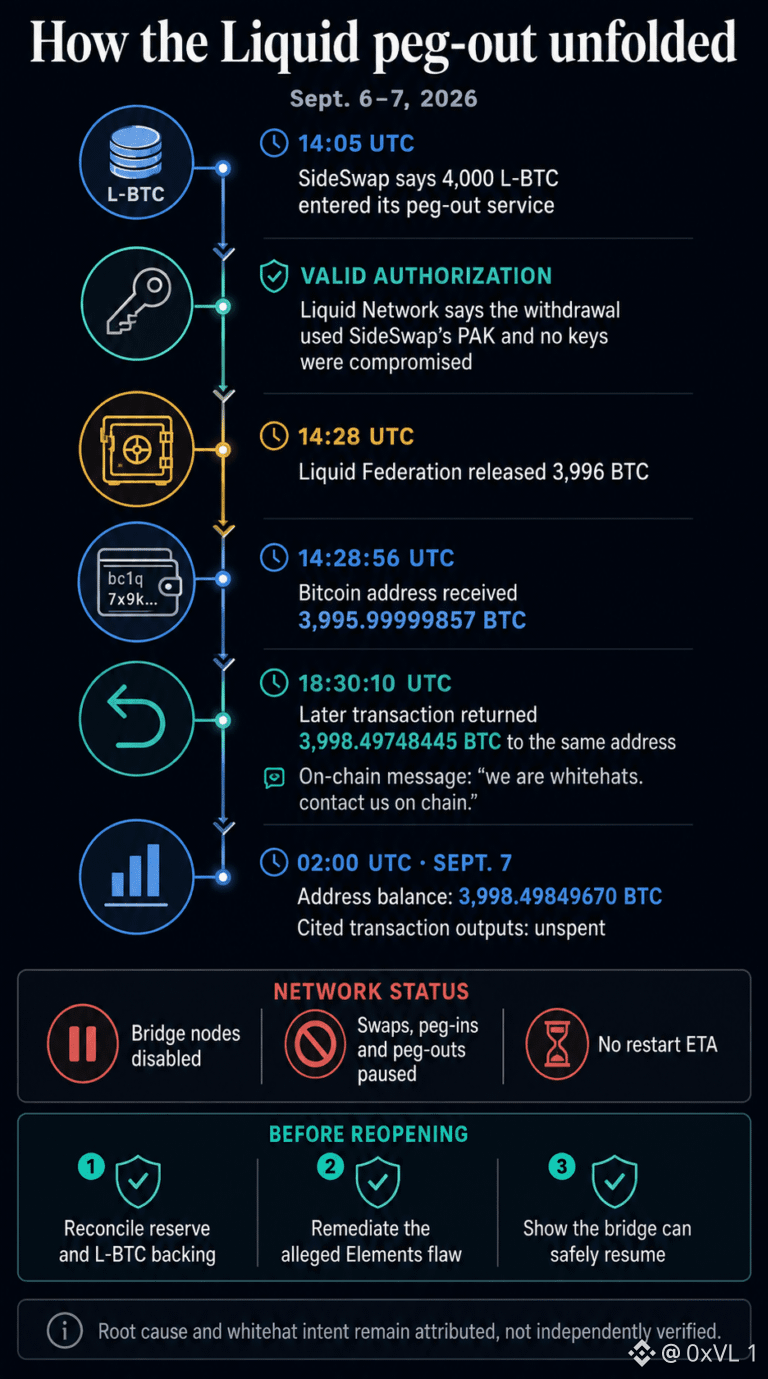
Tracking this Liquid Network situation has been highly engaging from a research perspective. It is genuinely interesting to watch a self-proclaimed white hat use OP_RETURN messages to negotiate directly with Blockstream on-chain, treating a $320 million withdrawal like a live bug bounty. The fact that they bypassed the 11-of-15 multisig by exploiting a logic flaw in the Elements software rather than stealing private keys shows a solid understanding of sidechain architecture. It reminds me of past bridge exploits where the code failed while the custody model technically worked as intended. I have to acknowledge the technical execution here; proving you can generate unbacked L-BTC and peg it out for real $BTC provides a very clear lesson for the ecosystem.
That being said, I have real concerns with how this entire scenario is playing out. Holding $320 million hostage until developers prove they have patched every node crosses the line from ethical disclosure to forced compliance. A standard white hat reports the vulnerability and collects a bounty; they do not unilaterally freeze liquidity and dictate operational terms to a federation of exchanges. This incident severely dents the trust we place in federated sidechain models. If a single software flaw can bypass the consensus mechanism and drain 95% of the reserves, we need to seriously re-evaluate the security assumptions used for scaling Bitcoin. Blockstream will need to provide a very thorough post-mortem once the dust settles.
That being said, I have real concerns with how this entire scenario is playing out. Holding $320 million hostage until developers prove they have patched every node crosses the line from ethical disclosure to forced compliance. A standard white hat reports the vulnerability and collects a bounty; they do not unilaterally freeze liquidity and dictate operational terms to a federation of exchanges. This incident severely dents the trust we place in federated sidechain models. If a single software flaw can bypass the consensus mechanism and drain 95% of the reserves, we need to seriously re-evaluate the security assumptions used for scaling Bitcoin. Blockstream will need to provide a very thorough post-mortem once the dust settles.