
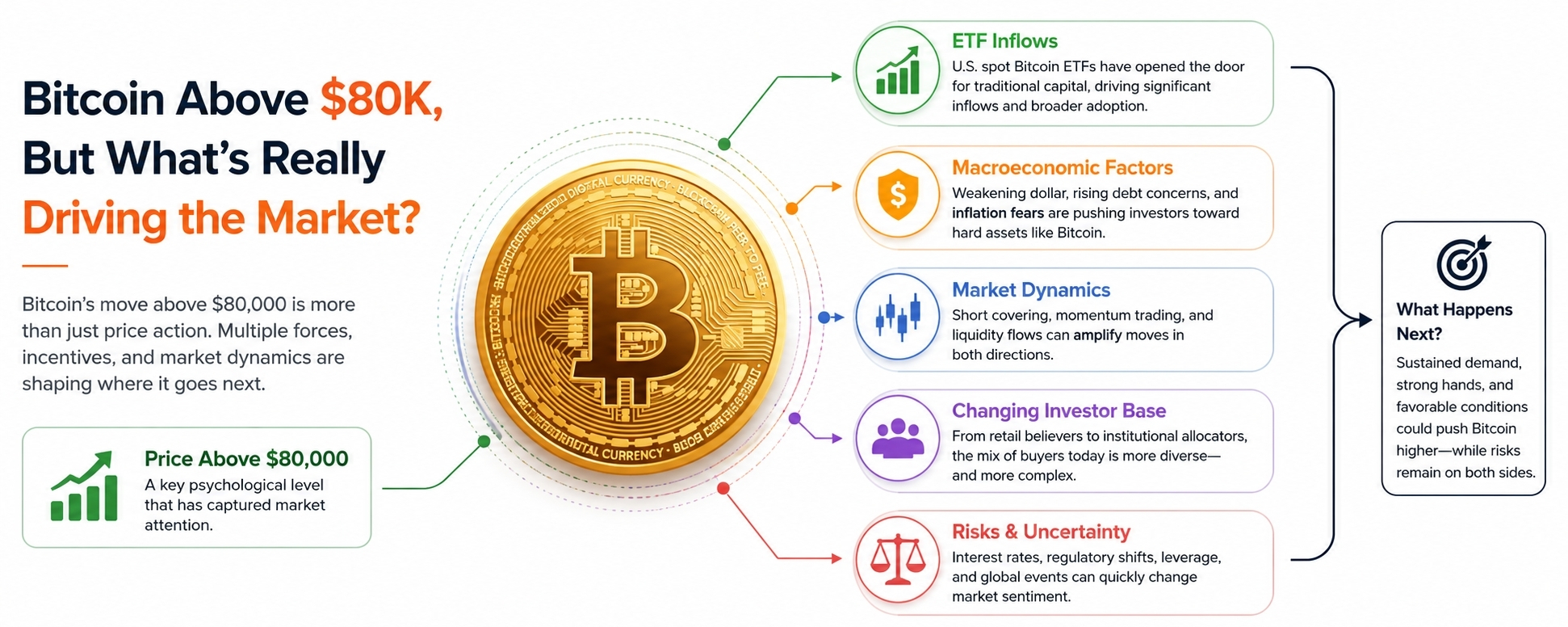


I’ve been looking at Bitcoin as if it were a project I’ve been quietly studying for years, not something I need to promote or predict. Right now, the number sitting in front of me is above $80,000 again, and my first reaction isn’t excitement. It’s curiosity. I want to understand what is actually pushing it higher, because Bitcoin has taught me over the years that the price is usually the easiest part of the story to see and the hardest part to understand.
Whenever Bitcoin crosses a big psychological level, the conversation changes almost immediately. A few weeks earlier, people can be worried about another decline. Then the market turns, the candles start moving higher, and suddenly everyone has a reason for why it was always going to happen. I’ve watched this cycle repeat enough times that I’ve become a little suspicious of explanations that arrive too quickly.
So I’m looking at this move differently.
What is really underneath it?
The obvious answer is demand. But even that needs to be unpacked. There is demand coming through U.S. spot Bitcoin ETFs. There is demand from investors who see Bitcoin as a hedge against currency debasement. There are traders reacting to momentum. There are short sellers closing positions because the market moved against them. There are long-term holders who may simply see weakness as an opportunity to accumulate.
All of these people can be buying Bitcoin at the same time.
But they are not buying it for the same reason.
That matters.
I keep thinking about how different Bitcoin ownership looks today compared with the early years. Back then, buying Bitcoin required a certain amount of effort and conviction. You had to understand wallets, exchanges, private keys and the strange idea of owning something that existed outside the traditional financial system.
Today, someone can get exposure through a familiar investment account without ever touching a Bitcoin wallet.
That is a huge change.
It has brought more money into the market, but it has also changed the character of that money.
An investor buying an ETF doesn’t necessarily have the same relationship with Bitcoin as someone who has held coins through several brutal market cycles. The ETF investor can treat Bitcoin as one position among many. If the position becomes uncomfortable, selling is only a few clicks away.
That doesn't make the investment less legitimate.
It just makes the incentives different.
And whenever I’m trying to understand a market, I pay more attention to incentives than narratives.
The ETF numbers are certainly significant. Billions of dollars have flowed into U.S. spot Bitcoin products since their launch, with BlackRock’s IBIT becoming the dominant vehicle by assets and cumulative inflows. But the flows have not been one-directional. There have been strong buying days followed by meaningful withdrawals.
That is something I don't want to ignore.
Money entering Bitcoin is important.
Money deciding whether to stay is probably more important.
A market can look incredibly strong while capital is still arriving. The more revealing moment comes when the excitement slows down and buyers have to decide whether they still want the asset at the current price.
That is where I think this $80,000 area becomes interesting.
It isn't just a number on a chart.
It is a test.
There are people who bought much lower and now have a reason to take some money off the table. There are traders who expected Bitcoin to remain weak and are now being forced to reconsider their positions. There are investors who missed the first part of the move and are wondering whether they should chase it.
Everyone is looking at the same price, but everyone is standing there for a different reason.
That is how markets become complicated.
The recent rally has also been connected to the softer U.S. dollar and renewed concerns about government debt and currency debasement. That narrative has become familiar around Bitcoin. When people lose confidence in traditional money or worry about the long-term purchasing power of currencies, Bitcoin is often brought back into the conversation.
I understand why.
But I’m still cautious about treating the story as complete.
Bitcoin may benefit from concerns about fiat currencies, but Bitcoin also trades inside the global financial system. It reacts to interest rates. It reacts to liquidity. It reacts to the dollar. It reacts to investor risk appetite.
That creates an interesting contradiction.
Bitcoin was designed as something that could exist independently of traditional monetary institutions.
Yet the market price can still be heavily influenced by what those institutions do.
A Federal Reserve decision can move Bitcoin.
A Treasury announcement can move Bitcoin.
Bond yields can move Bitcoin.
ETF flows can move Bitcoin.
None of those things changes Bitcoin’s supply schedule.
But they can change the willingness of people to buy it.
That distinction keeps coming back to me.
The network is one thing.
The market around the network is another.
And the bigger Bitcoin becomes, the more complicated that second layer gets.
There is also the issue of leverage.
This is one of those things that tends to disappear from the conversation when prices are rising. Everyone talks about spot demand and adoption, but derivatives can quietly make a move much larger than the underlying demand would suggest.
A trader who is short Bitcoin has to buy if the market moves far enough against them. That buying can push the price higher. The higher price can force another trader to close a position. Then another.
For a while, it can look like everyone suddenly believes in Bitcoin again.
But sometimes the market is not expressing conviction.
Sometimes it is simply forcing people to admit they were positioned incorrectly.
I find that distinction important because forced buying can create a very convincing rally.
The chart doesn't tell you why someone bought.
It only tells you that they did.
That is why I’m also watching what long-term holders are doing.
During periods of weakness, coins often move from impatient holders toward people who appear more comfortable with volatility. That kind of quiet accumulation has historically been one of the more interesting features of Bitcoin’s cycles.
There is no dramatic headline attached to it.
Nobody rings a bell.
Someone simply keeps buying while everyone else is nervous.
That behaviour tells me more than a thousand optimistic predictions.
Because patience is expensive.
It is easy to say you believe in Bitcoin when it is moving higher. It is much harder to keep believing when the market has spent months going nowhere or when your position is deeply underwater.
That is where conviction gets tested.
And I think the same test is coming for the newer institutional money.
If Bitcoin remains above $80,000 and eventually moves higher, the story will probably become even louder. More analysts will publish targets. More companies will discuss exposure. More investors will argue that Bitcoin has entered a completely different phase.
Maybe they will be right.
But I’m more interested in what happens if Bitcoin doesn't immediately go higher.
If it spends weeks around the same level, will investors continue buying?
If it drops 10% or 15%, does the demand remain?
If interest rates stay high, does the appetite for Bitcoin change?
If the dollar strengthens, does the debasement argument become less convincing?
If the market becomes nervous again, who steps in?
Those are the questions I would rather sit with.
Because a rising market can hide weaknesses.
A falling market tends to reveal them.
Bitcoin has survived enough crashes to deserve respect for its resilience. But resilience should not be confused with invulnerability. Every financial system eventually encounters situations where incentives become more important than beliefs.
A person can believe Bitcoin will be worth much more in ten years and still sell today because they need cash.
A fund can believe in the long-term thesis and still reduce its position because of risk limits.
A company can believe Bitcoin is undervalued and still sell because it has obligations to meet.
That is not hypocrisy.
That is simply how markets work.
People have reasons to buy, and people have reasons to sell.
Sometimes those reasons have nothing to do with the asset itself.
This is why I don't think the most interesting Bitcoin question right now is whether $80,000 is bullish or bearish.
I think the better question is what kind of behaviour this price level creates.
Will holders distribute?
Will new buyers keep arriving?
Will institutional money continue flowing?
Will leverage build again?
Will investors become comfortable enough to stop worrying about downside?
Or will the market discover that the people who were willing to buy at $60,000 are not necessarily willing to buy at $80,000?
There is no way to know that from the price alone.
We have to watch what happens next.
That is what makes Bitcoin interesting to me even after all these years. It is still a project that looks simple from a distance and becomes increasingly complicated the closer you get.
The protocol has rules.
The people around it don't.
The supply is predictable.
Demand isn't.
The network can continue operating regardless of sentiment.
The market cannot.
Maybe that is the real story behind Bitcoin being above $80,000.
Not that the market has finally figured out what Bitcoin is worth, but that another group of investors is being asked to decide what they are willing to pay for it and, more importantly, how long they are willing to hold it when the easy part of the story disappears.
For now, I’m watching rather than trying to call the outcome.
The price has moved.
The narrative has changed.
The money has changed.
But the real test is still ahead.
At some point, the excitement will quiet down. The charts will become less interesting. The headlines will move somewhere else.
That is usually when I want to pay the most attention.
Because when nobody is watching quite so closely, the incentives underneath