

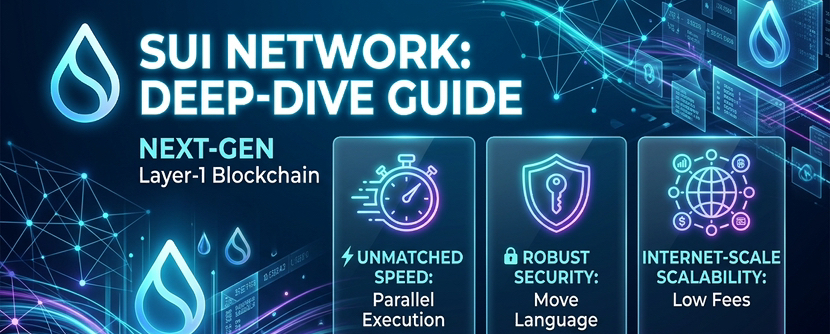
## 1. What is SUI Network and Who are Its Founders?
SUI Network is a high-performance, smart-contract-enabled Layer-1 blockchain that launched its mainnet in May 2023.
The protocol was created by Mysten Labs. The founding team at Mysten Labs—*Evan Cheng, Sam Blackshear, Adeniyi Abiodun, George Danezis, and Kostas Chalkias*—were lead engineers and researchers behind Meta’s (Facebook) ambitious Diem / Libra blockchain initiative. Following the conclusion of that project, the core team leveraged their research to design the Move programming language and establish the Sui Network.
---
## 2. Key Architectural Differentiators (Core Technology)
Unlike traditional blockchain architectures like Ethereum or Bitcoin, SUI utilizes a fundamentally different design built on three technological pillars:
### A. Object-Centric Data Model
Traditional blockchains rely on an account-based model where every transaction modifies a global state balance. SUI Network uses an object-centric model:
* Every token, NFT, or smart contract is treated as an independent "Object."
* Each object maintains its own distinct version history.
* Transactions touching separate, unrelated objects can execute independently without waiting for a global sequential consensus queue.
### B. Parallel Transaction Execution
While chains like Ethereum process transactions sequentially, SUI leverages parallel execution. Simple transactions—such as direct asset transfers or minting NFTs—bypass heavy consensus rounds, enabling sub-second finality and near-instant throughput without network congestion.
### C. Sui Move Programming Language
SUI is powered by Move, a Rust-based programming language engineered specifically for secure smart contracts. Sui Move natively prevents common vulnerability exploits (like re-entrancy attacks), providing enhanced protocol-level security.
---
## 3. SUI Token Utility
The $SUI token serves as the native utility, staking, and governance asset for the ecosystem:
1. Gas Fees: Paid in SUI for all execution, state storage, and smart contract operations.
2. Delegated Proof-of-Stake (DPoS): Holders delegate tokens to validators to secure the network and earn passive staking yield.
3. Governance: Token holders vote on protocol upgrades, parameter adjustments, and ecosystem treasury disbursements.
4. Storage Fund: SUI incorporates a storage fund mechanism to compensate validators for maintaining historical chain data over time, maintaining long-term economic equilibrium.
---
## 4. Tokenomics and Supply Metrics
Understanding SUI's economic design is crucial for long-term evaluation:
* Max Supply: 10 Billion SUI (Hard Capped)
* Circulating Supply: ~4.1 Billion SUI (Approximately 41% of total supply actively circulating $SUI
