




Hyperliquid established itself as one of the largest Dex perpetual futures exchanges in the world. By early 2026, it held roughly thirty-six percent of global on-chain perpetual futures trading volume. It built a massive user base by offering fast execution, zero gas fees, and deep liquidity for trading cryptocurrencies with leverage. However, focusing strictly on crypto prices limits the ceiling of any financial platform. The world is much larger than Bitcoin and Ethereum charts.
Hyperliquid Improvement Proposal 4, or HIP-4, is a major structural upgrade launched on the mainnet in May 2026. It fundamentally changes the platform. It introduces decentralized prediction markets and options directly into the core trading engine. It allows users to trade real-world outcomes without ever leaving their crypto trading terminal.
But, how does that work? Let's find out.
Assume you are a professional trader casually attempting to hedge against a major political election.
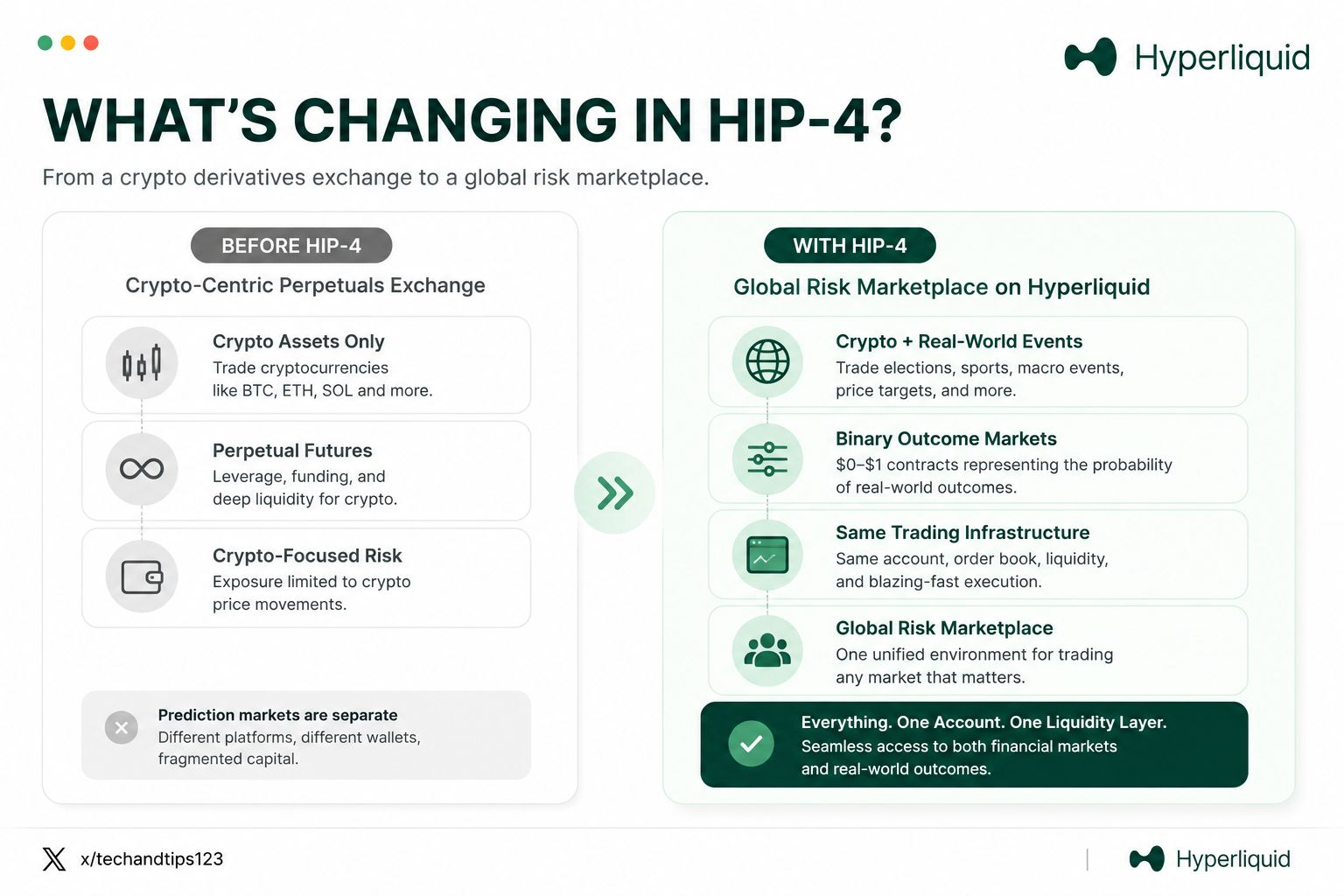
In the traditional DeFi ecosystem, your capital is heavily fragmented. You keep your trading capital on a decentralized derivatives exchange to long or short specific crypto assets. If you want to bet on the actual election result, you must withdraw funds and bridge them to a separate prediction market. You must lock your money in a completely isolated ecosystem like Polymarket or Kalshi. Those two platforms cannot communicate or share collateral.
HIP-4 changes the basic math of capital efficiency. It builds an outcome market directly inside the existing futures exchange.
Instead of opening a separate application, you navigate to a new tab on your existing Hyperliquid terminal. You see binary contracts representing specific events. These events can include political elections, sports outcomes, or specific price targets for Bitcoin by a certain date. You use the exact same trading account to buy shares in these outcomes. The prediction market and the financial market merge into one unified ledger on the HyperCore blockchain.
II. How HIP-4 Fuses Prediction Markets Into a Futures Engine
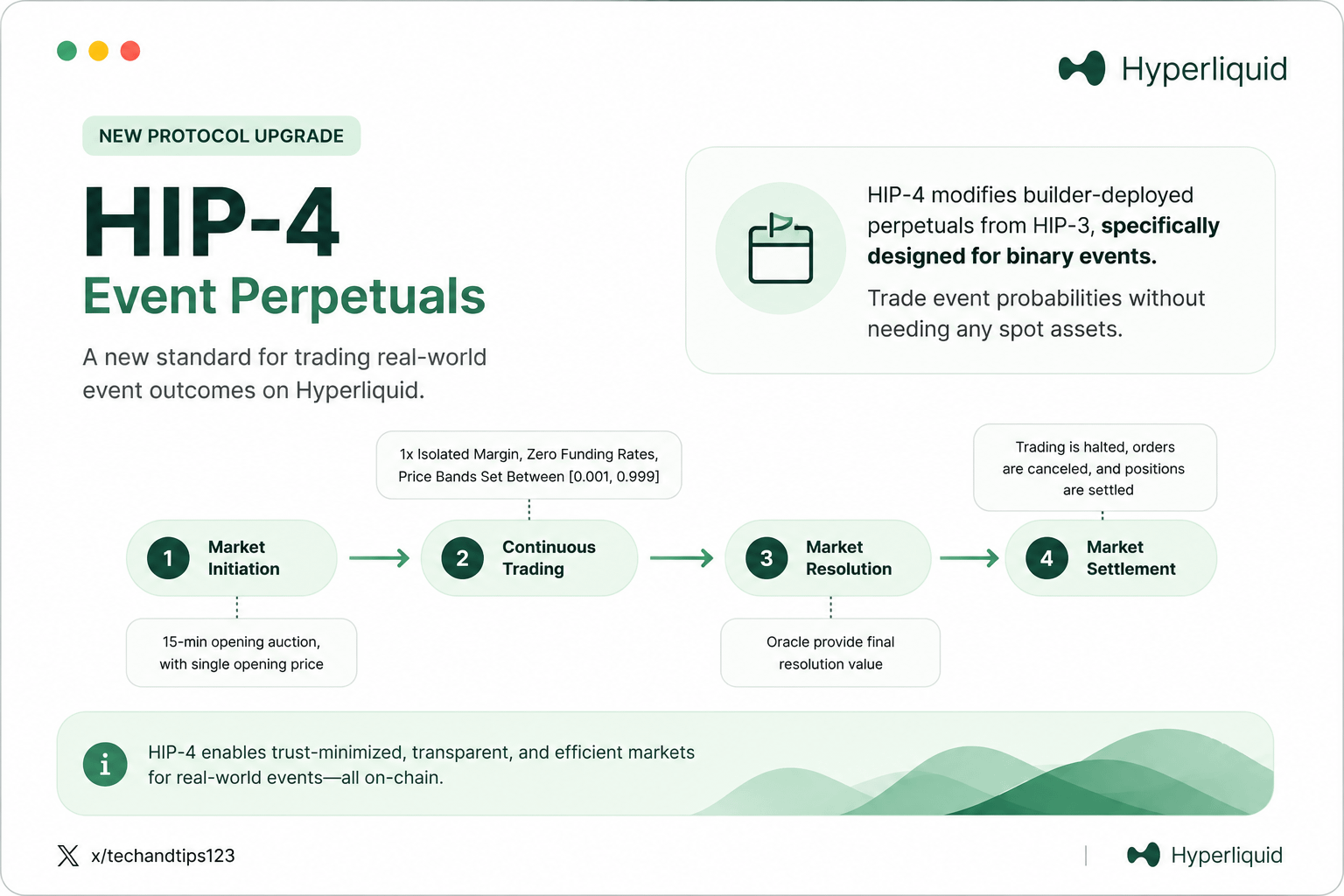
Integrating prediction markets into a high-speed futures exchange requires specific architectural rules. These outcome markets do not function like standard leveraged trading pairs.
Here is the exact mechanical flow of how HIP-4 processes an event contract.
HIP-4 does something no major derivatives exchange has done before. It takes the logic of a prediction market, binary outcomes, probability pricing, event settlement and bolts it directly onto a high-speed perpetual futures engine. The result isn't a separate product. It's the same matching engine, the same collateral pool, and the same account structure now pricing real-world events alongside crypto volatility. This changes what Hyperliquid is. It's no longer a crypto exchange. It's a risk market for everything.
❍ Binary Outcome Contracts
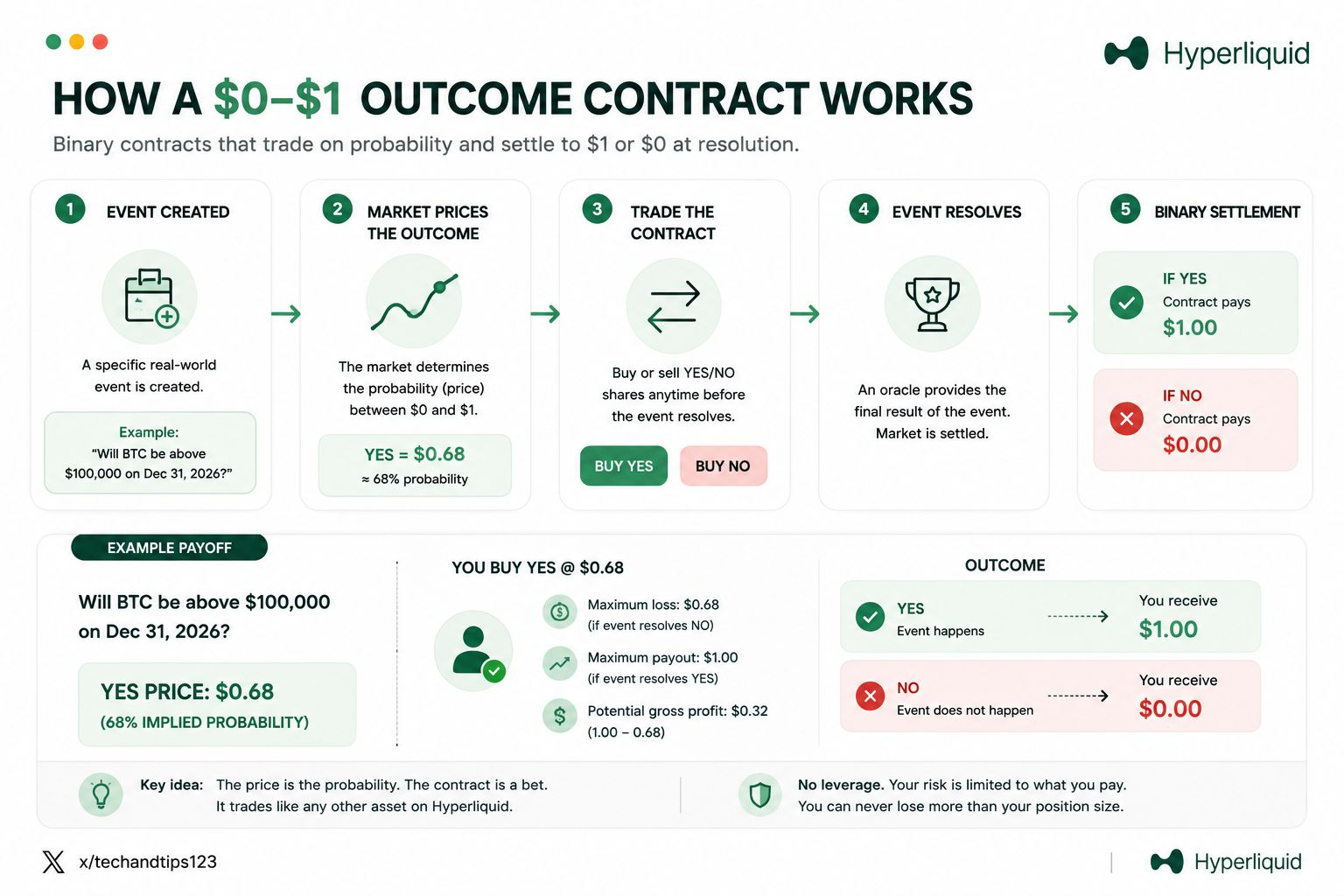
HIP-4 introduces a financial primitive called the outcome market. These are fully collateralized binary contracts. They are priced dynamically as a probability between zero and one. At expiration, the contract settles to a hard binary state. It settles to exactly one if the event happens. It settles to exactly zero if the event does not happen. You are buying a highly specific probability that constantly fluctuates based on market demand until the underlying event officially resolves.
Think of these contracts as a number between 0 and 1 that trades like a stock. If the market says "Candidate A wins" at 0.68, you pay $0.68 for a contract that will be worth $1.00 if they win and $0.00 if they lose. The price is the probability. The contract is a bet. And because it trades on the same order book as ETH and BTC, the transition from "buying altcoins" to "buying election outcomes" is seamless.
❍ Native Asset Settlement
Unlike many prediction markets that rely on external wrapped tokens, HIP-4 outcomes are held as native HyperCore assets. The contracts settle strictly in USDH, which is Hyperliquid's native ecosystem stablecoin. This removes the friction of relying on external smart contract bridges or third-party token matching layers. The outcome assets share the exact same matching engine and programming interface as the spot and perpetual markets.
Most prediction platforms are isolated islands. Your money sits on Polymarket, separate from your trading stack. HIP-4 outcomes are native HyperCore assets settled in USDH. That means no wrapping, no bridging, no second wallet. The capital you use to buy an election contract is the same capital you use to short Bitcoin. One ledger. One account. One stablecoin.
❍ Zero Liquidation Risk
When you trade perpetual futures on Hyperliquid, you use leverage. If the market moves against you drastically, the system liquidates your position and wipes out your collateral. Outcome contracts remove this mechanic entirely. There is zero leverage available for these specific prediction markets. Your position is fully collateralized the moment you open it. This means you can hold an outcome contract through extreme price volatility without any fear of a sudden margin call or forced closure.
If you've ever been liquidated on a leveraged trade, you know the pain of watching a position explode before you can react. Prediction contracts remove that nightmare entirely. You buy the outcome. You hold it. The price can swing wildly, but your position cannot be force-closed. It only resolves when the real-world event resolves. For traders who want exposure to volatility without the risk of margin calls, this is a new kind of safe harbor.
❍ Unified Cross-Margin Accounts
This is the headline feature, and it deserves more attention than it gets.
In a normal world, your prediction market capital is dead weight. It sits in a separate app, doing nothing until the event resolves. HIP-4 changes that. Because outcome contracts are fully collateralized and held in the same cross-margin account as your perpetual positions, they can act as active collateral.
Bet $100,000 on a pro-crypto election result. Use that same $100,000 to support a leveraged long position on Bitcoin. If the election goes your way, your prediction contract pays out and your leveraged trade benefits from the regulatory tailwind. Your capital works twice, in two correlated markets, from one account.
This is not just capital efficiency. It's a new form of cross-market hedging that traditional finance still can't replicate.
III. The Permissionless Staking Model
A major problem with decentralized prediction markets is quality control. If anyone can create a market for any obscure event, the platform quickly fills with fraudulent contracts and unresolvable disputes.
Hyperliquid solves this problem through a severe economic barrier.
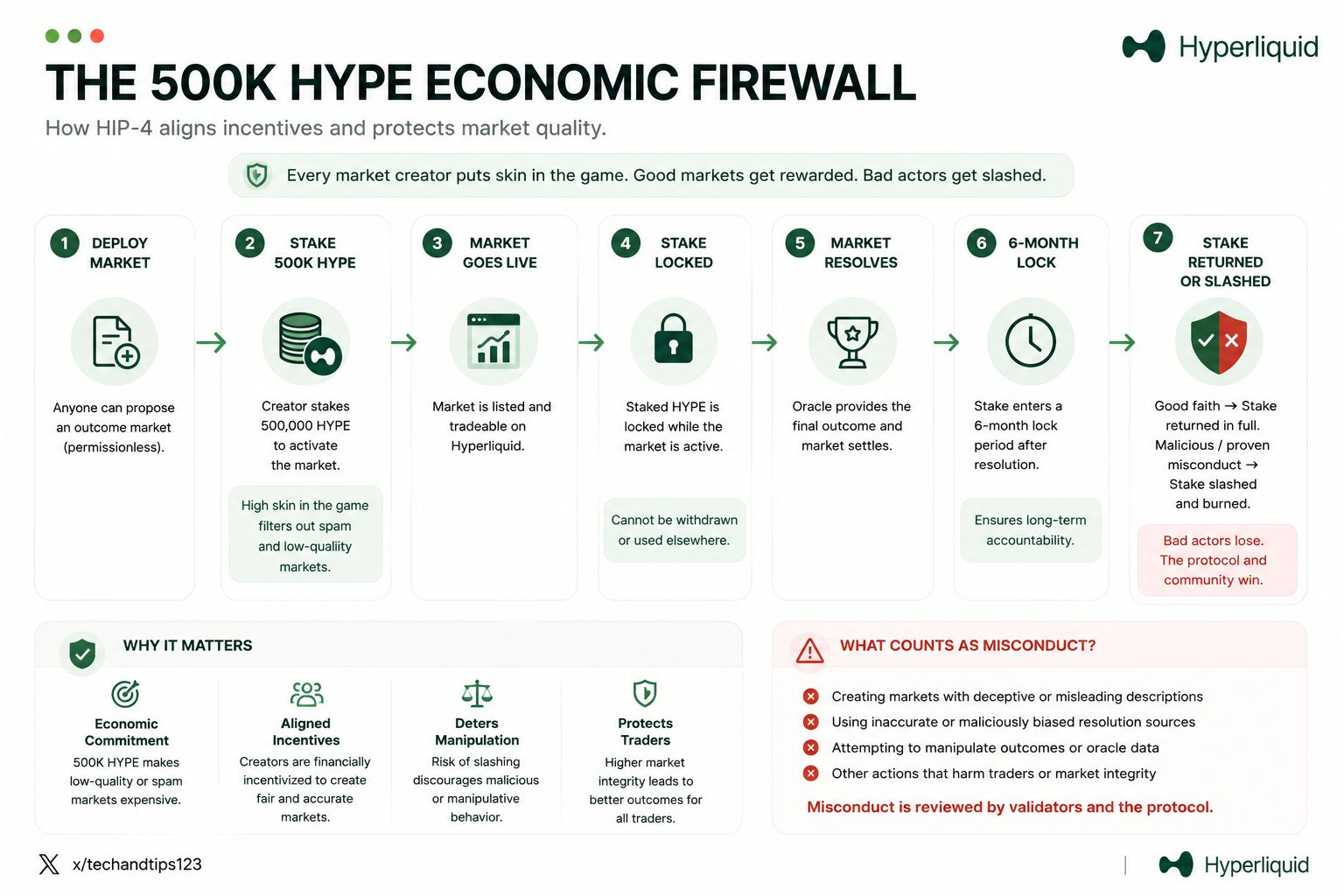
Prediction markets have a spam problem. Without a barrier to entry, you get thousands of low-quality markets with no liquidity and no trustworthy resolution. HIP-4 solves this with a brutally simple filter: it costs 500,000 in $HYPE tokens to launch a market.
That's not a fee. It's a stake. And it changes who gets to play market creator.
❍ The Staking Requirement
HIP-4 allows third-party developers to deploy their own permissionless markets. However, deploying a market is not free. The creator must stake five hundred thousand HYPE tokens to open the contract. This massive capital requirement immediately filters out spam. Only serious market makers and institutional entities can afford to launch new prediction markets on the protocol.
The 500,000 HYPE requirement is not arbitrary. At current prices, that's a serious commitment—enough to scare off random spammers but not enough to block serious market makers or institutions. It creates a minimum quality bar. The only entities willing to lock up that much capital are ones who genuinely believe their market will attract volume and generate fees.
❍ The Slashing Penalty
The staked capital is not just a passive deposit. It is a financial hostage. The HYPE tokens remain completely locked for six months after the market resolves. If the creator provides a fraudulent oracle resolution, or if the settlement data is intentionally manipulated, the network validators intervene. They slash the staked tokens, permanently burning the creator's capital. This aligns the economic incentives perfectly. The cost of cheating mathematically outweighs the potential profit of manipulating a small prediction market.
The staked HYPE doesn't just sit there passively. After the market resolves, the stake remains locked for six months. If the creator provides fraudulent oracle data or manipulates the settlement, validators can slash the entire stake. The tokens are burned. Gone forever.
The math is simple: cheating on a small market might net you a few hundred thousand dollars in manipulated payouts. Losing 500,000 HYPE could cost you millions. The incentive structure makes fraud economically stupid. That's the point.
IV. What HIP-4 Unlocks (and What Can Go Wrong)
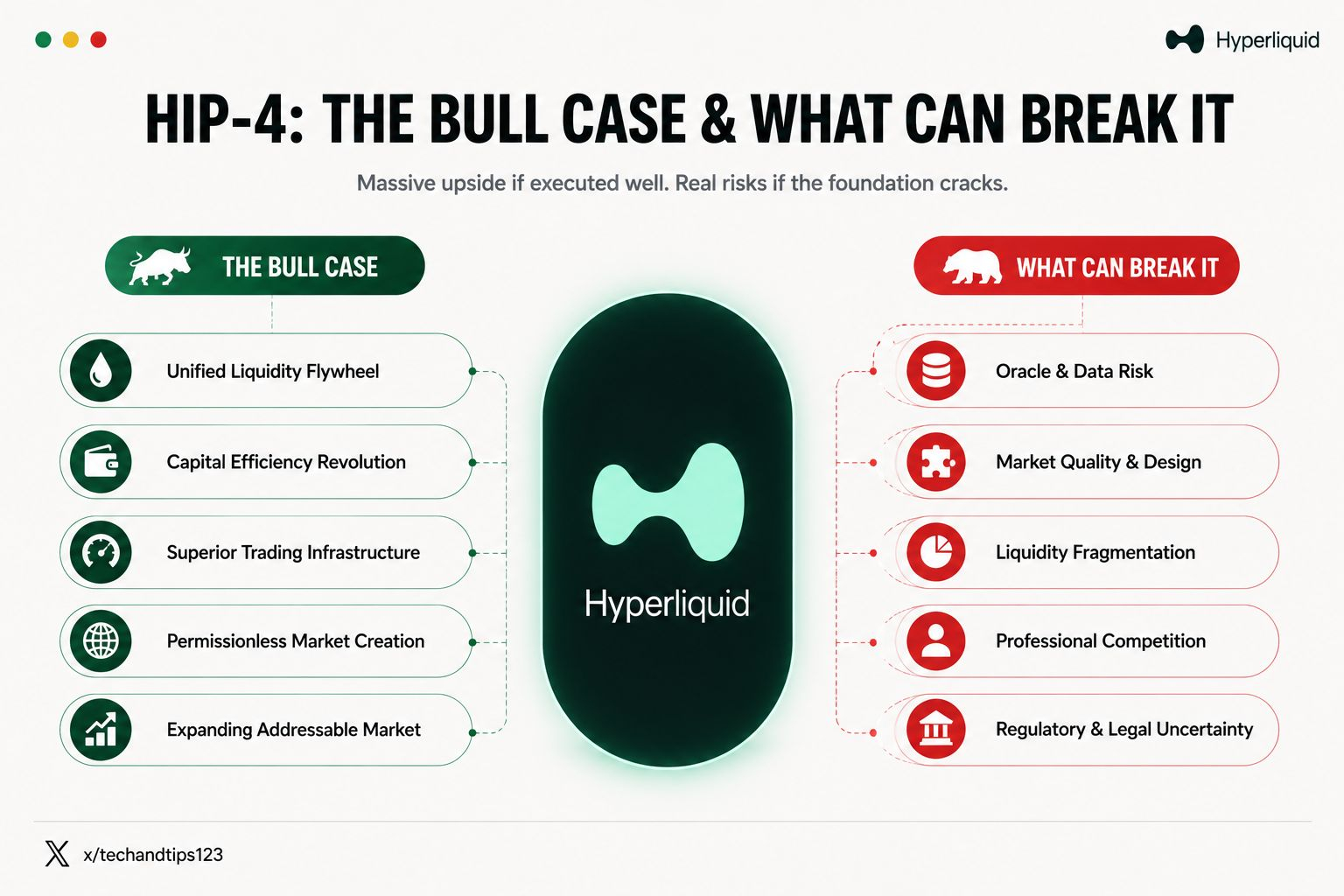
HIP-4 is a massive technological leap for DeFi, but it introduces distinct risks that standard perpetual traders are not used to managing.
❍ High-Frequency Prediction Trading
Hyperliquid has always been built for speed. Low-latency execution, rapid order cancellation, institutional-grade matching. Now that infrastructure is pointed at prediction markets. Algorithms can trade election odds the same way they trade ETH perps, reacting to breaking news in microseconds, adjusting positions in real time.
For retail traders, this is a double-edged sword. The liquidity is deeper, but the competition is faster. On Polymarket, you're trading against retail. On HIP-4, you're trading against the same infrastructure that hosts professional crypto prop desks.
❍ The Hidden Options Engine Inside HIP-4
Everyone is talking about elections and sports. But the most important feature of HIP-4 might be something else entirely.
A binary contract based on "Bitcoin above $100,000 by December 31" is not just a prediction. It's a bounded option. It pays out a fixed amount if the condition is met, zero if not. This gives traders a non-linear hedging tool that behaves like a call option without the complexity of traditional options markets.
Hyperliquid didn't launch an options exchange. It launched something more subtle—an options-like primitive disguised as a prediction market. If sophisticated traders figure this out, it could pull significant volume from dedicated options platforms.
❍ The Oracle Vulnerability
Every prediction market relies on an oracle. An oracle is the data feed that tells the smart contract who won the election or whether Bitcoin hit the target. The contract itself is immutable. But the oracle is not.
If the oracle is compromised, delayed, or simply wrong, the contract settles incorrectly. And because settlement is irreversible, there is no appeal process. The entire security model of HIP-4 rests on the reliability of third-party data providers. That's a single point of failure that even a 500,000 HYPE staking barrier cannot eliminate.
FIN
Decentralized prediction markets are historically isolated casinos. They offer fun speculation, but they struggle to integrate with serious institutional finance.
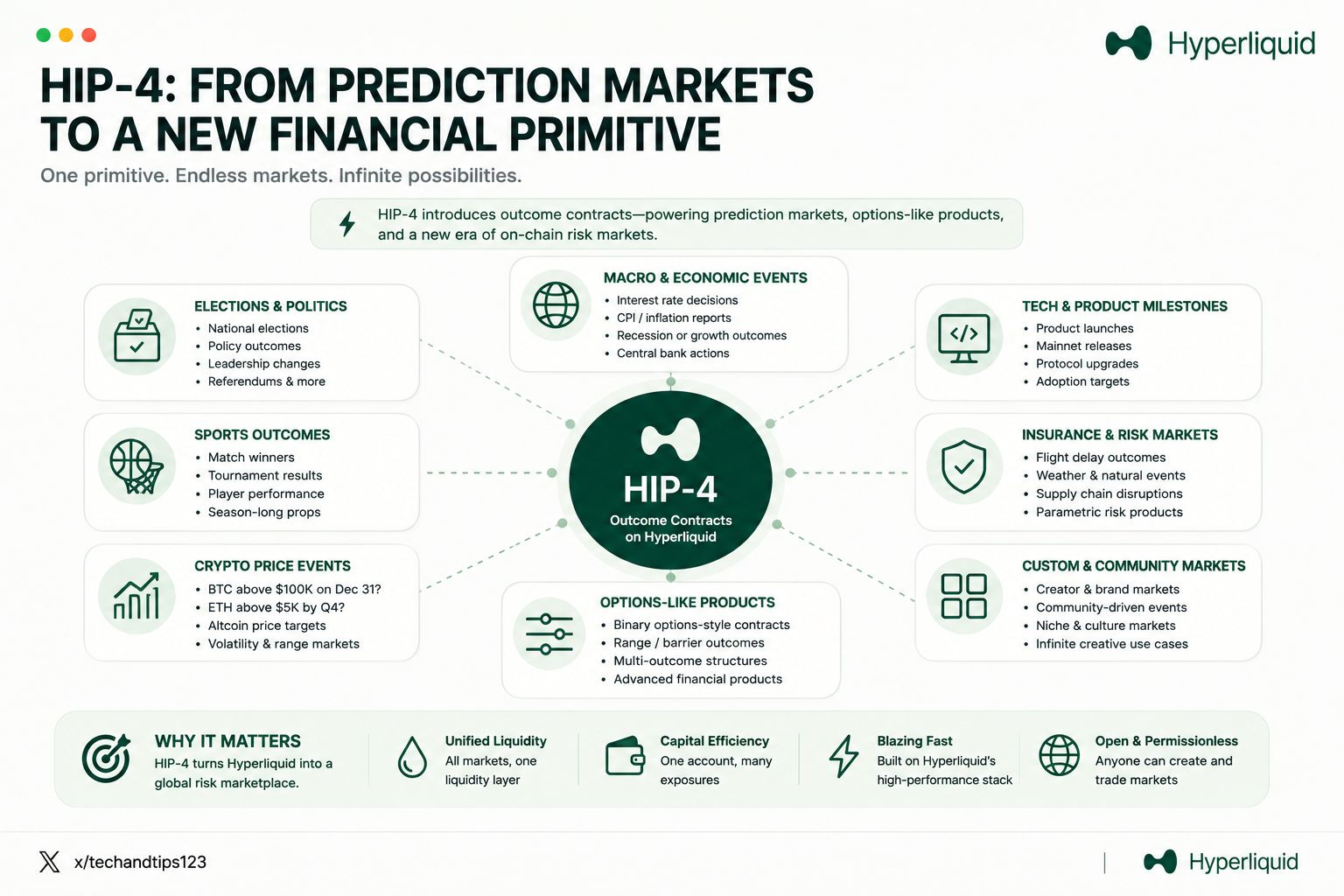
HIP-4 bridges that exact gap. It takes the probability mechanics of a prediction market and hardwires them directly into the liquidity engine of a major derivatives exchange. It transforms a binary bet into a fully composable financial instrument.
When you can use a political prediction to dynamically hedge a leveraged Bitcoin position within the same trading account, the platform stops being a crypto exchange. It becomes a global risk market. The success of HIP-4 depends on whether professional traders prefer this unified capital efficiency over the standalone experience of existing prediction platforms. On current evidence, the infrastructure is already winning..