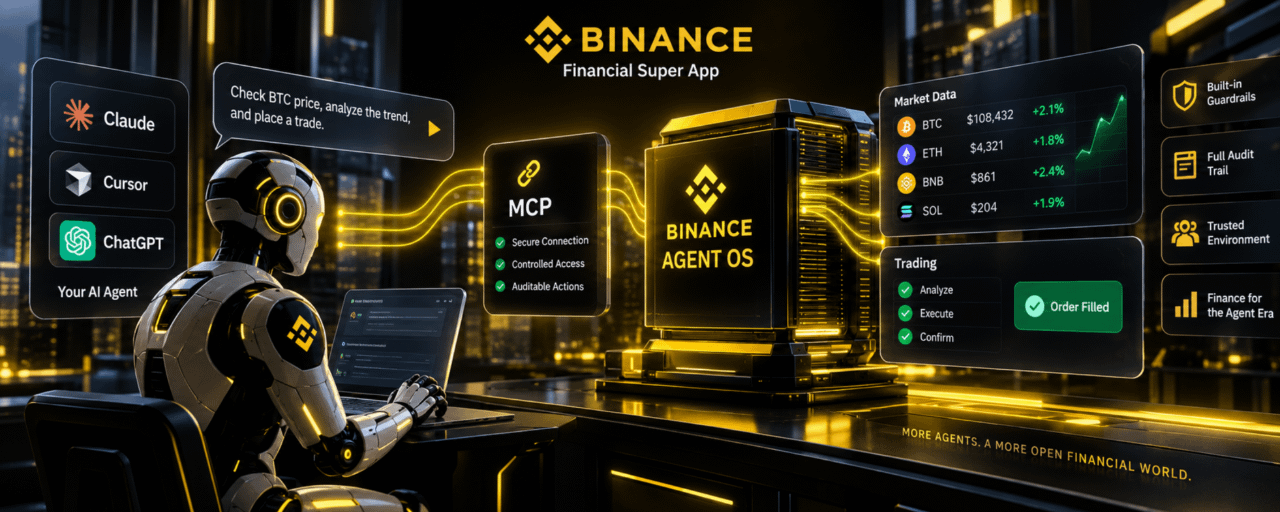

AI agents are moving beyond answering questions. The next step is giving them the ability to access real-world data, use financial tools, and take actions within clearly defined boundaries.
That is the idea behind Binance Agent OS, launched on August 20, 2026. It connects AI applications such as ChatGPT, Claude Code, Codex, and Cursor to Binance services through the Model Context Protocol (MCP), allowing an AI agent to interact with market data, account information, and trading functions when the user grants permission.
But the important question is not what an AI agent could do. It is what happens when an agent actually connects to financial infrastructure.
Step 1: The Agent Discovers Binance Tools
Imagine starting inside an AI environment such as Claude or Cursor.
Instead of manually opening multiple dashboards or writing API requests, the agent can discover the Binance tools available through the MCP connection. Depending on the permissions configured, those tools can include market-data queries, account information, and trading capabilities.
The interaction remains natural-language driven.
For example, a user could ask the agent to check the current BTC market, compare trading conditions, or review an account balance. The agent determines which Binance tool is appropriate, sends the request, and brings the result back into the conversation.
This is the first important shift: the AI is no longer simply generating an answer from its model knowledge. It is querying live financial infrastructure.
Step 2: From Market Data to Action
The workflow becomes more powerful when trading permissions are enabled.
An agent can retrieve relevant market information, evaluate the user's instructions against that data, and prepare an order. With the appropriate authorization, it can then submit the trade through Binance.
This creates an agentic trading workflow:
User instruction → AI reasoning → Binance tool call → market response → decision → execution
The key difference from a traditional chatbot is the final step. The agent can move from “Here is what I think you should do” to “Here is the action I have been authorized to perform.”
Step 3: The Guardrails Matter
Giving an AI access to financial infrastructure requires more than connectivity. It requires boundaries.
Binance Agent OS uses a dedicated sub-account model for agent activity. Users can control permissions, while withdrawals from the agent's sub-account are blocked by default. Funding is also controlled by the user, meaning the amount transferred into the sub-account effectively limits the agent's trading exposure.
Users can also choose between requiring approval for every order or allowing the agent to trade autonomously within the permissions and limits already configured. An emergency stop provides another way to revoke agent access if needed.
That architecture changes the conversation around AI trading. The goal is not unrestricted autonomy. It is controlled autonomy.
From Chatbot to Financial Agent
This is where Binance Agent OS and MCP become more than a technical announcement.
The infrastructure allows an AI agent to discover financial tools, retrieve live Binance market data, interact with trading functions, and operate inside a permissioned environment.
The broader implication is significant: finance for AI agents is becoming an actual infrastructure layer, not just a concept.
The future agent may not simply tell you what is happening in the market. It may be able to observe, reason, and act — while the user remains in control of the boundaries.
Step by step to set up your Binance Agent OS
#BinanceAgentOS #TradingBots #market