


Crypto traders spend countless hours watching support zones, resistance levels, moving averages and breakout patterns.
But this September, one decision from the Federal Reserve could have a bigger impact on the market than almost any technical pattern on the chart.
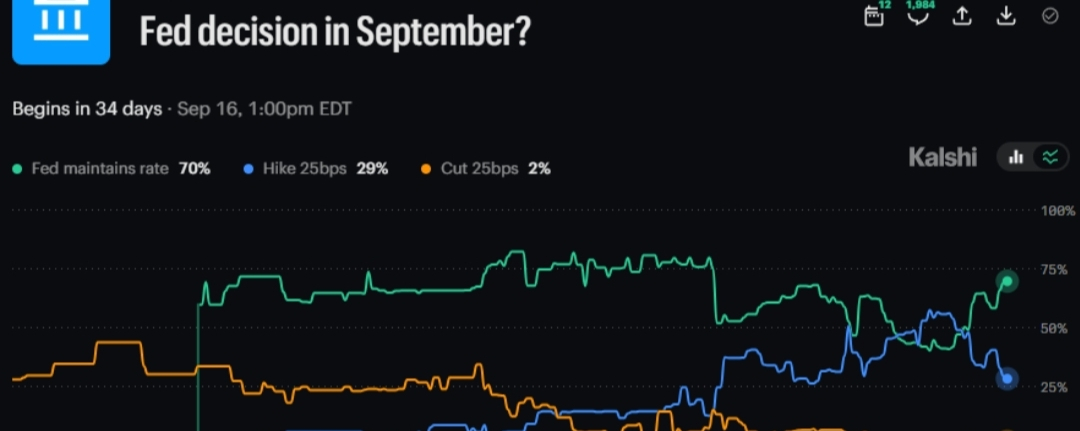
The Fed’s next policy meeting is scheduled for September 15–16, with the interest-rate decision and press conference coming on September 16.
And this meeting is getting particularly interesting.
The Fed Has Suddenly Become More Hawkish
The biggest change came after Federal Reserve Chair Kevin Warsh’s recent Jackson Hole speech.
Warsh emphasized that inflation remains above the Fed’s 2% target and said policymakers need confidence that underlying inflation is moving toward that goal at a sufficient pace. He also described labor-market conditions as broadly consistent with full employment.
Markets reacted quickly.
As of August 31, traders were pricing roughly a 60% probability of a September rate increase, while Barclays shifted its forecast and now expects a 25-basis-point hike in September followed by another in December.
That creates significant uncertainty heading into September.
And uncertainty often means volatility.
Why Should Crypto Traders Care About Interest Rates?
Bitcoin may be decentralized, but its market does not exist in isolation.
Crypto competes with stocks, bonds, cash and other assets for investor capital.
When interest rates rise, borrowing becomes more expensive and safer assets can offer more attractive returns. Financial conditions can tighten, making investors less willing to take risks.
That environment can become challenging for speculative assets such as crypto.
When markets expect easier monetary conditions, the opposite dynamic can occur. Investors may become more comfortable taking risk, and liquidity can move toward assets with greater potential returns.
This is why a Fed announcement can suddenly overpower a technically perfect-looking crypto setup.
Bitcoin Is Already Showing How Important the Fed Is
Bitcoin entered the final day of August below the major $80,000 psychological level.
On August 31, Bitcoin was trading around $78,545, after recovering somewhat from losses following Warsh’s comments.
That reaction is important.
Nothing about Bitcoin’s blockchain fundamentally changed because of one speech.
What changed was the market’s expectation for interest rates.
And expectations move capital.
But September 16 Isn’t the Only Date That Matters
The market will receive important economic information before the Fed makes its decision.
The August U.S. employment report is due on September 4. A Reuters poll expects payroll growth of around 58,000 jobs, following a surprise decline of 23,000 in July.
Then comes inflation.
August CPI data is scheduled for September 11, just days before the Fed meeting. Both the employment report and CPI could influence whether policymakers decide to raise rates.
That means crypto traders could experience several waves of volatility before the actual Fed announcement.
Hot Inflation Could Change Everything
Inflation remains the central problem.
Warsh recently noted that the Fed’s preferred 12-month PCE inflation measure stood at 3.7%, well above the central bank’s 2% objective.
If upcoming inflation data remains stubbornly high, expectations for tighter monetary policy could strengthen.
That could push bond yields higher, support the dollar and make financial conditions less friendly toward risk assets.
Bitcoin and altcoins could feel that pressure.
On the other hand, unexpectedly softer inflation could reduce expectations for aggressive tightening.
The market reaction could therefore begin well before September 16.
Why Chart Patterns Can Fail During Macro Events
Imagine Bitcoin forms a textbook bullish breakout.
Resistance breaks.
Volume increases.
Momentum looks strong.
Under normal conditions, traders might expect continuation.
Then unexpectedly strong inflation data arrives and markets rapidly increase expectations for higher interest rates.
Suddenly, the entire macro environment changes.
The breakout can fail even though the original technical setup looked convincing.
This does not mean technical analysis is useless.
It means technical analysis tells us what price is doing, while macroeconomic events can suddenly change why investors are buying or selling.
During major Fed weeks, both matter.
Altcoins Could Feel an Even Bigger Impact
Bitcoin usually receives most of the attention around macro events, but altcoins can experience even greater volatility.
Smaller cryptocurrencies generally carry more risk.
When investors become cautious, capital can move away from higher-risk parts of the market first.
So if September brings tighter financial conditions, Bitcoin may not be the only asset affected.
ETH, SOL and the wider altcoin market could experience amplified moves depending on how investors interpret the Fed’s message.
The same applies in the opposite direction if the market interprets the decision as more supportive of risk-taking.
The Fed’s Words Could Matter as Much as the Decision
Traders should not focus only on whether the Fed raises rates or keeps them unchanged.
The language surrounding the decision matters too.
Markets will be listening for clues about inflation, future rate decisions and the overall direction of monetary policy.
Warsh has also argued against excessive forward guidance, suggesting the Fed should preserve flexibility rather than making strong commitments about future decisions.
That could make markets even more sensitive to economic data and each new Fed communication.
September Could Become a Macro-Driven Crypto Market
September is shaping up to be about much more than support and resistance.
First comes employment data.
Then inflation.
Then the Federal Reserve.
Meanwhile, Bitcoin is sitting near one of the most watched psychological areas in the market.
A chart might show where Bitcoin could move next.
But the Fed could determine whether investors actually have the confidence and liquidity to push it there.
This September, the biggest signal for crypto may not appear on a Bitcoin chart at all — it may come directly from the Federal Reserve.