

The crypto market is often described in simple cycles.
Bitcoin rallies first. Ethereum follows. Then capital moves into altcoins and a broad “altseason” begins.
But the current market looks more selective than that.
Recent crypto ETF data shows that while Bitcoin experienced a pause in institutional flows, several alternative digital assets continued attracting capital. That does not automatically mean a full altcoin season has started, but it does suggest that investors are paying attention to opportunities beyond Bitcoin.
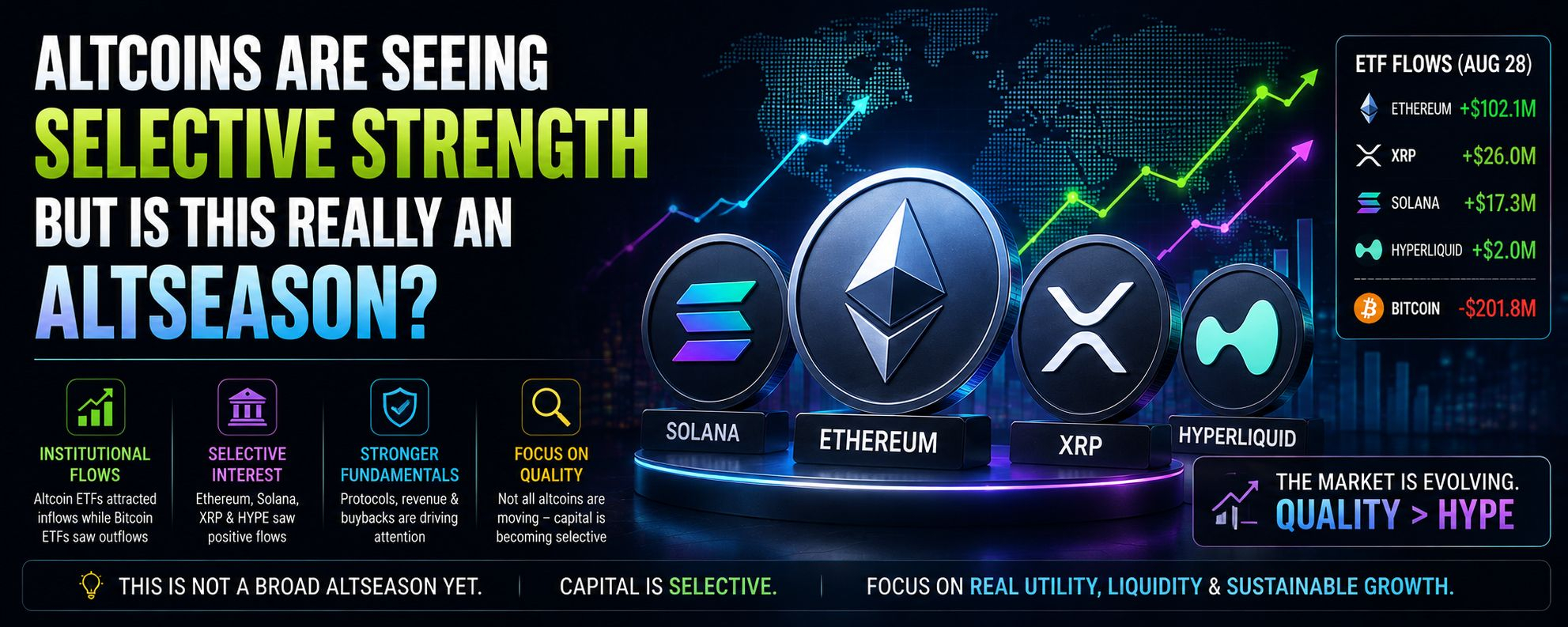
On August 28, U.S. spot Bitcoin ETFs recorded approximately $201.8 million in net outflows, ending a nine-trading-day inflow streak. At the same time, Ether, XRP, Solana and Hyperliquid investment products recorded positive flows.
Ethereum ETFs led the group with more than $102 million in net inflows that day. XRP, Solana and Hyperliquid products also recorded positive flows.
Solana has been particularly interesting from an institutional-flow perspective. On August 27, U.S. spot Solana ETFs recorded $60.91 million in net inflows, reported as their strongest daily inflow of 2026 at that point.
These numbers matter because they show a changing market structure.
In previous crypto cycles, institutional access was heavily concentrated around Bitcoin. Today, regulated investment products are expanding the ways investors can gain exposure to other digital assets.
However, there is an important distinction between selective strength and a broad altcoin rally.
Not every altcoin is attracting institutional money.
The strongest attention appears concentrated around assets with specific narratives or infrastructure behind them. Ethereum benefits from its established ecosystem and growing institutional products. Solana is gaining attention through expanding ETF access. XRP has also seen increased interest through investment products.
Hyperliquid represents another interesting trend.
The Financial Times recently reported that crypto projects have spent a record $638 million on token buybacks during 2026. Hyperliquid was highlighted as one of the platforms using revenue-linked buyback mechanisms.
Token buybacks have become an important discussion because they introduce a model familiar to traditional finance. In theory, reducing token supply or using protocol revenue for repurchases can support token economics.
But buybacks should not be confused with guaranteed price appreciation.
The Financial Times noted that the market impact of these programs has been mixed, and projects using buybacks can still experience price declines.
That may be the biggest difference in the current altcoin market.
Narratives alone are becoming less important than before. Investors are increasingly examining institutional access, liquidity, protocol activity and token economics.
This does not mean speculation has disappeared from crypto. It clearly has not.
But the recent ETF data suggests that capital is becoming more selective.
Instead of asking whether every altcoin will rally together, the more useful question may be: Which assets have a clear reason for new capital to enter?
For now, the evidence does not confirm a broad altseason.
Bitcoin and Ethereum still dominate institutional crypto flows. Data from August showed that the two largest assets accounted for the overwhelming majority of net inflows into spot crypto ETFs.
However, the continued interest in assets such as Solana, XRP and Hyperliquid shows that the market is gradually expanding beyond a Bitcoin-only institutional story.
The next phase of the altcoin market may therefore look different from previous cycles.
It may not be about everything rising at once.
It may be about capital becoming increasingly selective.