
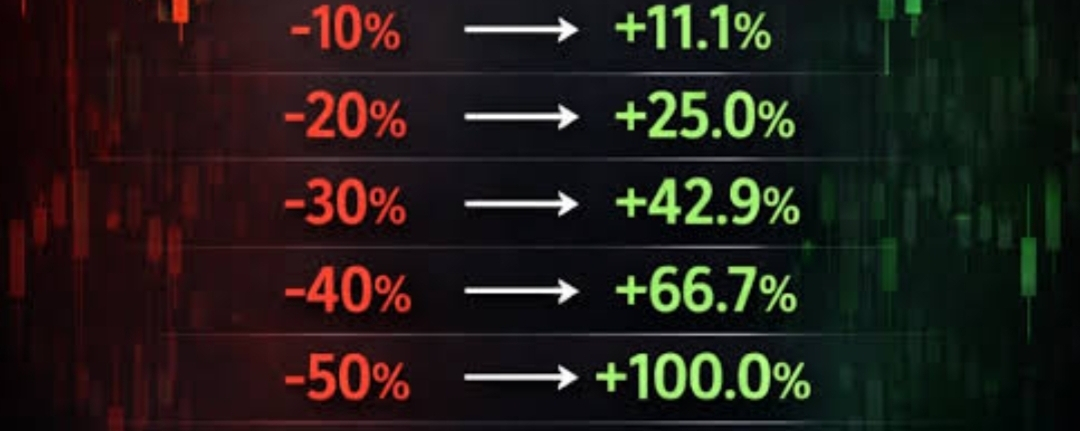


One of the most important lessons in trading has nothing to do with finding the next 10x coin. It is understanding how losses actually work.
Many traders assume that if an asset drops 50%, it only needs to gain 50% to return to the original price.
That sounds logical, but the math says otherwise.
A Simple Example
Imagine you buy a crypto asset at $100.
The price falls 50%.
Your investment is now worth $50.
If the price then rises 50%, you don't return to $100. A 50% increase on $50 is only $25, taking the value to $75.
To move from $50 back to $100, the asset needs to gain 100%.
That's the hidden danger of large losses.
The Deeper the Loss, the Harder the Recovery
This effect becomes increasingly severe as losses grow.
A 20% loss requires a 25% gain to recover. A 50% loss requires a 100% gain. An 80% loss requires a massive 400% gain just to return to the starting point.
This is why protecting capital matters so much.
Traders often focus completely on how much they could make from a position while giving much less attention to how much they could lose.
But avoiding one huge loss can sometimes be more valuable than finding several winning trades afterward.
Why This Matters in Crypto
Crypto makes this lesson especially important because large price swings can happen quickly.
A coin dropping 50% doesn't automatically become a bargain simply because it is cheaper. If the fundamentals, liquidity or market narrative have changed, the price can continue falling.
This is also why blindly averaging down can become dangerous. A lower entry price doesn't guarantee that the market will recover.
Risk Management Changes the Game
Successful trading isn't only about predicting whether the next candle will be green or red.
Position sizing, stop-loss planning and knowing how much you're prepared to risk before entering a trade can matter just as much as the entry itself.
Small losses are usually easier to recover from. Huge losses require increasingly larger gains.
That simple mathematical reality is why experienced traders often focus first on staying in the game.
The Lesson Every Trader Should Remember
You don't need to win every trade.
You don't need to catch every pump.
And you definitely don't need to risk your entire account chasing one opportunity.
The goal is to make sure one bad decision doesn't erase the progress made by many good ones.
In trading, making money matters. Protecting the money you already have matters just as much.