
#koreasinglestockleveragedetftradingfalls
Sometimes a hot new product doesn't get banned outright. Regulators just make it progressively harder to use, and watch trading fade on its own.
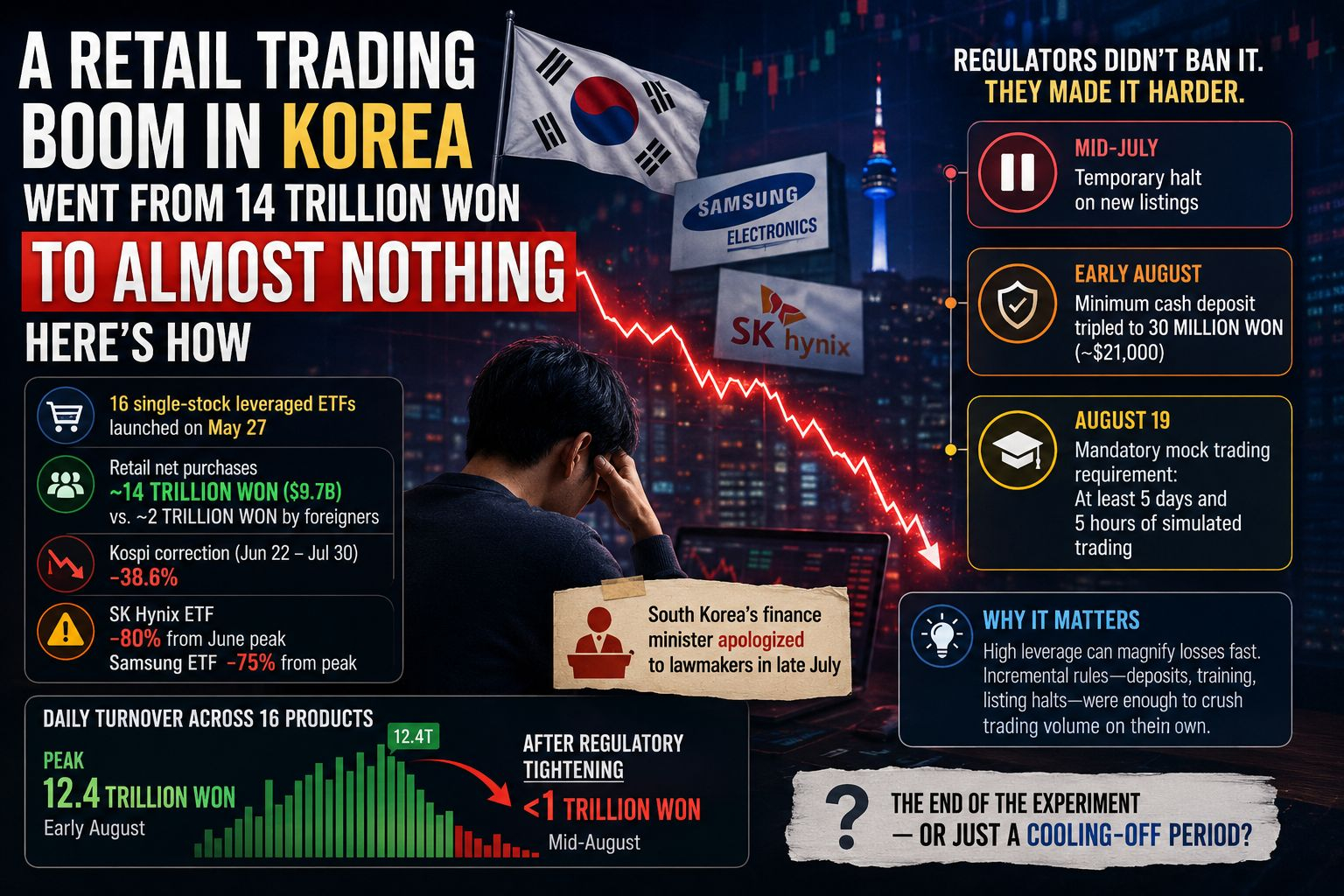
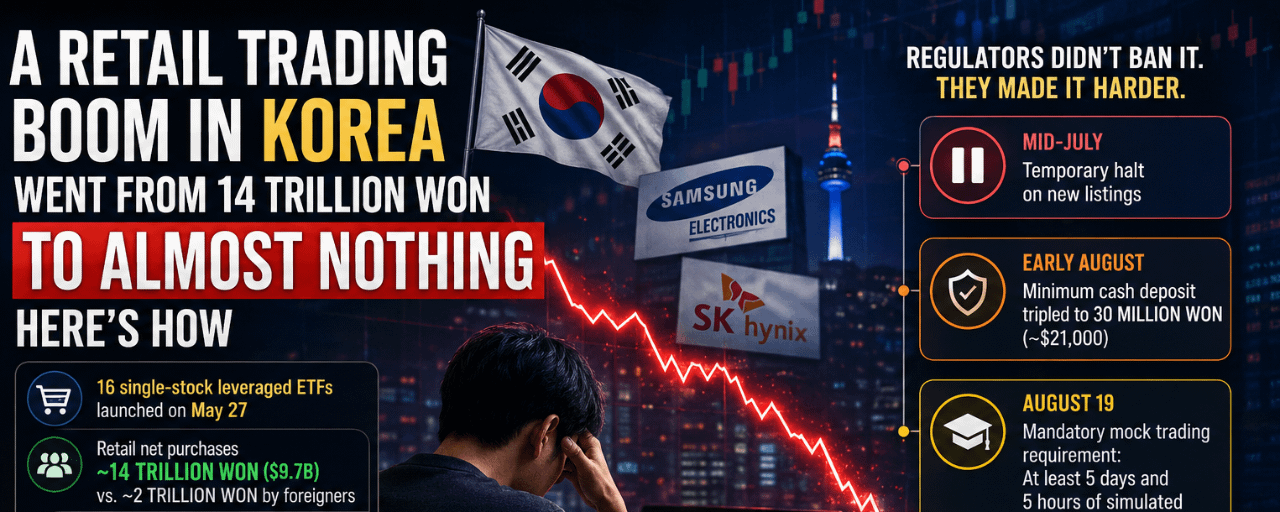
The breakdown: South Korea launched 16 single-stock leveraged ETFs on May 27, offering twice the daily return of individual stocks, including ones tracking chip giants Samsung Electronics and SK Hynix. Retail investors piled in fast, with net purchases reaching roughly 14 trillion won ($9.7 billion), far outpacing the roughly 2 trillion won bought by foreign investors. The products initially surged alongside Korea's AI-driven chip rally, but when the Kospi corrected sharply between June 22 and July 30 — falling 38.6% amid a chip-stock downturn — the leverage cut the other way hard: the SK Hynix-linked ETF fell more than 80% from its June peak, and the Samsung-linked product dropped nearly 75% from its own high. The scale of retail losses led South Korea's finance minister to publicly apologize to lawmakers in late July. Regulators then moved in stages: a temporary halt on new product listings in mid-July, a tripling of the minimum cash deposit requirement to 30 million won (about $21,000) in early August, and, most recently, a mandatory mock-trading requirement — at least five days and five hours of simulated trading — for any new investor, effective August 19. The cumulative effect has been sharp: daily turnover across the 16 products, which hit as high as 12.4 trillion won on a single day in early August, fell below 1 trillion won within days of the deposit increase, a level not seen since the products first launched.
Why it matters: This is a clear illustration of how quickly a high-leverage retail product can amplify losses at scale once a rally reverses — Korean retail investors concentrated heavily in these products relative to foreign investors, and the 2x structure turned an already steep correction into a far more damaging one for anyone holding through it. It's also notable how regulators achieved this outcome: rather than an outright ban, a series of incremental steps — deposit requirements, mandatory training, listing halts — has been enough to shrink trading volume dramatically on its own. It's worth remembering, too, that the Kospi index itself remained up substantially for the year even after this correction, a reminder that broad index performance can mask much sharper, concentrated losses within specific leveraged products tied to the same underlying stocks.
Closing thought: With trading now a fraction of its earlier volume after several rounds of tightening, does this mark the effective end of Korea's single-stock leveraged ETF experiment — or just a cooling-off period before retail appetite for high-leverage products returns?