


When traders analyze crypto, they usually focus on price, market cap, trading volume and technical indicators.
But one factor quietly influences almost everything happening in the market: liquidity.
Liquidity affects how easily you can buy or sell a cryptocurrency, how much your trade moves the price, how large spreads become and even how violently a coin can pump or dump.
Understanding liquidity can therefore be just as important as understanding price itself.
What Does Liquidity Mean in Crypto?
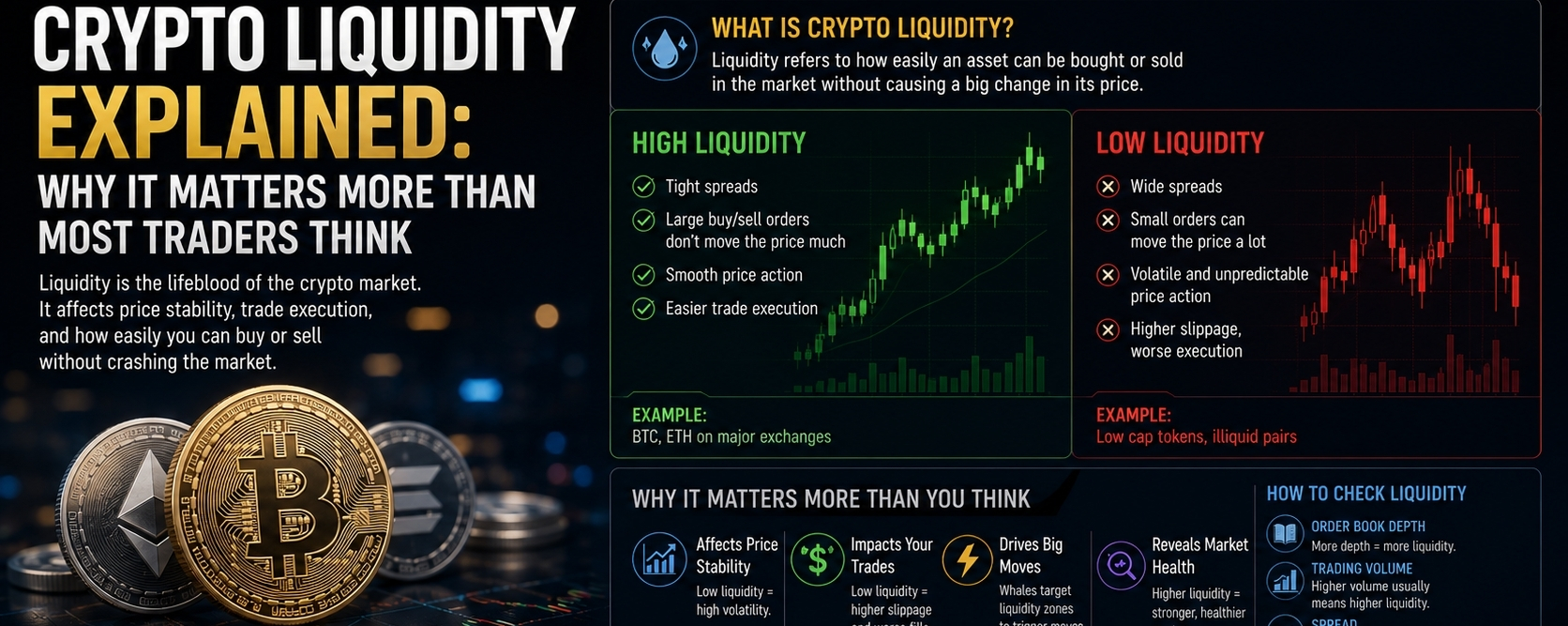
In simple words, liquidity describes how easily an asset can be bought or sold without significantly changing its price.
Imagine Bitcoin is trading around $80,000.
If thousands of buyers and sellers have orders close to the current price, a trader may be able to buy or sell a reasonable amount of BTC without moving the market very much.
That is a relatively liquid market.
Now imagine a small altcoin with very few buyers and sellers.
A large order could push its price several percentage points because there aren't enough orders available near the current price.
That is a less liquid market.
Why Bitcoin Usually Has Better Liquidity
Bitcoin is traded across many major exchanges and has enormous global participation.
There are normally large numbers of buy and sell orders around its current market price.
This deeper liquidity makes it easier for larger traders to enter and exit positions compared with many smaller cryptocurrencies.
It doesn't mean Bitcoin can't experience major volatility.
It simply means considerably more capital is generally required to move a deep BTC market than a tiny altcoin market.
The Order Book Shows Liquidity in Action
One of the easiest places to understand liquidity is an exchange's order book.
The order book contains bids from people who want to buy and asks from people who want to sell.
Suppose a token trades at $10.
There may be thousands of tokens available for sale between $10 and $10.05.
If someone places a relatively small market buy, those orders may absorb it without much price movement.
But if there are very few sellers between $10 and $11, a large market order could quickly consume the available supply.
Price could jump dramatically.
This is why order-book depth matters.
Liquidity and Trading Volume Aren't Exactly the Same
Liquidity and volume are closely connected, but they aren't identical.
Trading volume tells you how much of an asset has traded during a certain period.
Liquidity tells you how easily trades can happen around the current market price without creating significant price impact.
A cryptocurrency can show high reported volume while still having relatively poor order-book depth on a particular exchange or trading pair.
That's why looking only at 24-hour volume doesn't always provide the full picture.
Liquidity Determines Your Real Entry Price
Imagine a token is displayed at $1.
You decide to buy $50,000 worth.
If the market is highly liquid, most of your order might execute close to $1.
But in a thin market, there may not be enough tokens available at that exact price.
Part of your order could execute at $1.01, another part at $1.03 and the rest even higher.
Your average entry becomes worse than the price you initially saw.
This difference is known as slippage.
Why Slippage Matters
Slippage becomes particularly important when trading large positions or low-liquidity altcoins.
A chart might show a token trading at $1, but that doesn't necessarily mean you can buy or sell a huge amount at exactly $1.
The larger your order becomes relative to available liquidity, the greater its potential market impact.
This also matters when taking profits.
Buying a low-liquidity token can be easy while prices are rising.
Selling a large position during panic can be much harder.
There may simply not be enough buyers available at the prices you expect.
Liquidity Can Make Pumps More Explosive
Low liquidity is one reason small cryptocurrencies can produce enormous rallies.
Imagine relatively little sell liquidity exists above the current price.
Suddenly, buyers enter aggressively.
Those buyers consume the available sell orders, forcing trades to execute at increasingly higher prices.
Momentum traders notice the breakout and enter too.
Price can accelerate very quickly.
The chart may look extremely bullish, but part of the move can simply reflect a thin market.
This is why a 20% move in a small token isn't necessarily comparable with a 20% move in Bitcoin.
Liquidity Can Make Dumps Worse Too
The same mechanism works in reverse.
During a panic, everyone wants to sell.
But buyers may remove their orders or move them much lower.
Suddenly there is very little liquidity underneath the market.
Sell orders begin hitting lower and lower bids.
Price falls rapidly.
Leveraged long positions may then be liquidated, creating additional selling pressure.
What started as a normal correction can turn into a sharp cascade.
What Is a Bid-Ask Spread?
Liquidity also affects the difference between the highest price buyers are willing to pay and the lowest price sellers will accept.
This difference is called the bid-ask spread.
Highly liquid markets generally have tighter spreads.
Less liquid markets often have wider spreads.
For example, buyers might offer $9.99 while sellers ask $10.01 in a liquid market.
In a thin market, buyers might offer $9.70 while sellers demand $10.30.
That larger gap makes trading more expensive and uncertain.
Market Makers Play an Important Role
Market makers help provide liquidity by continuously placing buy and sell orders.
Their activity can create deeper order books and tighter spreads, making it easier for other participants to trade.
Without sufficient market-making activity, some markets can become extremely thin.
However, liquidity isn't permanent.
During major news events or extreme volatility, participants can remove orders quickly.
A market that appeared liquid during normal conditions can suddenly become much thinner.
That's one reason unexpected news can produce unusually large candles.
Why Whales Care About Liquidity
Large investors can't think about price in exactly the same way as someone making a small trade.
Suppose a whale wants to purchase millions of dollars worth of a smaller token.
Buying everything immediately could push the price dramatically higher before the entire order is filled.
The whale would effectively make their own purchase more expensive.
Large traders may therefore split orders into smaller pieces, use limit orders or execute over longer periods to reduce market impact.
The same challenge appears when they want to exit.
A portfolio can look extremely valuable on paper while being difficult to liquidate at the displayed market price.
Liquidity Can Cluster Around Important Levels
Liquidity isn't distributed evenly across a chart.
Large numbers of orders can accumulate around obvious areas such as previous highs, previous lows and major round numbers.
Derivatives markets add another layer because leveraged traders may have stop orders and liquidation levels clustered around similar areas.
When price reaches one of these zones, activity can accelerate quickly.
This helps explain why crypto sometimes moves slowly toward an important level and then suddenly explodes through it.
Bitcoin Liquidity Can Affect Altcoins
Bitcoin remains the center of the crypto market.
When liquidity and capital flow strongly into BTC, Bitcoin can dominate market attention while many altcoins remain relatively quiet.
If Bitcoin later stabilizes, traders may start moving profits into Ethereum and larger altcoins.
Eventually, capital can rotate further toward smaller assets.
This is one reason traders watch liquidity flows alongside Bitcoin dominance when looking for possible altcoin rotations.
Global Liquidity Matters Too
Liquidity isn't limited to crypto exchange order books.
The amount of money available throughout the wider financial system can also influence risk assets.
Interest rates, central-bank policies, credit conditions and investor risk appetite can affect how willing institutions and individuals are to allocate money to assets such as stocks and crypto.
When financial conditions become easier and investors have more appetite for risk, crypto can benefit.
When money becomes expensive and investors become defensive, speculative assets can face greater pressure.
This is why experienced crypto investors increasingly watch macroeconomic conditions alongside blockchain data and charts.
Why Liquidity Matters More Than Price Alone
A token priced at $0.10 can look cheap.
Another priced at $1,000 can look expensive.
But the individual token price tells you very little about liquidity.
The more useful questions are how deep the market is, how much volume is genuine, how large the spread is and how easily a meaningful position could actually be exited.
A huge paper profit doesn't mean much if there isn't enough liquidity available to realize it.
The Bottom Line
Liquidity is one of the invisible forces driving crypto markets.
It influences price movement, slippage, spreads, volatility, trade execution and the ability to enter or exit positions.
Deep liquidity generally makes markets smoother and easier to trade.
Thin liquidity can create bigger opportunities, but it can also create much greater risk.
That's why traders shouldn't look only at whether a coin is pumping.
They should also ask:
How much real liquidity is behind that move?
Because in crypto, finding a good entry matters but being able to exit when you want can matter even more.
This article is for educational purposes only and is not financial advice.